
key insights
- Hester Peirce is a leading proponent of the need for more transparent oversight of cryptocurrencies in the U.S. and is leaving the SEC in November.
- She is leaving as the SEC works on some of the most important rules affecting digital assets, including a proposed exemption for innovation that hasn’t been announced.
- The exit could shift internal dynamics at the SEC, leaving fewer commissioners at a time when crypto policy decisions remain unresolved.
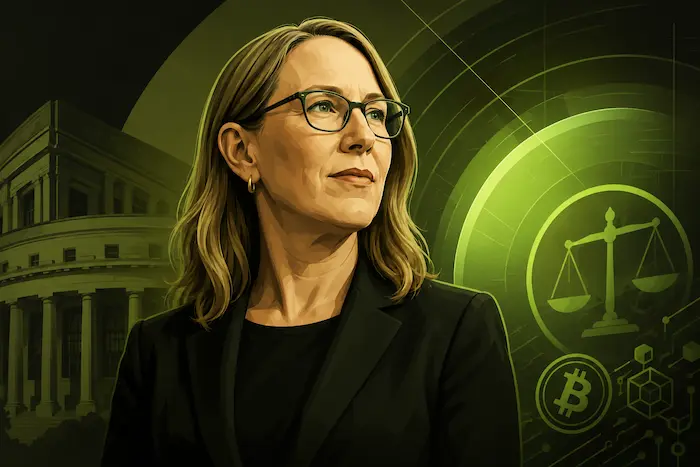
Crypto regulation in the United States is approaching a critical stage as Securities and Exchange Commission Commissioner Hester Peirce prepares to leave the agency in November. Her departure removes one of the most prominent advocates for regulatory clarity at a time when federal officials are working to define how digital assets will fit within the broader financial system.
Peirce, widely known across the industry as “Crypto Mom,” confirmed her plans during an appearance on The Rollup podcast. After nearly three decades in public service, she will leave Washington and begin a new role as an associate professor at Regent University School of Law.
The announcement arrives during a period of heightened attention on digital asset oversight. The SEC is also considering a number of proposals that have the potential to impact market structure, the definition of tokens, disclosure requirements, and investor protections in the future.
The shift from regulator to Educator
Peirce was appointed to the SEC in January, 2018, and became one of the most familiar faces of the agency in the SEC community. Throughout her tenure, she frequently called for clearer guidance for digital asset companies and criticized what she viewed as an overly aggressive enforcement approach toward emerging technologies.
The Senate confirmed her for a second term in August 2020. Although her term officially expired in June 2025, agency rules allowed her to remain in office while awaiting confirmation of a successor. That provision could have extended her service until December 2026.
Instead, Peirce opted to leave earlier and pursue a career in academia. During her podcast appearance, she said she is eager to work with students and help prepare future lawyers and policymakers to tackle unresolved regulatory challenges.
Regent University announced earlier this year that Peirce will teach courses covering securities regulation, financial markets, digital assets, and public policy.
Unfinished priorities inside the SEC
Peirce now heads the SEC’s Crypto Task Force, which was set up in early 2025 to give more clarity on the regulation of digital assets. The task force has been working on topics such as token classification, registration requirements and obligations, disclosure, and priorities for enforcement.
Before leaving office, Peirce hopes to advance several reforms that remain under discussion within the commission.
Those priorities include:
- Establishing a clearer framework for digital assets
- Expanding opportunities for companies to access public markets
- Reforming market structure rules, including the trade-through rule
Her departure creates uncertainty around how quickly these initiatives will move forward. Unless new commissioners are confirmed before November, the SEC will be left with Chairman Paul Atkins and Commissioner Mark Uyeda as its only active members.
The agency is designed to operate with five commissioners, and there are currently no Democratic-appointed commissioners serving on the panel.
Innovation Proposal Draws Industry Attention
The SEC’s proposed innovation exemption for digital asset projects is among the most closely watched regulatory developments
The proposal has sparked enormous interest from blockchain companies, tokenization platforms and investors who are looking for more flexibility in the face of the developing regulations. Peirce wanted to clear up some misunderstandings about the program, however.
Her comments indicated that the exemption hasn’t been issued yet, even though there was much speculation in the industry. She also ruled out the possibility of regulators using the proposal to facilitate the trading of synthetic securities.
Rather, she called this a targeted regulatory measure to promote responsible innovation while protecting investors.
Her remarks indicate that the watchdogs are still “suspicious” when considering whether new technologies fit into existing securities law.
Why the Industry Is Watching Closely
After years of calling for a more stable and predictable regulatory environment, Peirce got the nickname “Crypto Mom. Her public discourse and dissents frequently struck a chord with industry players who claimed uncertainty was hampering innovation and investment.
In recent times, the SEC has turned its attention to policy matters regarding tokenization, custody, market access and the definition of digital assets. The post of one of the commission’s most vocal Crypto advocates is expected to be filled by those efforts after she leaves, though losing one of the strongest Crypto supporters in the commission could have an impact on future debates.
The coming few months could be important for businesses in the digital asset industry. While a number of regulatory options are still under discussion, the decisions reached in the process may affect how companies finance, develop and engage with existing financial institutions.
Conclusion
This is a big step forward in SEC’s discussion of regulating digital assets and its departure from its own strategy. Although the agency’s overall Crypto agenda is on-going, her departure eliminates a consistent voice advocating for greater rules and regulatory clarity. The SEC announced in November that it is still deliberating on Crypto policy’s direction and pace, and industry players will closely track to determine whether the trajectory will continue to change as the SEC fine-tunes its stance.