ERC-404 is the token standard for Ethereum that integrates fungible and non-fungible tokens. It was created by anonymous developers known under the names “ctrl” and “Acme” and provides the ability to divide ownership of the NFTs into tradable token units with some relation to unique digital assets.
In contrast to already existing Ethereum standards like ERC-20 and ERC-721, the proposed standard ERC-404 has not yet passed the Ethereum standardization process and can be considered unofficial.
ERC-404 has become interesting due to providing the native way of NFT fractionalization without the usage of any additional protocols. Besides that, the standard touches upon the discussion about compatibility and security issues related to possible adoption. According to Kucoin, ERC-404 can be considered an experimental implementation and not an official Ethereum standard.
ERC-404 Is a Blend of ERC-20 and ERC-721 Token Standards
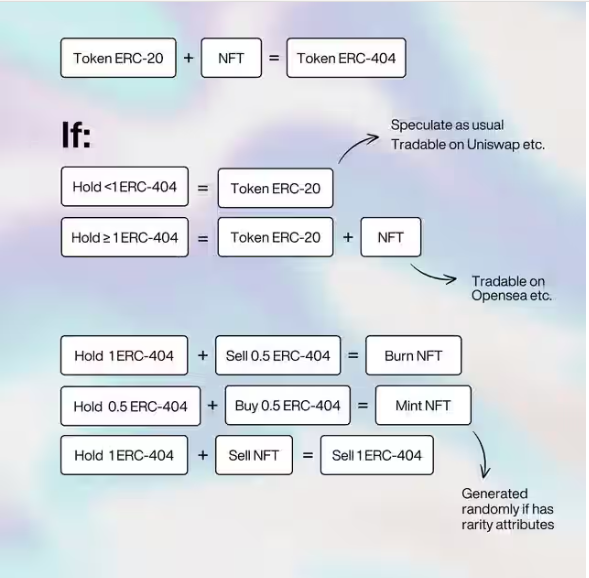
ERC-404 is an innovation made by blending traits in the two most common types of Ethereum tokens. Tokens under the ERC-20 protocol have their values interchangeable because they are fungible, and each piece has an equivalent value to other pieces.
On the other hand, ERC-721 tokens are non-fungible, and they are also referred to as NFTs. This standard has merged the above ideas into a semi-fungible asset, according to developers. In this case, token fractions will still retain their tradability and have a relationship with the related NFT.
Source: Orochi
In addition, there is no need for different fractionalization methods because the implementation has the concept of fractionality in the token itself.
Mint-and-Burn Mechanism Used in ERC-404
ERC-404 adopts an automated mint-and-burn scheme which connects token balances to NFT ownership. When a holder acquires one complete ERC-404 token, the corresponding NFT is minted directly into the wallet.
If part of that token is later sold, the linked NFT is automatically burned because complete ownership no longer exists.
When a wallet accumulates enough fractions to equal one complete token again, the protocol automatically mints a replacement NFT. This mechanism makes it possible for fractions to be traded like crypto tokens and keeps updating the ownership of the NFT through the use of smart contracts.
ERC-404 Solves NFT Liquidity Problem
Liquidity is among the key challenges that the ERC-404 technology solves, as noted in the source. Traditionally, buying an NFT means buying the whole NFT, which becomes difficult when the price is high.
In ERC-404, people buy the fractions instead of NFTs themselves. As per the source materials, these fractions behave like ERC-20 tokens. The implementation also removes the need to lock NFTs into external fractionalization protocols because ownership changes are managed directly within the ERC-404 framework.
Key Features
- Supports native fractional ownership of NFTs.
- Uses automatic minting and burning to manage NFT ownership.
- Allows experimentation with decentralized finance applications using hybrid assets.
Comparison between ERC-404 and Already Established Ethereum Standards
| Type of Token | ERC-20 | ERC-721 | ERC-404 |
| Fungible | Yes | No | Partially |
| NFT Support | No | Yes | Yes |
| Fractional Ownership | No | Limited | Yes |
| Tradable on DEXs | Yes | Limited | Yes |
| Official Ethereum Standard | Yes | Yes | No |
Early Projects Using ERC-404
Several projects have adopted the experimental framework. Pandora became one of the earliest implementations by linking 10,000 ERC-20 tokens with an equal number of Replicant NFTs. Purchasing one complete token automatically generated its corresponding NFT.
There are other similar instances as well, such as DeFrogs, which is a collection of 10,000 ERC-404 profile picture NFTs that are based on Pepe. Similarly, there is another instance known as Monkees, where there is a collection of 100 NFTs with different attributes.
Current Limitations
- The standard has not completed Ethereum’s official review process.
- Wallet and marketplace compatibility is still problematic.
- The complexity of smart contracts may bring in some more aspects of security.
Potential Risks of ERC-404
According to Kucoin, there are quite a few limitations regarding ERC-404. The token standard has not been accepted according to the procedure of Ethereum Improvement Proposal and has not undergone the review process applied to token standards.
In such a situation, compatibility varies depending on the wallet, NFT marketplace, and decentralized finance platform. It is also said that the more complex the smart contract logic, the more unknown risks can be hidden in it. The developers plan to submit ERC-404 for the review process, but no schedule has been provided.
Conclusion
ERC-404 offers a combination of the functionalities of fungible tokens and NFT ownership in the form of automated mint-and-burn mechanisms.
The standard allows for native fractional ownership, improves liquidity for NFT-related assets, and provides characteristics of both ERC-20 and ERC-721 standards.
Still, the implementation is experimental, unofficial, and needs to be taken into consideration from perspectives of compatibility and security due to the lack of formal adoption by Ethereum at this moment.
FAQs
What is ERC-404?
ERC-404 is an experimental Ethereum standard that combines functionalities of ERC-20 and ERC-721 to enable the process of fractional NFT ownership.
How does ERC-404 control NFT ownership?
In turn, ERC-404 uses the mechanism of automated mint-and-burn. Full token ownership implies minting of an NFT, while selling of fractions means burning it until it is fully owned again.
Is ERC-404 an official Ethereum standard?
No. ERC-404 is not an officially recognized standard in Ethereum yet.