

The blockchain technology requires decentralized participation, where thousands of individuals and devices can verify transactions and ensure the security of a decentralized network.
The decentralized nature of the technology makes it resilient and eliminates the need for a centralized mechanism, but at the same time, creates issues of security, which occur when members of the network abuse the system.
One of the attacks, which can be used to disrupt the blockchain network, is the Sybil attack, where a person or an entity creates several artificial identities, accounts, or nodes in order to increase their control over the network. In doing so, the attacker pretends to be several participants of the network rather than just one.
While consensus algorithms for major blockchain networks have been adopted to mitigate such attacks from becoming a threat, smaller networks and decentralized platforms whose operation depends on identities are still exposed to this risk.
What Is a Sybil Attack?
A Sybil attack is a type of security threat wherein an individual manages many identities that are fake in a decentralized network. Instead of joining the network through one identity, an individual joins the network through multiple identities.
The terminology is derived from a case study in 1973 about a patient named Sybil with more than one personality. Computer engineers have used this terminology to refer to identity-based attacks on distributed systems.
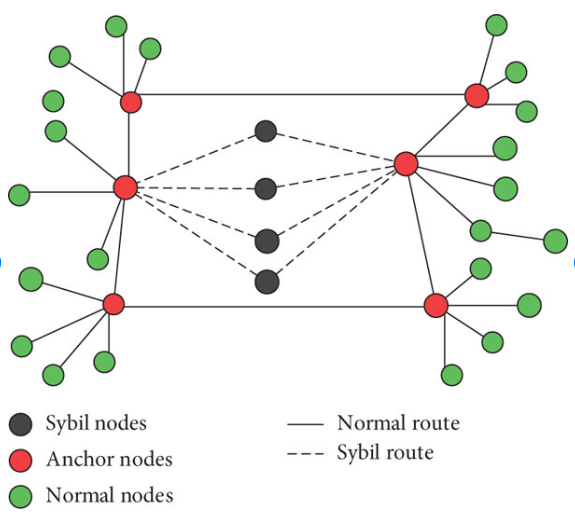
Sybil attack in wireless sensor networks, Source: Research Gate
Effects of Using Multiple Identities in Blockchain Networks
A blockchain network uses distributed nodes that interact with each other to validate transactions and reach consensus. In cases where creating identities is easy or unlimited, then attackers will be able to create many more nodes.
The above identities may work together to:
- Influence the proposals and results of voting.
- Halt or sabotage valid transactions on the network.
- Harvest data linking the addresses to the specific identities.
If the attacker controls more than 50% of the processing power or the hash rate of the network, he can carry out a 51% attack. This means that the attacker can re-order the transactions, prevent validation of transactions or reverse the transactions carried out during the time of control.
Exposure of Networks to Different Degrees
The risk of a Sybil attack succeeding is dependent on the blockchain platform and the consensus mechanism used.
Such platforms include:
- Young blockchain technologies with very few validators.
- P2P communication layer and dApps built on the user’s identities.
- Small permissionless networks where building identities does not require many resources.
Blockchain systems like Bitcoin and Ethereum demand significant computing or monetary investments before attackers can have an impact on the consensus process. Such demands make the costs of attacks quite expensive.
Features of the Sybil Attack
| Features | Details |
| Primary motive | Gaining undue advantage through multiple false identities or nodes. |
| Target | Blockchain networks, decentralized applications, DAO, peer-to-peer networks, and DeFi networks. |
| Primary Methods | Making false wallets, controlling multiple nodes, governance attacks, and airdrop attacks. |
| Impact of Attack | Manipulation of the consensus process, delayed transactions, privacy violations, spam attacks, double-spending attack, and disruption of the network. |
| Primary Prevention Techniques | Proof of Work, Proof of Stake, Delegated Proof of Stake, decentralized identity system, reputation system, and Sybil resistant tools. |
Techniques for Defending Against Sybil Attack
There are a few techniques used by blockchain networks to mitigate the impact of a Sybil attack since it is easier to control influence over a network if it is based on the use of resources rather than identities.
These include the following:
- Proof of Work (PoW): This technique is used by Bitcoin; the miners have to do computational work before approving new blocks.
- Proof of Stake (PoS): Participants need to hold cryptocurrency to participate in consensus. Influence is measured by how big the stake is, which makes it costly to perform any large-scale attacks.
- Delegated Proof of Stake and Identity-Based Systems: There are blockchain protocols that attempt to minimize their vulnerability through selecting a few validators or leveraging identity, reputation, social trust graph, zero-knowledge proof, and biometrics.
DeFi Airdrops Offer Yet Another Target to Sybil Attacks
There are also sybil attacks associated with DeFi space, such as token airdrop programs.
When DeFi protocols allocate tokens to early users through airdrops, attackers may create hundreds or thousands of wallet addresses to qualify for multiple allocations intended for separate participants.
To reduce this activity, many projects perform Sybil detection before completing airdrop snapshots. Detection methods commonly analyze:
- Wallet funding sources.
- Timing of transactions and gas consumption.
- Behavioral traits on-chain that show evidence of coordination.
These strategies make it easier to detect malicious wallet activity, but not necessarily resolve the problem altogether. Participation versus fake accounts continues to be a concern for decentralized networks.
Impact of Sybil Attacks Beyond Blockchain
In addition to cryptocurrency systems, fake accounts can also be used in other systems.
These include file-sharing networks, voting websites, decentralized autonomous organizations (DAOs), and social media applications. In all these cases, the attacker uses many fake identities to either sway the participation of users, interfere with communications, or affect the process of decision making.
Within the blockchain governance system, coordinated wallet creation has also been seen in influencing the voting process and selection of validators in less protected systems.
Security Measures for Individuals
Individuals themselves cannot directly mitigate Sybil attacks, but there are some measures that can help avoid Sybil attacks on the platform where the individuals operate.
Individuals can enhance their knowledge through the following means:
- Understanding the decentralization of validators before joining any blockchain network.
- Joining blockchain networks that have been tested in terms of security.
- Learning about governance systems and security updates from blockchain developers.
Conclusion
The Sybil attack still poses a threat to blockchain and decentralized technology because this type of attack requires the creation of many fake identities that help to control the network activities.
However, it should be noted that the level of risk depends on the network architecture, which means that smaller blockchain projects and identity-based platforms are more vulnerable than large blockchain communities.
FAQs
What is a Sybil attack?
The Sybil attack is an attack where an individual or company creates many fake identities or nodes to control a decentralized network.
Why is Sybil attack a security threat?
They can affect decision-making, manipulate consensus in weaker networks, slow down legitimate transactions, harvest users’ data, and benefit from token distribution events.
Can Bitcoin fall victim to a Sybil attack?
Due to the Proof of Work consensus mechanism, a large Sybil attack on Bitcoin is costly since the influence is achieved via computational power.