

With the adoption of cryptocurrencies growing, it is becoming ever more relevant to discuss the importance of exchanges, wallet providers, decentralized applications, and even blockchain infrastructure in the daily usage of cryptocurrencies.
The need to provide continuous access to such services makes them vulnerable to network-based cyber attacks, which aim at disrupting operations instead of targeting the security of the blockchain itself. DoS Attack activity remains an issue affecting cryptocurrency infrastructure by causing disruption in online services with the use of too much traffic or requests.
What Is a DoS Attack?
Denial-of-Service (DoS) is a kind of cyberattack designed to prevent access to servers, applications, and other network resources. A large amount of traffic or special requests are sent in order to overwhelm the computer resources and make the targeted resource slow and unresponsive to the users.
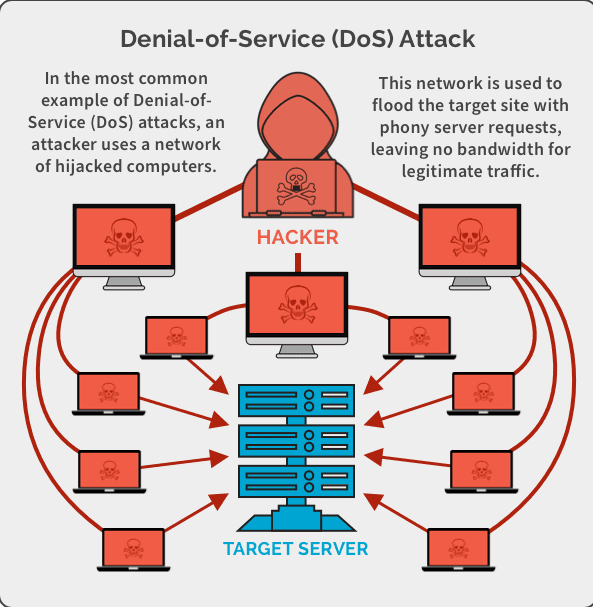
Source: Spanning
DoS attacks may be performed on various crypto-related services, which do not include blockchain itself. Such networks and applications as cryptocurrency exchanges, wallets, blockchain nodes, DeFi services, and many more may be temporarily unavailable due to DoS attacks.
The aim is not to try to crack the encryption process of the blockchain or the private keys but to affect the availability and deny access to the service to the users during the attack.
Table Comparison Between DoS Attack and DDoS Attack
| Attribute | DoS Attack | DDoS Attack |
| Attack source | One Device/One IP Address | Many compromised Devices (Botnet) |
| Amount of Traffic Generated | Low | high |
| Detection | Easier to detect | Harder since there are many sources for the attack |
| Mitigation | Usually mitigated by blocking one source | Advanced mitigations services and traffic scrubbing are required |
| Target | Usually Servers/Websites/Applications | Blockchain Infrastructure/Exchanges/Wallets Services/Large Online Platforms |
Common Methods of DoS Attack
There are different methods that are used to create traffic overload.
In the case of a buffer overflow attack, extra data is sent to a server or program beyond its allotted memory buffer size. After the memory buffer limit is exceeded, the process becomes unstable, malfunctions, or crashes.
An ICMP flood, otherwise called a ping or smurf attack, attacks a poorly configured device by flooding the network with an excessive number of redundant packets. The device broadcasts rather than directs the traffic to a single endpoint, and the whole network suffers from a waste of resources.
A SYN flood takes advantage of the TCP three-way handshake process used for establishing internet connections. The attacker sends multiple request packets but does not complete the handshake procedure, thus forcing the server to allocate connections to incomplete requests.
Among the features of these attacks are:
- Each attack aims at the vulnerability of communication in the network or system resources.
- The main purpose of the attacks is disruption of service availability, but not stealing cryptocurrencies.
- Service disruption can vary from slow performance to complete disruption of service.
Why Blockchains Continue to Function
Although blockchains constantly face attacks aimed at crypto-related services, they are built in such a way that makes them resilient to the disruption of service.
Unlike many other digital systems, Bitcoin and other decentralized blockchains process transactions between various independent nodes.
Affected nodes are synchronized with the network and rejoin after having downloaded the most recent blockchain information.
A few reasons that make blockchain systems resilient:
- There are many distributed nodes that keep validating transactions despite being offline in some cases
- More hash rates in the network result in more robustness against any attempt at large-scale destruction
- The consensus algorithm keeps the system running without depending on one vulnerable component.
Preventive Steps to Lower the Likelihood of DoS Attacks
Many methods of security are taken into account by organizations running the crypto infrastructure to be protected from DoS and DDoS attacks.
Rate limiting limits the number of requests that can be made by a single Internet Protocol address within a given timeframe. Traffic filters and firewalls have the ability to detect and drop malicious traffic flows before they get to the application server.
The CDNs allocate the traffic coming in to several physically distant servers, hence reducing the pressure on a certain site in case of increased traffic flow.
Companies also use specialized service providers to mitigate DDoS attacks.
Methods used in defending against DDoS include:
- Rate Limiting of excessive requests from IP addresses.
- Firewalls and traffic filtering to prevent any suspicious activity on the network.
- CDN infrastructure and DDoS mitigation service to absorb all malicious traffic before it hits the production server.
Conclusion
A DoS Attack is one of the most popular ways of disrupting cryptocurrency services through the flooding of online infrastructure with too much network traffic.
Although it can affect exchanges, wallets, nodes, and even decentralization apps for some time, DoS Attacks are not able to damage the integrity of decentralized blockchain.
Bitcoin, as an example of public blockchain, still verifies the transactions from the nodes no matter what happens with particular services. Companies minimize their risks with help of various security measures.
Frequently Asked Questions
What is a DoS attack?
A DoS attack is an attack in cyberspace whereby the server, application, or network is flooded with too many requests, causing it not to be available to the real users.
What is the difference between a DoS attack and a DDoS attack?
A DoS attack is sourced from one computer while a DDoS attack is sourced from several computers at once.
Can a DoS attack cause the loss of cryptocurrencies?
No. A DoS attack does not lead to the loss of digital currency or private keys.