
The blockchain startups have started to use community-based governance, where community members assist in making important decisions and do not rely on a few members of the management committee in the decision-making process.
As the significance of DeFi, DAPPS, and DAOs in the blockchain industry increases, community governance has become an important aspect for many communities.
This can be done using Governance tokens that allow the holders of the tokens to cast their votes through governance platforms with the use of blockchain technology.
What Are Governance Tokens?
Governance tokens are a form of digital money that provides the ability to vote on decisions made in a decentralized blockchain system. Unlike ordinary stocks that are shares of ownership in companies, governance tokens provide the opportunity to take part in the decision-making process by voting on certain proposals.
Decision-making in traditional companies is carried out centrally through management boards. The central decision-making process is substituted by the governance tokens with the help of community participation.
However, most governance schemes use token quantity as a basis for assigning votes, though there have been some other methods used by different projects that help to increase participation and limit the centralization of governance.
Key Features of Governance Tokens
- They give voting rights rather than owning a stake in a company.
- They enable communities to make changes to protocols.
- The votes are accessible through the blockchain network.
How Governance Tokens Work
Using smart contracts, blockchain protocols can facilitate governance proposals and voting processes. Upon receiving governance tokens, the user will then be able to start voting.
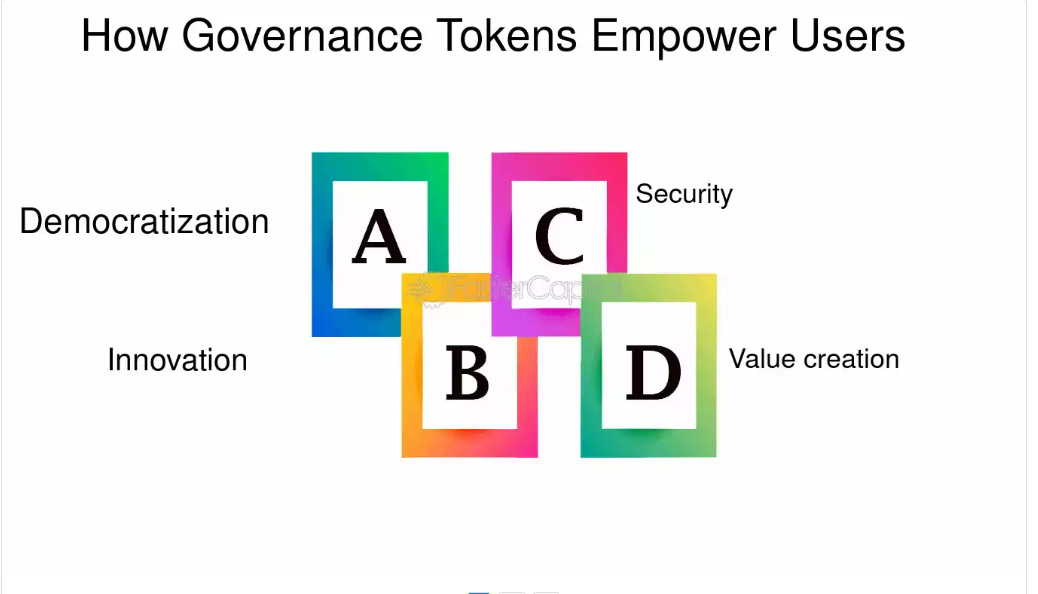
Source: Fatercapital
Governance is done following this procedure:
- An individual within the community presents the idea.
- There will be a period of discussion before voting is initiated.
- Voting happens, and any approved proposals are implemented once the quorum criteria are met.
In many projects, there is issuance of governance tokens to active participants of the protocol. This allows contributors to participate in future decision-making processes. The results of the voting process are captured through smart contracts.
Popular Tokenized Governance Project Listings
Multiple blockchain networks have developed governance tokens as part of their governance process for continuous development.
| Project | Governance Token | Functions of Governance |
| Maker (Sky Ecosystem) | SKY (earlier MKR) | Parameters of protocol, collateral, and stability fees |
| Compound | COMP | Interest models, supported assets, protocol upgrades |
| Uniswap | UNI | Allocations of treasury, grants, and protocol upgrades |
| Aave | AAVE | Lending parameters, risk policies, asset listings |
| PancakeSwap | CAKE | Tokenomics, governance proposals |
| Curve | veCRV | Voting on protocol governance and incentives |
The MakerDAO project, formerly known as Sky Ecosystem, was among the first to implement a governance framework before changing MKR tokens for SKY and rebranding in 2024.
The Compound project implemented the community governance model by giving up administrative rights back in 2020. In addition, platforms such as Optimism, Arbitrum, ApeCoin DAO, and Decentraland use governance mechanisms where token holders can make decisions about improving protocols and other related issues.
Governance Tokens Still Keep Improving
Blockchain projects keep improving their governance models amid evolving participation trends within decentralized ecosystems.
Some of the recent innovations are:
- Pendle upgraded itself from vePENDLE to sPENDLE and adopted shorter unlocking periods.
- PancakeSwap shifted from veCAKE to a one-token, one-vote system through Tokenomics 3.0.
- Balancer discontinued using veBAL, whereas Curve keeps running the veCRV system with lockup participation above 50%.
Many projects have tried experimenting with delegative voting, quadratic voting, and reputation-based governance to promote community participation.
Pros and Cons of Governance Tokens
Token-based governance divides decision-making powers among blockchain communities while being transparent on the blockchain. Governance can be done on treasury funding, protocol updates, fees, rewards for staking, partnerships, grants, and risk management.
But governance processes have their challenges too.
Strengths
- Community members take part in the governance of the protocol directly.
- Transparency of the voting process is ensured by blockchain technology.
- Distributed decision making is not centralized.
Weaknesses
- Token owners having large amounts of tokens gain great voting power.
- Lack of voters’ engagement decreases the effectiveness of the governance system.
- Proposals can be technically complicated for ordinary users to assess.
Security is another aspect that needs to be considered as well. In 2022, the Beanstalk protocol was subjected to a flash loan attack following the acquisition by the attacker of about $182 million worth of voting rights and the subsequent withdrawal of an equivalent value from the treasury of the protocol.
This showed that there were security risks related to governance models which only had token-based voting systems with no other form of protection.
What Governance Tokens Mean for Blockchain Networks
The use of governance tokens is still relevant within blockchain protocols in that they enable community voting in the management of the protocols.
The evolution of the governance model is reflected in the emergence of alternative forms of voting aimed at increasing participation and solving concentration and security issues.
However, governance models are still subject to further technical advancement and changing regulations, meaning that governance tokens will be a permanent part of blockchain architecture.
Conclusion
Governance tokens continue to be a cornerstone for decentralized decision-making in blockchain, through which communities have control over protocol governance and development.
Voting within a smart contract enables token holders to have a say in the proposals about updates, management of the treasury, fees, and other protocol changes.
Although governance models ensure transparency and more community involvement, there are still issues like voting concentration, poor voter turnout, security threats, and regulations to deal with.
FAQS
What are governance tokens?
Governance tokens are cryptocurrencies that facilitate users to vote regarding any change to the protocol and dApps deployed on the blockchain.
How do governance tokens work?
Governance tokens function via smart contracts, which help in managing the proposal voting and its implementation.
Blockchains that use governance tokens?
Some of these include Sky (Maker), Compound, Uniswap, Aave, PancakeSwap, Curve, Optimism, Arbitrum, ApeCoin DAO, and Decentraland.