
key insights
- The precedent being set is more harmful to Saylor than spam, he believes.
- Adam Back believes protocol level filtering is in opposition to the decentralized and permissionless nature of Bitcoin.
- There remains a significant lack of network support that is well below the level needed to reach activation.
Bitcoin BIP 110 is a bit of a hot topic again, after Strategy Executive Chairman Michael Saylor has issued a warning about a potential dangerous precedent. His comments, published on X on Sunday, shifted attention away from spam transactions and toward the long-term implications of changing Bitcoin’s consensus rules.
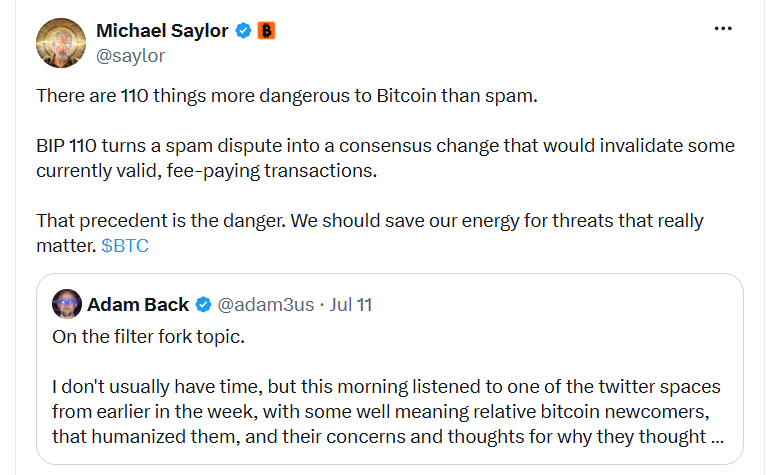
The discussion gained momentum after Blockstream Chief Executive Adam Back echoed similar concerns. Both argued that the proposal threatens Bitcoin’s permissionless design more than the spam problem it seeks to address. Their criticism comes as support for the proposal remains limited across the network.
Debate shifts from spam to network governance
The latest discussion began after Back commented on community conversations surrounding transaction filtering. He said many participants viewed the issue as a technical fix for spam, yet he argued that protocol-level restrictions create much broader concerns.
Saylor responded by stating that Bitcoin BIP 110 transforms a disagreement over spam into a consensus change capable of rejecting transactions that remain valid today.
“There are 110 things more dangerous to Bitcoin than spam,” Saylor wrote on X. He added that changing consensus rules for this purpose establishes a precedent that could affect future network decisions.
Back agreed that spam remains an issue. However, he argued that Bitcoin’s decentralized structure prevents any individual or group from deciding which transactions deserve inclusion. According to him, users can modify their own software but cannot impose those preferences across the network.
Back also rejected accusations that outside funding influences Bitcoin Core developers. He said grant providers generally support development without directing technical priorities or protocol decisions.
Proposal continues to divide the Bitcoin community
Bitcoin BIP 110 proposes temporary protocol-level limits on non-financial data stored in Bitcoin transactions. The measure primarily targets Ordinals inscriptions, which allow users to embed images, text and other digital content on the blockchain.
Supporters say that the proposal would help to lower blockchain bloat and enhance the efficiency of the blockchain network. They also state the restrictions would not be permanent, just temporary and would not alter transaction validation.
Critics disagree. They say the idea would sweep below the radar transactions that are already valid under Bitcoin’s rules, and are subject to standard transaction fees.Some developers also believe the restrictions could prove ineffective because users may discover alternative methods to bypass them.
Back warned that forcing the proposal without broad agreement risks creating competing versions of Bitcoin through a network split. He said anyone seeking stricter transaction rules remains free to launch a separate blockchain instead of changing Bitcoin itself.
Network data at a glance
| Metric | Current Status |
|---|
| Miner support for BIP 110 | About 1% of recent blocks |
| Required support for activation | More than 55% of validating nodes |
| Current Ordinals activity | Fewer than 10,000 inscriptions daily |
| Peak Ordinals activity | More than 400,000 daily in August 2023 |
Wider consequences extend beyond Ordinals
Although the debate centers on spam transactions, the broader issue involves Bitcoin’s governance model. Some opponents say that protocol-level content filtering would undermine Bitcoin’s neutrality.
Meanwhile, proponents argue that excessive blockchain bloating costs and congests the network. They feel that temporary restrictions are a viable solution, while not changing the Bitcoin architecture permanently.
Bitcoin BIP 110 has not had much support, so that’s not the reason for assuming that it will get activated any time soon. Despite this, the conversation has revealed significant conflicts on the path forward for Bitcoin development as new use cases arise.
Future governance debate may influence future upgrades
Bitcoin BIP 110 was a controversial proposal that once again brings into focus a challenge facing the world’s largest cryptocurrency. All proposed rule changes need to be balanced between technical improvements and the Bitcoin principle of decentralization and predictable consensus.
The proposal is currently met with much opposition from key industry players and not much network support. Regardless of whether Bitcoin BIP 110 makes it, the debate has made it clear that it is important for as many people as possible to agree before changing the rules of Bitcoin itself. The result will have a potential effect on the way future protocol improvements will be judged throughout the ecosystem.
Conclusion
However, the near term looks gloomy for Bitcoin BIP 110 as network support is still far from the activation threshold. However, the proposal has sparked a larger debate on how to keep Bitcoin at both ends—technical improvement and maintaining its decentralization and predictable consensus.
This debate isn’t limited to spam and Ordinals. Rather, it has evolved into a broader debate on who should set the rules for the future of Bitcoin, and how changing the rules of the game should be done without compromising the fundamentals of the network.