
The technology of digital payments keeps evolving due to increasing amount of stablecoins within the blockchain financial system. Increased involvement of institutions, expanding on-chain liquidity, and new regulations led to more attention paid to those networks that exist for payment processing alone and not for cryptocurrencies.
In this regard, Stripe and the crypto investment company Paradigm have come up with Tempo blockchain, which is a Layer 1 payment-focused blockchain network.
The project arrives as the stablecoin market surpasses $300 billion in on-chain value, according to DeFi Llama, while U.S. Treasury Secretary Scott Bessent has previously stated that the asset class could eventually reach a $2 trillion market capitalization.
Instead of competing as another general-purpose blockchain, Tempo has been designed to address payment processing through infrastructure tailored for businesses, developers, and financial institutions.
What Is Tempo Blockchain?
Tempo blockchain is an Ethereum Virtual Machine (EVM)-compatible Layer 1 network developed by Stripe and Paradigm to support stablecoin-based payment activity. In contrast to conventional Layer 1 blockchains which can facilitate decentralized finance, gaming, and token trading, Tempo is developed particularly for payment infrastructure.
Source: Solulabs
Tempo is an innovation that utilizes the knowledge of Stripe on digital payments and Paradigm on blockchain development for constructing infrastructure for high-stakes transactions.
Important facts about the Tempo blockchain
- Developed as an EVM-compatible Layer 1 chain.
- Designed specifically for stablecoin payments.
- Initially operating through a private testnet before becoming permissionless.
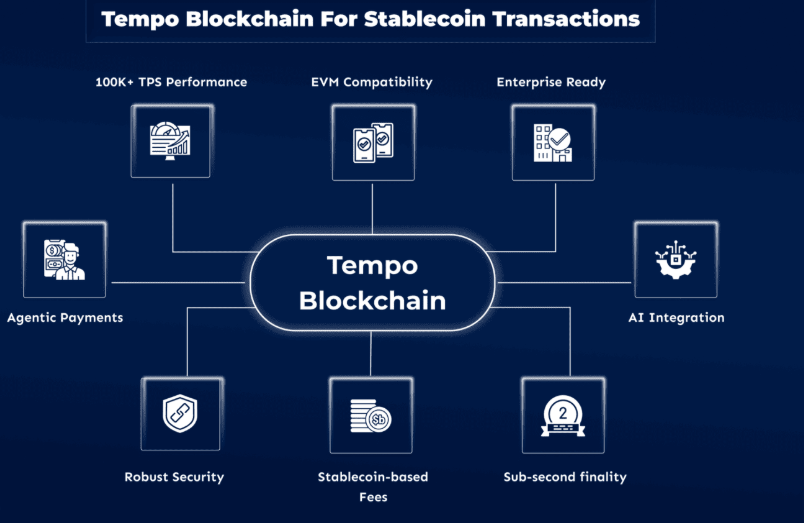
Tempo Blockchain Features Designed for Payments
The network introduces technical capabilities intended to support payment processing at scale while reducing operational complexity for users and businesses.
Payment-focused capabilities include
- Approximately 100,000 transactions per second (TPS).
- Low transaction fees.
- Batch transfer that allows processing many payments at once.
- Memo fields for attaching payment information.
- Optional privacy features while maintaining financial compliance.
Unlike many blockchain networks that require fees to be paid using a native token, Tempo allows transaction costs to be settled using supported stablecoins such as USDC and USDT through its integrated automated market maker.
| Feature | Tempo Blockchain |
| Network Type | Layer 1 |
| Compatibility | Ethereum Virtual Machine (EVM) |
| Primary Focus | Stablecoin payments |
| Transaction Speed | Around 100,000 TPS |
| Gas Payments | USDC, USDT and supported stablecoins |
| Current Stage | Private testnet |
| Future Plan | Open permissionless network |
Design Partners and Infrastructure Development
Tempo blockchain is currently being tested with a group of early design partners before expanding to wider participation.
According to the project, organizations contributing design input include OpenAI, Shopify, Visa, and several other companies involved in payments and financial technology. Some of these participants are also operating validator nodes during the network’s initial testing phase.
The project has also developed infrastructure partnerships for supporting wallet and interoperability between blockchain networks.
Infrastructure partners include
- Phantom and MetaMask for wallet connectivity.
- Across and LayerZero for interoperability.
- Bridge and Privy for stablecoin and wallet infrastructure.
The validator network currently consists of independent operators while the blockchain prepares for its planned transition to an open, permissionless validation model.
Funding and Ongoing Development
The development of Tempo blockchain has been supported by significant funding as work continues on payment infrastructure.
According to a Fortune report published in October, the company completed a $500 million Series A funding round that valued the project at approximately $5 billion.
The engineering team has also expanded. In October, Ethereum developer Dankrad Feist joined the project to contribute to the network’s technical development.
Current testing focuses on practical payment applications, including:
- Cross-border payments.
- International remittances.
- Merchant settlement.
- Stablecoin payment infrastructure.
Stablecoin Market Supports Tempo Blockchain Development
The launch of Tempo blockchain comes during continued expansion of the stablecoin market.
According to DeFi Llama, stablecoins now represent more than $300 billion in on-chain market capitalization. Regulatory developments have also increased following the passage of the GENIUS Act in July 2025, while Treasury Secretary Scott Bessent has previously stated that the sector could grow toward $2 trillion.
Rather than supporting a broad range of blockchain activity, Tempo has been developed around payment settlement using stablecoins. Its architecture combines high transaction throughput, payment-specific functionality, enterprise-focused infrastructure, and validator expansion plans as development continues through its private testnet.
What Tempo Blockchain Is Designed to Support
As development progresses, the network is being tested for several payment-related applications.
Planned use cases
- Cross-border payments.
- Remittances.
- Global payroll.
- Merchant transactions.
- Programmable financial services.
These use cases remain under evaluation during the private testing phase alongside infrastructure development and validator expansion.
Conclusion
Tempo blockchain has entered development as a Layer 1 network focused entirely on stablecoin payments and financial settlement. Tempo Blockchain has been built using Stripe and Paradigm technologies, which leverage blockchain technology together with the payment infrastructure by means of such tools as stablecoin gas payments, batched payments, privacy features, and fast transactions.
In light of private testing, infrastructure partnerships, and the upcoming move to a permissionless blockchain, Tempo keeps developing based on blockchain payment functionality amid the growing stablecoin market.
FAQs
What is Tempo blockchain?
Tempo blockchain is an EVM-compatible Layer 1 network developed by Stripe and Paradigm for stablecoin payments and financial settlement.
Is Tempo blockchain live?
No, the network is running on a private testnet at present with certain design partners.
Which stablecoins are eligible for the gas fees?
The network is designed to use some stablecoins like USDC and USDT for paying the transaction fees.
How fast is Tempo blockchain?
According to the project, Tempo is designed to process approximately 100,000 transactions per second.
Who are Tempo’s infrastructure partners?
Current infrastructure partners include Phantom, MetaMask, Across, LayerZero, Bridge, and Privy.