

Key Insights
- Ripple has been granted initial permission for a CASP licence under the EU’s MiCA regulation.
- The approval has the potential to open up regulated crypto and stablecoin services in 30 EEA countries.
- The flow of development is easing as companies rush to get MiCA certification in time for important regulatory deadlines.
After getting preliminary authorization in Luxembourg, Ripple has taken a step further to get regulatory clearance in the entire European Union. The development will boost the company’s market standing in one of the world’s largest regulated digital asset markets. It is also as financial institutions ramp up blockchain’s use in payment and settlement systems.
The Luxembourg nod provides Ripple with access to regulated crypto offerings in Europe’s EEA countries. The transfer comes as crypto companies grapple with the need to comply with the Markets in Crypto-Assets (MiCA) regulation of the European Union (EU).
Luxembourg strengthens European strategy
Luxembourg’s Commission de Surveillance du Secteur Financier (CSSF) has issued Luxembourg’s first provisional license for a crypto asset service provider as announced by Ripple.
The regulator issued a green light letter, indicating that they are planning to grant the license once the company meets the remaining requirements.
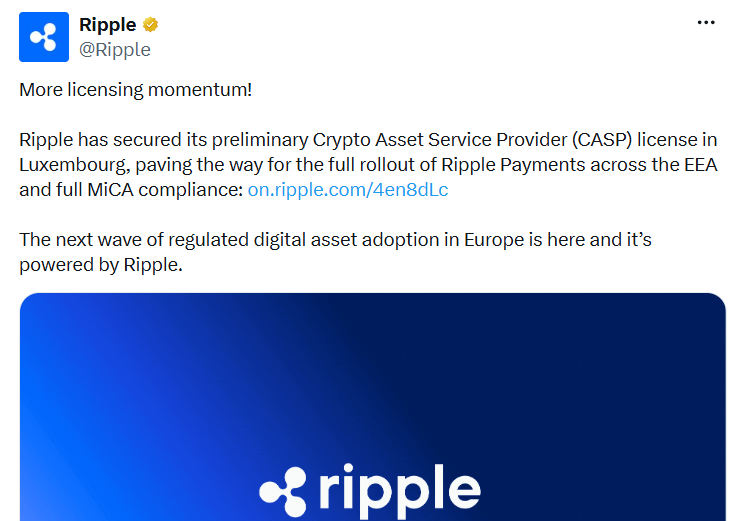
MiCA’s passporting would permit Ripple to provide regulated cryptoasset services in the EEA under a full CASP license. Under the system, firms that receive authorization in one member state can provide services throughout the bloc without seeking separate approvals in every jurisdiction.
The latest step builds on Ripple’s existing Electronic Money Institution license in Luxembourg. The company secured that authorization earlier this year as part of a broader strategy to expand regulated payment services in Europe.
According to Ripple, the combination of CASP and EMI licenses would allow banks, fintech companies, and corporate customers to access cryptoasset and stablecoin payment infrastructure through a single integration. Clients would be able to collect, exchange, and distribute funds using one platform.
Cassie Craddock, Managing Director for the United Kingdom and Europe at Ripple, said demand for institutional digital asset services continues to rise across the region.
She further said that financial infrastructure is getting increasingly on-chain as institutions are looking to make more efficient payment and settlement infrastructure.
Expansion plans are driven by institutional adoption
The approval follows the trend of financial institutions in Europe. As the regulatory landscape becomes more defined, banks, payment providers and fintech companies ramp up their investments in digital asset infrastructure.
Ripple thinks that MiCA has established a better ground for institutional adoption. The regulation, which was enacted in 2023, was one of the world’s first in-depth crypto regulatory frameworks.
The regulations laid down specific standards for crypto service providers, stablecoin issuers and other digital asset firms in the European Union.
The company reported that it is attracting more interest from banks and other institutions that are interested in blockchain technology to power cross-border payments, collateral management, settlement services, and tokenization.
These use cases have become a major focus for firms seeking to modernize financial operations.
Craddock said financial institutions are actively building digital asset capabilities to remain competitive. She added that Ripple’s regulatory track record and infrastructure position the company to support that transition.
The company also highlighted its growing compliance footprint. Ripple said it now holds more than 75 regulatory licenses worldwide. The figure reflects a broader effort to expand operations in jurisdictions that offer clear regulatory frameworks for digital assets.
Matthew Osborne, Ripple’s Head of Policy for the UK and Europe, thanked Luxembourg’s regulator for its cooperation during the licensing process. He described Luxembourg as a natural hub for the company’s European operations.
MiCA deadline raises pressure across industry
Ripple’s progress comes as competition for MiCA approvals intensifies. All the crypto businesses in Europe have been working for months to meet the tougher regulations that will come into force in a few months.
A number of big industry players have already obtained licenses. Coinbase, Kraken, Bitstamp, Crypto.com and OKX have all received licenses via various jurisdictions across Europe. Their authorizations enable them to offer services throughout the European Economic Area in line with MiCA’s passporting criteria.
Ripple is not just in the business of trading cryptocurrencies with the retail consumer, like many of its competitors, but instead it’s more of a payments infrastructure player.The company aims to expand adoption of its blockchain-based payment network and RLUSD stablecoin among institutional users.
The timing could prove important. A key MiCA transition period ends on July 1. After that date, firms operating without the required approvals could face regulatory restrictions or enforcement action.
At the same time, policymakers have started reviewing parts of the framework. However, there are some industry members who believe that MiCa’s requirements for stablecoins are too strict.
Reserve rules that mandate that a significant portion of backing assets be kept in the form of cash deposits are cited by critics. Others have questioned the regulations on interest-bearing stablecoin products.
Conclusion
Ripple must meet final conditions before it gets full CASP license. But the initial approval boosts its confidence in Europe at a crucial time for the crypto market.
Once authorized, Ripple will be able to enter into one of the world’s largest regulated digital asset markets. The ruling may also speed up the company’s institutional payments and stablecoin expansion and its wider crypto offerings in Europe.