

Stablecoin regulation in the United States has moved to a new stage after the implementation of the GENIUS Act, which can be considered the federal act that sets the regulations concerning the reserve backing, transparency, supervision, and protection of consumers.
The GENIUS Act entered into force on July 18, 2025, and it is the first national regulatory act that is focused solely on payment stablecoins.
These regulations are coming at a time when stablecoins are growing popular in the sphere of cryptocurrency exchange, blockchain operations, payments, and other financial operations. With these regulations, the criteria of stablecoin issuance are set, and the principles of stablecoins are determined.
What Is the GENIUS Act?
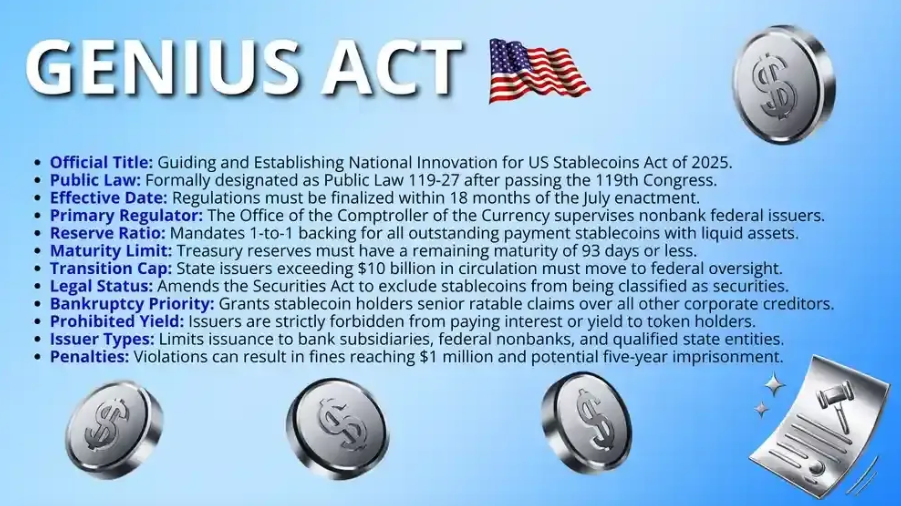
Guiding and Establishing National Innovation for U.S. Stablecoins Act is referred to as the GENIUS Act. This Act lays down the regulations for payment stablecoins and their issuers in the U.S.
Stablecoins are digital currency coins which are tied to the U.S. Dollar and whose values do not change. Stablecoins are usually used for trading in cryptocurrencies and digital commerce.
Source: Data Wallet
Through the GENIUS Act, the standards regulating the issuance and supervision of these digital coins are established. The Act is consistent with other international initiatives on the regulation of stablecoins.
Why Was the GENIUS Act Proposed?
Stablecoin has become the subject of regulatory interest in light of its rapid development and increased presence in financial structures. There are hundreds of billions of dollars being traded through stablecoins, and this becomes an important issue for regulators when it comes to managing the reserves and withdrawal rights.
The GENIUS Act was introduced to solve the issues related to the lack of transparency on issuers’ reserves and liabilities. The regulation aims to introduce consistent requirements for entities issuing payment stablecoins.
The act will clarify the process by which the stablecoin issuers conduct their operations and how the reserve assets should be managed.
Requirements of the GENIUS Act
The GENIUS Act makes several requirements for issuers that operate in the USA. The stablecoin, which falls under this model, should be fully backed by highly liquid assets such as US dollars and US Treasury bills. Such reserves should not be used in any kind of lending or speculation.
Issuers will have to provide monthly reporting about reserve positions. Issuers that possess more than $50 billion worth of stablecoins will also need to conduct independent annual audits. The act also requires adherence to the Anti-Money Laundering, Sanctions, and Know Your Customer rules.
Further, issuers will need to be able to freeze, seize, or burn tokens in response to any lawful order. If issuers become insolvent, the holders of stablecoins have priority rights on reserve assets.
Moreover, issuers are barred from marketing stablecoins as government-sponsored, federally insured, or fiat currencies.
| Requirement | Description |
| Reserve Backing | Stablecoins have to be fully reserved on an approved liquid asset basis |
| Monthly Reporting | Disclosure of reserve data must be carried out routinely |
| Annual Audits | Necessary for issuers with stablecoins worth over $50 billion |
| Anti-Money Laundering/Know Your Customer Compliance | Observe financial crime regulation laws |
| Consumer Protection | Priority claim of stablecoin owners in case of insolvency |
| Regulatory Oversight | Federal and state oversight according to the issuer’s size |
How the GENIUS Act May Impact Stablecoins and Blockchain Networks
The GENIUS Act proposes a regulatory regime that impacts stablecoin issuers, payment service providers, financial institutions, and blockchain networks.
The framework offers compliance standards for issuers of stablecoins with reserves. Conventional financial firms can issue stablecoins within the framework as well.
Blockchain usage may also be impacted by the act. Blockchain networks such as Ethereum, Solana, and Layer 2 networks facilitate transactions in stablecoins; hence, increased adoption of stablecoins means more blockchain network usage.
In addition, the framework might increase demand for U.S. Treasury bills due to reserve requirements.
Gaps in Regulatory Coverage Still Present
Despite the fact that the GENIUS Act provides for a comprehensive regulation, some areas are still left beyond its scope.
The law prohibits issuers from paying any interest directly to the stablecoin owners; nevertheless, it does not include exchanges or affiliate companies that provide yields on their products. Therefore, there is still room for stablecoin-associated yields to be delivered via indirect means.
Additionally, the law leaves some gaps regarding offshore issuers. Foreign stablecoin issuers may continue their business operations under another set of regulations, provided that their assets can be accessed on specific markets. Hence, there will be discrepancies between the requirements applicable to domestic and foreign issuers.
These discrepancies have raised doubts about consistency in regulation in the wider stablecoin industry.
The Terra Collapse and the Importance of Reserve Requirements
Reserves were extremely critical in terms of their significance after Terra fell in 2022. Terra is an algorithmic stablecoin and not a collateral-backed one.
Its failure to uphold its value against the US dollar led to more than $40 billion in losses. This made the danger of having non-collateralized stablecoins very apparent.
The GENIUS Act provides for this by mandating that the approved liquid reserves back the covered stablecoins. The reserve requirement, the reporting, and audit provisions provided under the act are aimed at ensuring that more transparency is provided regarding the management of backing assets.
Conclusion
The GENIUS Act provides for a national regulation of payment stablecoins within the United States. The act requires issuers to have reserve backing, reporting, audits, consumer protection, and regulatory supervision. The act also provides for how both federal and state regulators will regulate the activities of the payment stablecoins.
FAQs
What does GENIUS stand for?
GENIUS stands for Guiding and Establishing National Innovation for U.S. Stablecoins.
What would serve as backing for stablecoins under the GENIUS Act?
The collateralized assets could consist of U.S. dollars and U.S. government short-term bonds.
Should stablecoin issuers be compelled to make reserve disclosures?
Yes. Reserve disclosures must be done monthly, and the larger issuers must undergo an annual audit.