

Top AI tokens by use case span several areas of crypto infrastructure, with projects focusing on decentralized machine intelligence, GPU computing, cloud services, autonomous agents, blockchain data, oracle services, storage and web data collection.
Bittensor, Render, Akash, NEAR, Virtuals Protocol, Artificial Superintelligence Alliance, The Graph, Chainlink, Filecoin and Grass have been associated with different parts of this market. CoinGecko and CoinDesk Indices data also show that several of these assets remain represented in AI-related crypto market categories and indices.
Top AI tokens by use case are divided across infrastructure categories
The projects covered in the AI-token sector do not perform the same function. Their networks address different infrastructure requirements, which separates their token use cases despite their classification within the broader AI category.
Three major areas identified among the projects include:
- Computing infrastructure, including decentralized GPU and cloud resources from Render and Akash.
- AI and autonomous-agent infrastructure, including Bittensor, NEAR, Virtuals Protocol and Artificial Superintelligence Alliance.
Data infrastructure, including The Graph, Chainlink, Filecoin and Grass.
Bittensor’s TAO is connected to decentralized machine intelligence through a subnet-based network. Bittensor documentation states that its Dynamic TAO system uses TAO and subnet-specific alpha tokens within an economic structure involving miners, validators, and subnet participants.
In April 2026, a 72-billion-parameter model had been trained across more than 70 globally distributed nodes in Bittensor’s distributed-training ecosystem. Moreover, more than 68% of issued TAO was staked at the time.
Render and Akash provide decentralized computing infrastructure
Render’s RENDER is associated with distributed GPU computing. The Render Network describes its infrastructure as a system that connects users with distributed GPU capacity for workloads including 3D rendering, generative AI imaging and spatial computing.
The network’s official materials also identify integrations involving generative AI companies and applications. This places RENDER within the computing side of the AI-token sector rather than the autonomous-agent category.
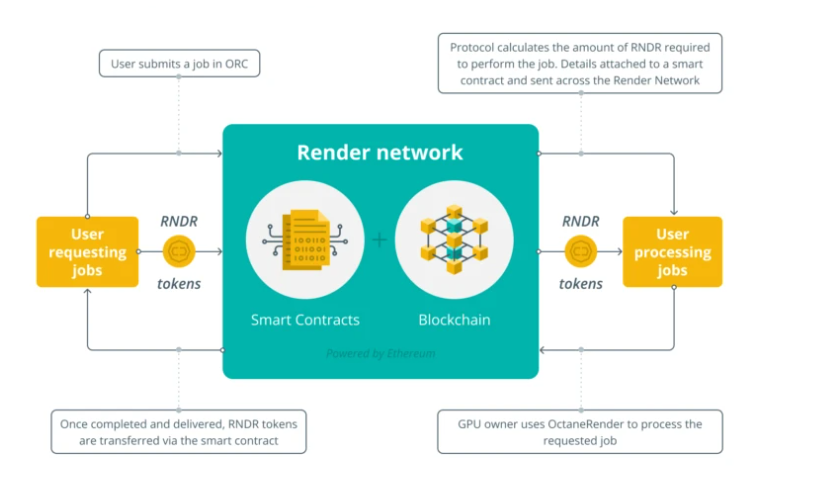
Process flow of Render Network, Source: TradingView
Akash Network uses AKT in a decentralized cloud marketplace. Its documentation describes a system in which independent providers offer computing resources through bids, including CPU, memory, storage, and GPU capacity.
Akash has also positioned its GPU infrastructure for AI workloads such as model training, fine-tuning, and inference. Its role therefore centers on access to computing resources rather than the development of an individual AI model.
| Token | Primary use case | Infrastructure area |
| TAO | Decentralized machine intelligence | AI networks |
| RENDER | Distributed GPU computing | Computing |
| AKT | Decentralized cloud computing | Cloud and GPU |
| NEAR | Autonomous agents and cross-chain execution | AI and blockchain |
| VIRTUAL | Autonomous AI agents | Agent infrastructure |
| FET | Decentralized AI and agents | AI infrastructure |
| GRT | Blockchain data indexing | Data |
| LINK | Oracle data and computation | Data and connectivity |
| FIL | Decentralized storage | Storage |
| GRASS | Web data collection | AI data |
AI tokens also target autonomous agents and blockchain connectivity
NEAR Protocol has included autonomous AI agents and cross-chain transactions in its 2026 roadmap. Its Chain Signatures infrastructure allows applications to sign transactions across supported blockchain networks. NEAR has also described confidential AI infrastructure using trusted execution environments for private inference.
Virtuals Protocol focuses on autonomous AI agents and their deployment. The Block reported in January 2026 that Virtuals was among assets included on a list considered by Grayscale. The same report stated that consideration did not guarantee the creation of an investment product.
The Artificial Superintelligence Alliance uses FET as its market ticker and is associated with autonomous agents and decentralized AI infrastructure. CoinGecko’s current market data continues to identify the asset as FET under the Artificial Superintelligence Alliance name.
These projects therefore address AI-related functions at the application and execution layers, rather than concentrating primarily on physical computing resources.
Data networks and storage form another part of the sector
The Graph uses GRT within a decentralized blockchain indexing network. Its infrastructure relies on independent indexers that process queries and provide structured blockchain information through Subgraphs.
The Graph’s Horizon architecture also introduced changes to how indexers provision GRT for individual data services. The token can be placed within the blockchain data infrastructure, not as AI computations.
LINK from Chainlink is another separate data token. The oracle infrastructure links smart contracts to the outside data and computation, while LINK is used in payment and staking within the network.
FIL of Filecoin is linked to decentralized storage. Grayscale included Filecoin in a decentralized AI fund launched in 2024 alongside Bittensor, Livepeer, NEAR, and Render, linking decentralized storage with AI infrastructure.
Grass addresses web data collection. Its network uses distributed internet infrastructure to collect and provide web data. In a July 2026 update, Grass identified scale, data permanence and data quality as challenges associated with obtaining useful web information for AI systems.
Market concentration can still be seen among major AI-related tokens
Market statistics prove that the AI-token group has a significant level of market concentration. The Block reported in April 2026 that Bittensor, Render and Artificial Superintelligence Alliance represented more than 71% of the GMCI AI Index.
CoinDesk Indices’ July 2026 reconstitution retained Chainlink, NEAR, Bittensor, Render, Filecoin and Artificial Superintelligence Alliance in its crypto indices. CoinGecko also maintains a dedicated artificial intelligence category covering related crypto assets.
FAQs
What are the main uses of AI tokens?
The projects covered in this article are associated with decentralized machine intelligence, GPU computing, cloud infrastructure, autonomous agents, blockchain indexing, oracle services, decentralized storage and web data collection.
Which token is associated with decentralized machine intelligence?
Bittensor’s TAO is associated with decentralized machine intelligence through its subnet structure and Dynamic TAO system.
What does RENDER provide?
RENDER is associated with decentralized GPU computing for workloads including 3D rendering, generative AI imaging and spatial computing.