The projects involving artificial intelligence and blockchain technology have become more common in August 2026. Different blockchains occupy different positions in decentralized machine learning, GPU computing, blockchain data, AI training data, autonomous agents, and blockchain infrastructure.
Some of the best projects involving artificial intelligence and blockchain technology include Bittensor, NEAR Protocol, Render, Internet Computer, Artificial Superintelligence Alliance, Akash Network, The Graph, Grass, Virtuals Protocol, and Talus. It is expected that the total market cap of all the AI tokens will reach about $20.8 billion, according to CoinGecko.
The projects operate across decentralized machine learning, GPU computing, blockchain data, AI training data, autonomous agents, and on-chain AI infrastructure. CoinGecko currently values the broader AI-token category at about $20.8 billion. The ranking is based on network utility, AI relevance, development activity, infrastructure, ecosystem traction, and market presence rather than expected token returns.
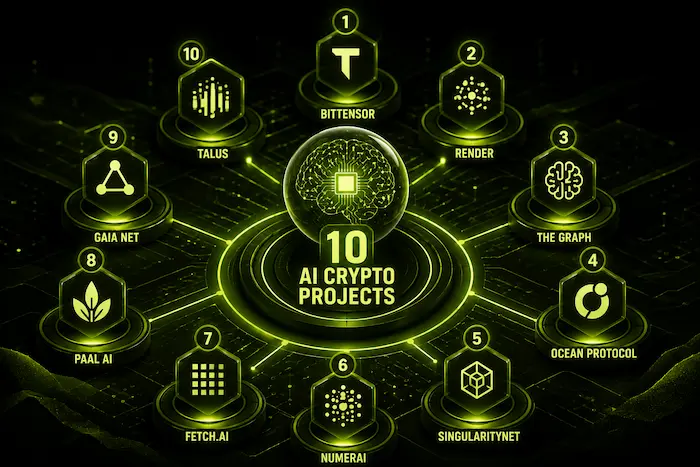
List of Top 10 Artificial Intelligence-Based Cryptocurrency Companies
| Rank | Company | Main AI or infrastructure area |
| 1 | Bittensor | Decentralized machine learning |
| 2 | NEAR Protocol | AI agents & private inference |
| 3 | Render | Decentralized GPU computing |
| 4 | Internet Computer | On-chain AI applications |
| 5 | Artificial Superintelligence Alliance | Decentralized AI infrastructure |
| 6 | Akash Network | Decentralized AI compute |
| 7 | The Graph | Blockchain data for AI agents |
| 8 | Grass | AI training and inference data |
| 9 | Virtuals Protocol | Autonomous AI agents |
| 10 | Talus | On-chain AI agent |
Bittensor leads the Top 10 AI Crypto Projects with its decentralized machine learning protocol. The network organizes machine learning into subnets using TAO incentives for participants.
In the V440 update of July 2026, known as Emission Gate, Bittensor introduced changes to its emission policy for the subnets in which the lowest-ranked get fewer emissions, transferred to the highest-ranked ones. The emissions from the 94 networks below the threshold dropped from 38.4% to 12.5%, whereas the top eight networks had their emissions increase from 32.8% to 52.7%.
The NEAR Protocol has been working hard in 2026 on AI agents, confidentiality of execution, agent credentials, confidential inference, and infrastructure for the agents to perform transactions and coordination. Its current platform also includes integrations involving Brave, Ledger, NVIDIA, and Intel. NEAR is developing dynamic resharding to adjust shard configurations as network demand changes.
Render and Internet Computer expand blockchain-based AI computing
Render Network has expanded from decentralized GPU rendering into machine-learning training, inference, fine-tuning, and generative AI workflows. Its compute-client documentation describes APIs that allow external applications to access decentralized GPU resources. The network also supports AI-related workflows for image, video, and 3D content.
Internet Computer targets applications and computation running directly on decentralized blockchain infrastructure. Its Motoko compiler received updates in June and July 2026. The application subnet experienced a temporary halt on July 25, but the problem was subsequently fixed. According to CoinGecko, ICP ranks among the larger AI-based tokens, with a market cap exceeding $1 billion.
AI data and compute networks have distinct roles
Artificial Superintelligence Alliance has three projects, namely, Fetch.ai, SingularityNET, and CUDOS, that help promote decentralized AI technology. Some of its research involves an AI-based blockchain architecture consisting of shards, staking, transaction fees, and reserves controlled by the governance.
Akash Network specializes in decentralized cloud computing for AI tasks. Its Q1 2026 report said cumulative compute spending exceeded $5 million during the first 90 days of the year. Akash also introduced Homenode for individual GPU owners and added confidential computing capabilities on July 28.
The Graph offers blockchain data infrastructure via Subgraphs, Firehose, Substreams, and Amp. However, by July 2026, The Graph had handled more than 1.27 trillion queries for over 75,000 projects. Some of the major highlights in The Graph 2026 roadmap are the AI-enabled Interface, which includes Subgraph MCP and Subgraph A2A.
Revenues from GrassAI training & inference data generated approximately $17 million in the first half of 2026 and are expected to generate revenues of around $65 million to $75 million in 2026 annually. Grass is also moving towards inference data with Live Context Retrieval.
Virtuals Protocol specializes in tokenized AI agents and includes the ERC-8004 protocol for registered agents. On-chain identity and reputation for registered agents were introduced when Virtuals Protocol was launched in February.
Talus is yet another blockchain platform dedicated to the deployment of AI agents and workflow automation. Talus entered the mainnet era in 2026 and released the Talus/acc builder program in May.
FAQs
What are the Top 10 AI Crypto Projects in August 2026?
The list contains such projects as Bittensor, NEAR Protocol, Render, Internet Computer, Artificial Superintelligence Alliance, Akash Network, The Graph, Grass, Virtuals Protocol, and Talus.
What is the decentralized machine learning project?
This is Bittensor, where subnets and TAO define decentralized machine learning services.
Which projects deal with AI agents?
NEAR Protocol, Virtuals Protocol, and Talus have AI agent-related developments or infrastructure.