Decentralized autonomous organizations have adopted more infrastructure options in 2026, with their governance expanding from token-based voting to include treasury management, permission settings, contributor payments, and community access.
Ethereum.org’s DAO page, last updated on Aug. 11, 2026, lists tools for governance, multi-signature wallet custody, role management, DAO creation, and contributor collaboration.
In addition, in 2026, a research dataset was compiled that recorded 85,000 DAO communities, 330,000 proposals, and 66 million votes across six main governance platforms. These numbers demonstrate the scope of DAO operations and explain why companies need specialized infrastructure for separate activities.
The expansion of DAO infrastructure reflects the growing number of tasks involved in running decentralized organizations. Voting platforms can handle proposals and governance decisions, but they do not necessarily provide treasury custody, contributor payments, membership controls, or programmable roles.
That division has produced a more layered approach to DAO operations. A community can use one application to approve a proposal, another to secure its treasury, and another to determine who receives access to specific channels or contributor programs.
The 2026 research dataset also found differences in how major platforms expose governance and voting data. This makes the function of each tool an important consideration when evaluating DAO infrastructure rather than treating every governance application as interchangeable.
Among the applications listed by Ethereum.org are Snapshot, Agora, Hats Protocol, Aragon, DAOhaus, Splits, Safe, Coordinape, Guild and Endaoment.
Key takeaways
- Snapshot and Agora address different forms of DAO governance and voting.
- Safe, Hats and Splits focus on treasury security, permissions and financial operations.
- Guild, Coordinape and Endaoment extend DAO infrastructure into access, compensation and philanthropy.
Top DAO tools serve different operational roles
| Tool | Primary function | Notable capability |
| Snapshot | Governance | Configurable voting strategies and multiple voting formats |
| Agora | Onchain governance | Governor-based proposals, delegation and transaction simulation |
| Safe | Treasury | Multisig custody and programmable smart accounts |
| Aragon | DAO creation | Modular plugins for governance and permissions |
| Hats Protocol | Roles | Programmable onchain permissions |
| DAOhaus | Membership governance | Moloch-style governance and ragequit |
| Guild | Community management | Access based on wallet and activity requirements |
| Coordinape | Contributor compensation | Peer-based GIVE allocation |
| Splits | Treasury operations | Automated payment and revenue distribution |
| Endaoment | Philanthropy | Structured crypto-based charitable funding |
Snapshot remains a prominent option for organizations seeking accessible governance without requiring participants to pay gas for standard voting. Its documentation says voting power can be determined through configurable strategies, with more than 400 strategies available. The platform supports single-choice, weighted, approval, and quadratic voting.
Its spaces also bring proposals, votes, delegates, and governance information into one interface. However, traditional Snapshot voting is off-chain, meaning a vote does not automatically constitute an on-chain treasury transaction. Snapshot has also expanded through Snapshot X and support for Governor-based governance and on-chain execution.
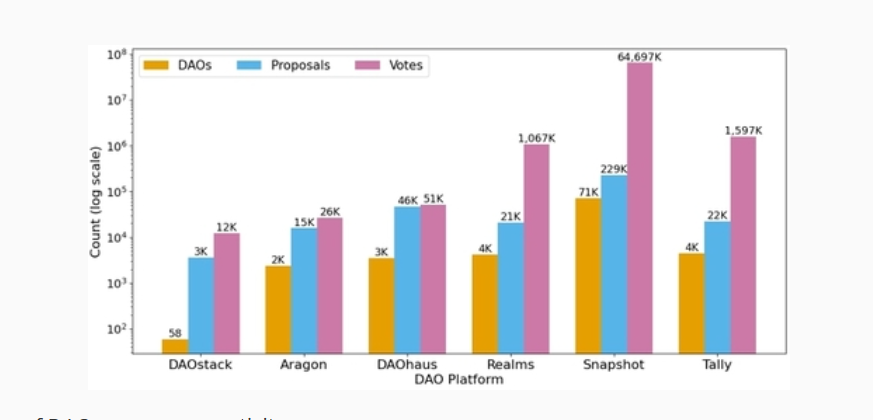
Distribution of DAO governance activity, Source: ACM
Agora takes a more direct approach to enforceable on-chain governance. Its platform supports proposals, voting, delegation, role management, security councils, dual governance, multiple-choice proposals, and transaction simulation.
Agora reports that more than 800,000 votes have been cast on its Governor contracts and that more than 103,000 users access its system monthly. Those figures are company-reported.
For protocol DAOs requiring configurable on-chain governance, Agora uses OpenZeppelin’s Governor framework. Its open-source architecture also allows organizations to deploy or modify the software.
Treasury and permissions are separate from voting
Safe serves a different role by providing treasury and smart-account infrastructure rather than acting primarily as a voting platform. DAOs can use multisig arrangements in which several authorized participants approve transactions before funds move.
Safe says its infrastructure supports treasury management across more than 28 networks. Organizations can configure owners, proposers, administrators, signing thresholds and security policies. Its modular smart-account architecture also supports programmable permissions and integrations with decentralized applications.
Aragon allows organizations to develop on-chain governance using a modular framework. Its OSx system uses plugins for governance, treasury functions, and permission controls. Organizations can install, replace and upgrade plugins without redeploying the entire organization, while developers can create custom plugins and applications.
Hats Protocol focuses specifically on organizational authority. Its programmable on-chain roles can combine responsibilities, permissions, accountability, and incentives. Hats are represented through non-transferable ERC-1155-style tokens and organized into Hats trees that can determine who creates, modifies, or revokes roles.
Community access and contributor payments add another layer
DAOhaus is specialized around the Moloch governance model. Its Moloch v3 framework uses ERC-20-compatible shares and loot while separating governance from treasury execution through Safe and Zodiac infrastructure.
The model also includes ragequit, allowing eligible members to leave under defined conditions and receive their proportional share of treasury assets.
Guild operates at the community-management layer. Its system uses requirements, roles, and rewards to determine access based on wallet holdings, on-chain activity, social credentials, and other conditions. Guild says it supports more than 60 EVM chains and can connect communities across Discord, Telegram, X, and GitHub.
Coordinape addresses contributor recognition and compensation. Its Circles and Epochs allow contributors to allocate GIVE to peers based on the value they believe those contributors created. Its documentation lists applications including grants, salaries, and project compensation.
Splits focuses on financial operations. Its infrastructure allows it to share the collected funds among several recipients and automate payment processes. Splits claimed that more than 100 teams were able to process above $50 million through their product in 2025. An August 18, 2026 update also introduced cost-basis and holding-period tracking in its accounting product, although accounting v2 was still private at that point.
Endaoment represents a more specialized use case. Ethereum.org lists it under DAO philanthropy, while its Universal Impact Pool uses matching contributions to distribute funding among eligible nonprofits. Its interface also shows support from Nouns DAO.
Conclusion
The 2026 DAO infrastructure landscape spans far more than proposal voting. Snapshot and Agora handle governance, Safe supports treasury custody, Aragon provides modular organization infrastructure, and Hats enables programmable roles.
DAOhaus, Guild, Coordinape, Splits and Endaoment address membership governance, community access, contributor compensation, financial operations and philanthropy.
FAQs
What are DAO tools used for?
DAO tools support different organizational functions, including voting, treasury custody, programmable roles, community access, contributor compensation, payments, and philanthropy.
Which DAO tools focus on governance?
Snapshot and Agora are the key tools related to governance in the provided information. The Snapshot tool provides voting strategy configuration, and Agora highlights on-chain governance.
What is Safe used for in a DAO?
Safe provides treasury and smart-account infrastructure. DAOs can configure multiple authorized participants, signing thresholds, and other security policies for controlling assets.
Why do DAOs use multiple tools?
Different platforms address different operational requirements. A DAO can combine governance, treasury custody, permissions, community access and contributor management rather than relying on one application.