

- The Bitcoin mining activities carried out by Tether in Uruguay were stopped owing to an issue involving electricity quotas and overdue payments.
- Tether had spent $120 million at two Uruguay mining locations before stopping the operations.
- In Brazil, Tether’s test project is scheduled to run on approximately 10 MW of surplus green energy generated by Adecoagro.
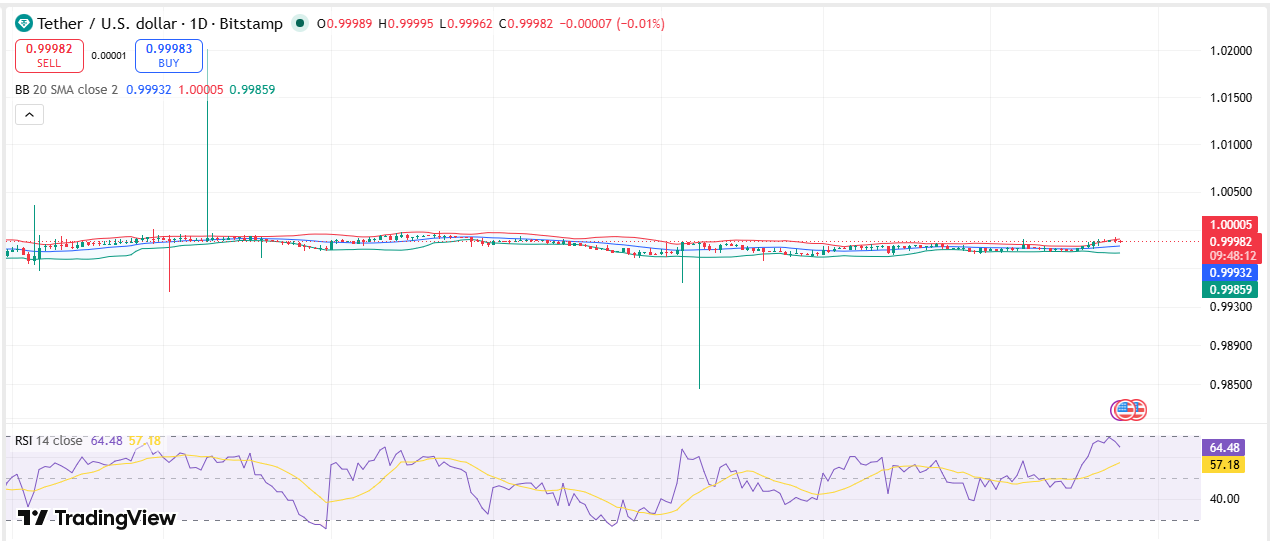
Tether Bitcoin mining developments in Uruguay come as USDT continues to trade close to its dollar peg, with the stablecoin at $0.9998 and a 0.09% weekly gain. Its market capitalization stands at $183.19 billion, while 24-hour trading volume has increased 44.83% to $115.02 billion.
TradingView data for the Tether-to-U.S.-dollar pair on Coinbase shows USDT near parity at $0.99969, with the pair opening at $0.99978 before reaching an intraday high of $0.99993 and a low of 0.99945.
Exponential moving averages are still in a tight cluster in the range of $0.99923-$0.99939, whereas Fibonacci levels determine the $0.99707 and $0.98047 levels as lower technical levels.
USDT Technical Analysis Shows Tight Trading Range
From the analysis above, USDT has been near the $1 mark in the observed trading range. The Coinbase pair witnessed a 0.01% decline on a daily basis at $0.99969, while the weekly figure stood at a 0.09% increase.
The tight cluster of the exponential moving averages is in the range of $0.99923-$0.99939. Fibonacci analysis places the $0.236 retracement level at $0.99707, while the 1.618 projection reaches $0.98047.
Source: Trading View
The reported market data also shows substantial trading activity. USDT’s 24-hour volume reached $115.02 billion after rising 44.83%, while its market capitalization stood at $183.19 billion.
Tether Bitcoin Mining Project Faced Electricity Dispute
Against this market backdrop, Tether’s Uruguay Bitcoin mining operation has ended following a dispute between its local entity Microfin and state utility UTE over electricity allocation.
The dispute had already commenced by late 2024. The company Microfin considered the contracted electricity allowance to be minimum and open for an increase whereas UTE took the allowance to be maximum.
Microfin stopped paying electricity bills in May 2025. In June, it notified UTE that it intended to terminate the contracts. Revised terms were not completed, and UTE disconnected the mining sites on July 25.
By November, Tether had notified labor authorities that it would cease operations and lay off most staff. Microfin subsequently settled its outstanding UTE debt in December.
Uruguay Project Spending Estimated at $120 Million
A former contractor estimated that Tether spent approximately $60 million at each of two mining sites in Uruguay’s Florida department. The combined estimate is about $120 million.
The $120 million figure represents estimated spending across the two sites and is not a confirmed loss disclosed by Tether.
The Uruguay project had been launched in 2023, when Tether cited Uruguay’s renewable electricity generation and grid reliability in connection with its Bitcoin mining plans.
Brazil Pilot Uses About 10 MW
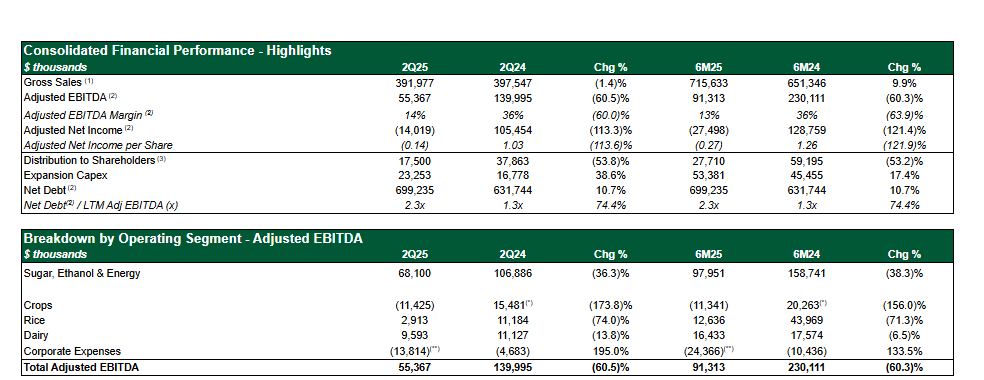
Tether’s subsequent renewable-energy mining initiative in Brazil involves Adecoagro, a producer of agricultural goods and energy in South America.
Adecoagro representatives visited Tether’s Uruguay mining facility in February 2025 while the companies explored renewable-powered cryptocurrency mining. Five months later, they announced a memorandum of understanding for a pilot project in Brazil.
Source: SEC
The disclosed power figures distinguish the Brazil pilot from the broader renewable capacity associated with Adecoagro. The companies referenced more than 230 MW of renewable generation capacity across South America, but that figure does not represent electricity committed to Bitcoin mining.
Adecoagro said the pilot would use about 10 MW of surplus renewable energy that would otherwise be sold into the spot market.
Uruguay and Brazil Disclosures Remain Separate
The available disclosures do not establish that Tether redesigned the Brazil pilot because of the Uruguay project’s problems. They also do not establish that the Brazil initiative has encountered the same electricity-contract dispute.
The Uruguay operation involved two sites in Florida and ended after disagreements over electricity allocation, unpaid bills and incomplete revised terms. The Brazil pilot is described as using about 10 MW of surplus renewable energy from Adecoagro.
The more than 230 MW figure refers to Adecoagro’s broader renewable-generation capacity in South America rather than the amount allocated to Bitcoin mining.
FAQs
What is USDT trading at?
USDT is trading at $0.9998 based on the provided market data.
What happened to Tether’s Uruguay Bitcoin mining project?
UTE disconnected the sites on July 25 after an electricity allocation dispute and unpaid bills.
How much was reportedly spent on the Uruguay sites?
A former contractor estimated spending at approximately $120 million across two sites.
How much power will the Brazil pilot use?
Adecoagro said the pilot would use about 10 MW of surplus renewable energy.