The choice of a DEX is not confined to examining the platform with the highest trading volume. Figures from DeFiLlama reveal notable differences in terms of trading volume and TVL of different Top DEXes, and recent security attacks highlight threats posed by oracles, validators, signing keys, and tokens.
Although in January 2026, DEXs occupied 13.6% of the spot market, the new list of Top 10 DEXes shows the current trading volumes and other characteristics of the largest DEXes.
Top 10 Decentralized Exchanges by Volume
The latest DeFiLlama ranking considers 30-day DEX volumes alongside the TVL as a secondary parameter for liquidity.
| Rank | DEX | 30-Day Volume | TVL |
| 1 | Uniswap | $40.2B | $3.06B |
| 2 | PancakeSwap | $24.2B | $2.04B |
| 3 | Aerodrome | $13.0B | $326M |
| 4 | Fluid | $3.8B | Not provided |
| 5 | Curve | $5.7B | Not provided |
| 6 | Raydium | $4.4B | Not provided |
| 7 | Meteora | $3.9B | $284M |
| 8 | BisonFi | Not provided | Not provided |
| 9 | GoonFi | Not provided | Not provided |
| 10 | DODO | Not provided | Not provided |
This ranking is determined based on the latest DeFiLlama ranking; however, it may differ depending on the changes in on-chain activities of the protocols. CoinGecko shows the volumes of individual exchanges but no volumes or TVLs for BisonFi, GoonFi, and DODO.
Uniswap is the leading protocol with $40.2 billion of 30-day volume and $3.06 billion of TVL. It functions on Ethereum, Base, and Arbitrum blockchains. The second position belongs to PancakeSwap with $24.2 billion of volume and $2.04 billion of TVL, with 96.5% of its TVL on the BNB Chain.
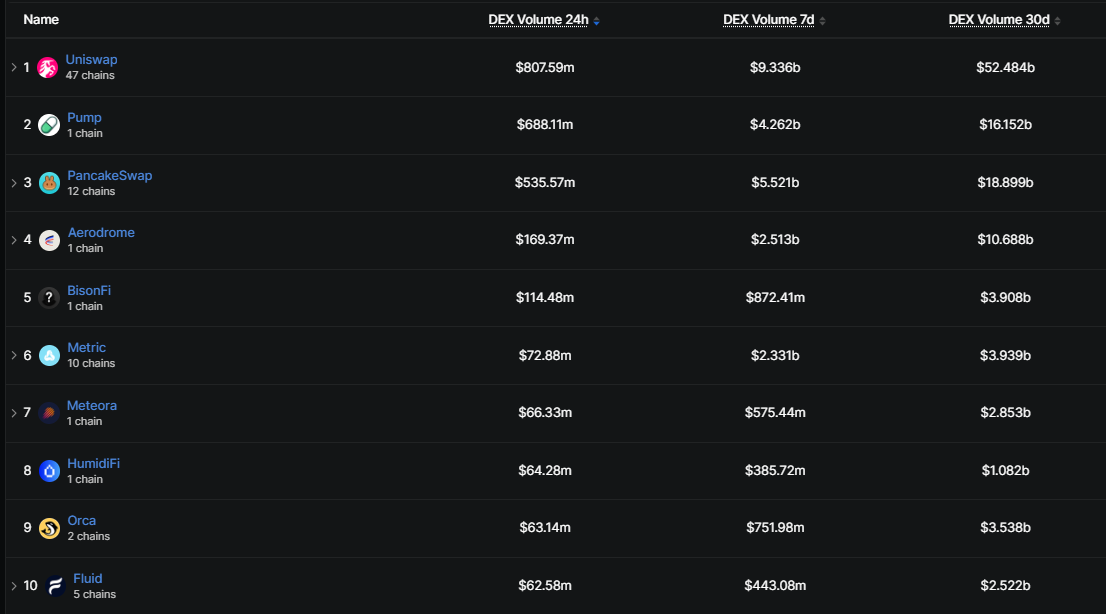
Source: DeFiLlama ranking
Aerodrome shows about $13 billion of 30-day volume and about $326 million of TVL. Fluid recorded about $3.8 billion in volume across Ethereum, Arbitrum, Plasma, Base, and Polygon. Curve recorded approximately $5.7 billion, while Raydium and Meteora recorded about $4.4 billion and $3.9 billion, respectively.
Trading Volume Does Not Equal Liquidity
The Top 10 Decentralized Exchanges also show why volume and TVL should not be treated as identical measurements. Volume reflects the value traded, whereas TVL is the measure of the assets held in a particular protocol.
Moreover, liquidity concentration, trading volume, gas fees, and external liquidity can impact market depth and execution.
According to CoinGecko, DEXs’ share of the spot markets increased from 6.9% in January 2024 to 13.6% in January 2026.
Uniswap and PancakeSwap were part of the 10 largest spot exchanges within the period of August 2025 to January 2026, with a total market cap of $542.6 billion and $548.4 billion, respectively.
Security Adds Another Layer
The top 10 Decentralized Exchanges are now also evaluated in regard to other security risks. DeFiLlama documented 99 exploits in Q2 2026. Ostium suffered an attack on July 15 involving price-reporting infrastructure, while AFX Trade lost about $24.15 million on July 22 after validator signing keys connected to a protocol-operated bridge were compromised.
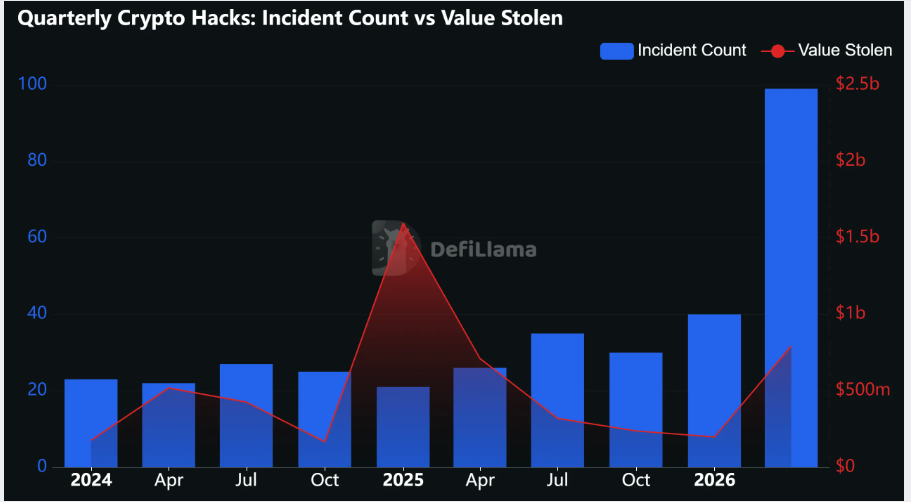
99 exploits in Q2 2026, Source: DeFiLlama
Blockaid reported that five hot-validator signatures authorized the $24.15 million USDC withdrawal. Offchain Labs co-founder Steven Goldfeder said Arbitrum’s native bridge was not affected, placing the reported failure around key management and protocol infrastructure rather than Arbitrum’s core bridge.
A separate June incident involving an AIDC token burn flaw was reported to have drained about $121,000 from a PancakeSwap liquidity pool. DeFiLlama identifies this as a vulnerability involving an external token rather than PancakeSwap’s core contracts.
DEX Security Extends Beyond Smart Contracts
The security challenges for the Top 10 Decentralized Exchanges include smart contract security audits, governance, upgrades, oracles, bridges, permissioned administration, bug bounties, and incident response.
Some of the other security challenges faced by users include phishing attacks, malicious token approval, and wallet attacks. In a recent study conducted on MEV and DEX attacks via Science Direct, it has been found that MEV behavior, along with ordering attacks such as sandwich attacks, is present in DEXs.
What Happens Next
Decentralized Exchanges rankings continue to be an evolving picture due to the fact that 24-hour, 7-day, and 30-day metrics might affect the order of protocols. The Uniswap protocol is also open for governance decisions related to the v4 protocol fees and further v4 deployments.
Consequently, current information shows two different metrics for DEXs’ activity: trading volume and liquidity. Recent examples also prove that security concerns reach not only smart contracts but also infrastructure, signing keys, oracles, and other external programs.
FAQs
What are the Top 10 Decentralized Exchanges?
According to the ranking provided by DeFiLlama, Top 10 decentralized exchanges include Uniswap, PancakeSwap, Aerodrome, Fluid, Curve, Raydium, Meteora, BisonFi, GoonFi, and DODO.
Which DEX leads in the 30-day trading volume?
The first position in the ranking of 30-day trading volume belongs to Uniswap which has accumulated a total trading volume of $40.2 billion.
What is the DEX spot market share in January 2026?
The spot market share for DEX is 13.6% in January 2026, according to CoinGecko.