

U.S. spot Bitcoin ETFs recorded $924.5 million in net inflows during the week ended August 28, 2026, according to Farside Investors, extending a broader recovery in demand during August.
BlackRock’s iShares Bitcoin Trust (IBIT) accounted for much of the recent buying, although the trend reversed on August 28 when the funds registered a $201.9 million net outflow.
The latest figures followed a stronger period earlier in the month. Between August 17 and August 21, U.S. spot Bitcoin ETFs attracted approximately $1.92 billion in net inflows.
Over seven trading sessions through August 27, investors had directed roughly $2.5 billion into the funds, marking the largest inflow period since October, according to Dow Jones Market Data cited by The Wall Street Journal.
The figures highlight the growing role of exchange-traded funds as a route for investors seeking Bitcoin exposure through traditional securities-market infrastructure. This framework eliminates the need for investment in Bitcoin directly as well as handling of private keys or self-custody arrangements.
Demand for Spot Bitcoin ETF Soars in August
These flows mark a clear deviation from times when selling pressure was dominant earlier in the year 2026. U.S. spot Bitcoin ETFs recorded a 10-session outflow streak in late May, with cumulative losses approaching $3 billion, according to Decrypt.
Farside data showed five consecutive positive sessions from August 17 through August 21. Daily inflows during that period were $297.5 million, $189.3 million, $517.2 million, $606.3 million, and $307.5 million, respectively.
Buying continued into the following week. The funds recorded $337.6 million in net inflows on August 24 and another $314.3 million on August 25. August 26 added $232.2 million, while August 27 generated $242.3 million.
That sequence ended on August 28 with a $201.9 million outflow. ARKB accounted for $114.9 million of the outflow, while IBIT recorded a $33.4 million outflow.
The change occurred alongside a sharp Bitcoin price recovery. BeInCrypto, citing Galaxy Research, reported that Bitcoin increased from $62,818 to $77,593 between August 17 and August 23, a weekly gain of $14,775. That period also produced the strongest U.S. spot Bitcoin ETF inflow week since October 2025, according to the publication.
Key Takeaways
- U.S. spot Bitcoin ETFs recorded $924.5 million in weekly net inflows through August 28.
- BlackRock’s IBIT remained the largest fund by assets and attracted major inflows during the week.
- ETF demand reversed on August 28 with a $201.9 million net outflow.
BlackRock Leads the Spot Bitcoin ETF Market
BlackRock has established a substantial lead among U.S. spot Bitcoin ETF issuers. As of August 28, IBIT had $60.34 billion in net assets, according to BlackRock, with an expense ratio of 0.25%.
Farside recorded IBIT inflows of $208.9 million on August 24, $284.4 million on August 25, $200.8 million on August 26 and $277.6 million on August 27.
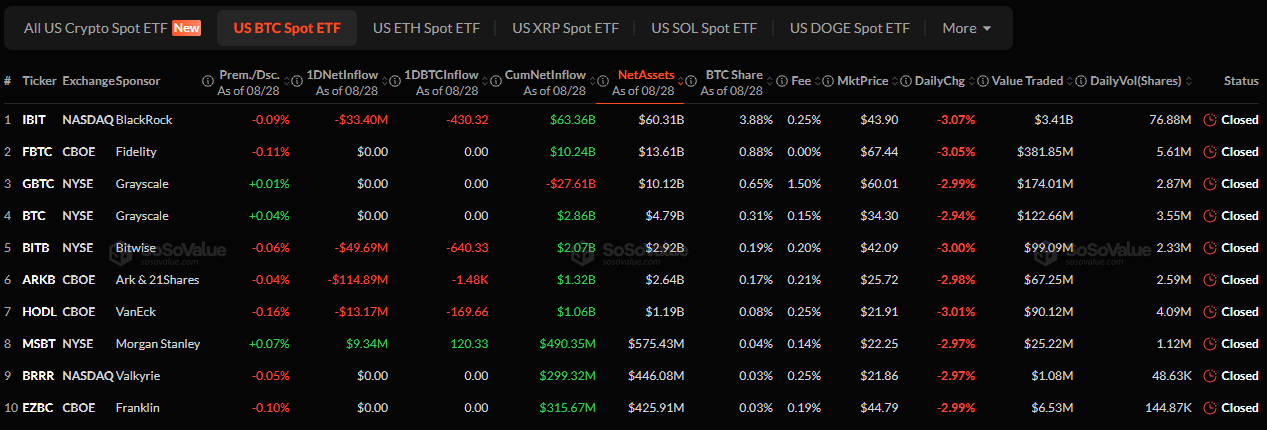
Source: SosoValue
Other major funds remained considerably smaller by assets under management.
| Issuer | ETF | Ticker | AUM Aug. 28 | Expense Ratio |
| BlackRock | iShares Bitcoin Trust | IBIT | $60.34B | 0.25% |
| Fidelity | Fidelity Wise Origin Bitcoin Fund | FBTC | $13.61B | 0.25% |
| Grayscale | Grayscale Bitcoin Trust ETF | GBTC | $10.12B | 1.50% |
| ARK 21Shares | ARK 21Shares Bitcoin ETF | ARKB | $2.64B | 0.21% |
| Bitwise | Bitwise Bitcoin ETF | BITB | $2.97B | 0.20% |
The data also show differences in fund expenses. GBTC carried a 1.50% expense ratio, compared with 0.25% for IBIT and FBTC, 0.21% for ARKB and 0.20% for BITB.
How Bitcoin ETFs Differ From Direct Ownership
A spot Bitcoin ETF holds Bitcoin as its underlying asset and issues shares that trade on a stock exchange. Investors can therefore obtain exposure to Bitcoin without directly purchasing or securing the cryptocurrency.
Bitcoin owners get access to private keys, the ability to transfer funds between different wallets, and the use of Bitcoin infrastructure. ETF investors rarely have any control over the underlying private keys, as these are managed inside the fund framework.
| Factor | Spot Bitcoin ETF | Direct Bitcoin |
| Trading venue | Stock exchange | Crypto exchange or marketplace |
| Custody | Fund and custodians | Investor or third-party custodian |
| Private keys | Generally not controlled by investor | Can be controlled by investor |
| On-chain transfers | No | Yes |
| ETF management fee | Yes | No ETF expense ratio |
The U.S. Securities and Exchange Commission approved multiple spot Bitcoin exchange-traded products on January 10, 2024, and the products began trading publicly on January 11. The approval followed a federal court ruling that required the agency to reconsider its earlier rejection of Grayscale’s proposed product.
The SEC made clear that approving the exchange-traded products did not constitute an endorsement of Bitcoin itself.
ETF Flows Do Not Capture the Entire Bitcoin Market
ETF flows provide information about demand for regulated Bitcoin exposure, but they are not a standalone measure of the entire market. Spot exchanges, derivatives markets, corporate treasuries, miners, and other participants can affect Bitcoin independently of ETF activity.
The August data demonstrate the speed at which ETF flows can change. The funds recorded $242.3 million in net inflows on August 27 before registering a $201.9 million outflow the following day.
The broader financial environment also shifted during the period. Reuters reported on August 28 that global equity funds recorded their first weekly outflow since May 20, with $5.87 billion withdrawn during the week ending August 26. U.S. equity funds recorded $22.33 billion in net outflows.
Conclusion
U.S. spot Bitcoin ETFs attracted $924.5 million in net inflows during the week ending August 28, extending strong demand seen earlier in August.
BlackRock’s IBIT remained the largest fund by assets and recorded several major daily inflows, while the market ended the week with a $201.9 million outflow. The latest figures show renewed ETF demand while also underscoring how quickly daily flows can change.
FAQs
Which Bitcoin ETF has the largest assets?
BlackRock’s IBIT had $60.34 billion in net assets as of August 28, according to BlackRock.
Did Bitcoin ETF flows remain positive throughout the week?
No. After several sessions of inflows, the funds recorded a $201.9 million net outflow on August 28.
When did spot Bitcoin ETFs begin trading in the U.S.?
The SEC had approved several spot Bitcoin ETFs in January 10, 2024, and they started trading from January 11, 2024.