The price of Bitcoin stood at approximately $62,829 on August 14, 2026, according to Fortune, after falling from $63,558 the previous day. The process of purchasing your first BTC is not only about knowing the value of the cryptocurrency, but involves many more things.
One should seek a trusted platform, secure his/her account, check each and every transaction, and know how to safely keep the cryptocurrency. Since the majority of Bitcoin transactions cannot be reversed, the process of securing private keys and checking the wallet address becomes crucial.
For buyers, the process of buying involves seeking a legitimate platform, completing the verification of their identity, securing the account, checking the transaction details, and keeping the digital currency. Since most of the Bitcoin transactions cannot be reversed, losing control of private keys and sending BTC to the wrong wallet results in the loss of money.
How to Purchase Bitcoin via a Verified Platform
The majority of newcomers purchase Bitcoin via a centralized exchange, also known as CEX. The process entails depositing regular money and exchanging it for the virtual currency. In choosing a platform, the user must consider issues such as location availability, identity verification, costs, withdrawals, safety, and regulation.
The decentralized exchange, or DEX, works in a different way since the user will deal with smart contracts hosted on the blockchain through their personal wallet.
Among the important precautions that should be taken prior to opening an account are:
- Ensuring that the website is accessible in the user’s geographical location.
- Reviewing fees, withdrawal policies, and security features.
- Verifying the authenticity of the website or app before providing any personal details.
After the user has chosen a platform, they might be required to go through the KYC process, which means “Know Your Customer.” This can involve details such as one’s name, date of birth, and government identification.
Securing the Account Prior to Buying Bitcoin
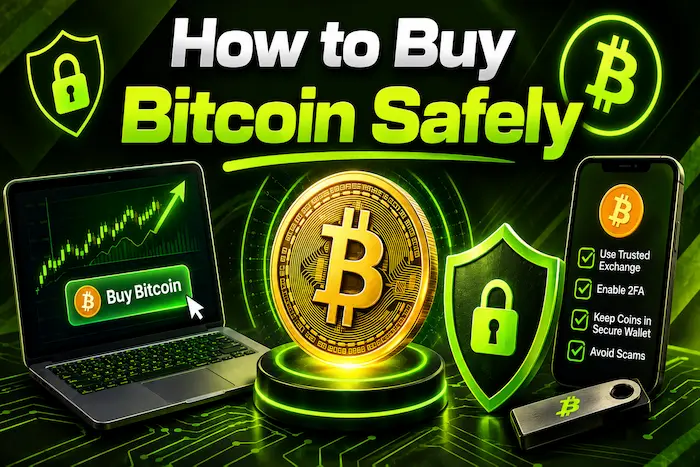
Account security needs to be put in place before making deposits. It is recommended that you make use of a strong password and set up multifactor authentication. The email account linked to the exchange platform should also be secured, as control of this account can be used to initiate a password reset request or security notification.
Withdrawal allowlisting is an additional measure that can help restrict withdrawals to preapproved accounts. It is recommended to use only secure and verified payment methods to avoid issues when making deposits and setting the transaction limits.
After the account is funded, it is now time to choose BTC as your coin of choice and either enter the amount of bitcoin you wish to use or the amount of conventional money you will be spending.
Fees and available order types vary by platform.
| Purchase stage | Key consideration |
| Platform | Availability, verification, fees and security |
| Account | Strong password and multifactor authentication |
| Deposit | Verified payment method and transaction limits |
| Purchase | BTC amount, price, fees and total cost |
| Withdrawal | Correct wallet address and test transfer |
Bitcoin Storage and Private-Key Security
Buying BTC does not place physical coins inside a wallet. Bitcoin operates on the blockchain, and wallets hold the cryptographic keys that authorize transactions. When it comes to third-party custody, the exchange typically holds the corresponding private keys, whereas with self-custody, the person holding the Bitcoin holds the private keys.
Hot wallets are always online, whereas cold wallets keep signing information offline. A hardware wallet is one type of cold wallet. Cold wallets offer protection against cyber-attacks; however, loss, theft, or damage to the hardware could cause irreversible loss of access.
A wallet may generate a seed phrase that can restore access. The phrase should not be shared, photographed for cloud storage, or entered into unfamiliar websites. Buyers need to ensure that this is not shared with anyone pretending to represent customer support.
A small transaction can be conducted first before making a larger transfer when depositing BTC to a private wallet. Transactions involving Bitcoins cannot be reversed once confirmed, hence the need for address verification.
Frequently Asked Questions
Does one have to purchase an entire Bitcoin?
No, Bitcoin can be divided into satoshis, with one Bitcoin being equivalent to 100 million satoshis.
What is the difference between a CEX and a DEX?
The CEX gives users an account where they can deposit fiat money or buy cryptocurrencies, while the DEX relies on blockchain and the user’s wallet.
What should the buyer do about scams?
Buyers should verify the sites and applications themselves, ignore any requests related to guaranteed income, withdrawal charges, recovery charges or immediate transfer requests. FBI and the FTC have raised red flags regarding fraudulent platforms and investments in cryptocurrencies.