The emergence of blockchain technology has offered many new ways of raising money through non-conventional fundraising techniques. With the increasing popularity of digital assets, startup teams have started taking advantage of this blockchain-based funding method to gain initial investors for their projects and raise funds for product development.
Among other techniques being used by startups, the Initial Coin Offering (ICO) technique allows cryptocurrencies to raise funds through digital token sales before the release of their products/services.
Unlike conventional methods, which include transferring some ownership in exchange for money, ICOs provide an opportunity to raise funds through the distribution of tokens using blockchain technology.
This model was formed during the development of the crypto industry and attracted attention with the development of blockchain technology.
Moreover, ICOs have provided an alternative funding source by enabling projects to form a community of people who are interested in the development of the network itself.
Even though ICOs have common elements with regular fundraising events, they work differently and have different risk levels. The popularity of ICOs that increased from 2013 to 2017 made them one of the most talked-about funding instruments within the digital asset industry.
Comparison of an Initial Coin Offering to an IPO
Both an Initial Coin Offering and an Initial Public Offering help companies raise funds, but there are significant differences between the two.
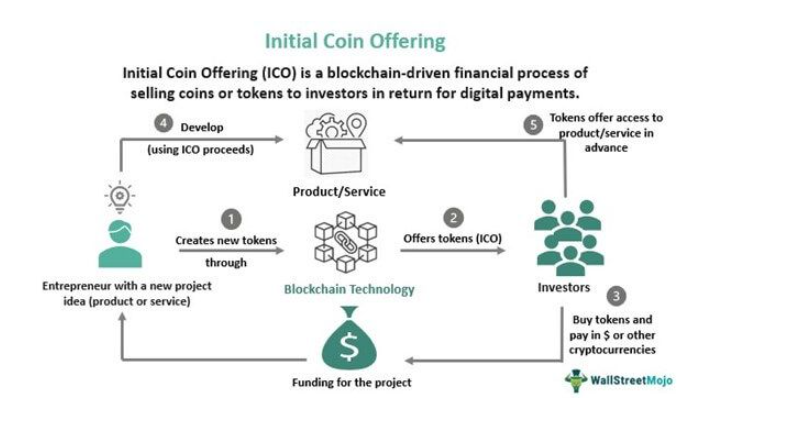
Source: Wall Street Mojo
An IPO requires that a privately held company offer stocks for public purchase through regulatory filings. The registration process will usually involve filing financial information and disclosure of the risks involved with the investment.
On the other hand, in an ICO, tokens and not the stocks of a company are offered for sale. Since tokens rarely constitute ownership in any company, ICOs have traditionally not required registration at all. However, certain token projects that qualify as securities may yet find themselves falling within the ambit of securities laws.
Main differences include:
- The issuance of IPO is through regulated security offerings backed by required disclosures.
- ICO entails the issuance of blockchain tokens which usually do not confer any equity ownership.
- ICOs can be subject to lawsuits should their tokens be classified as securities under prevailing laws.
History of Development of the ICO
History of the development of Initial Coin Offering goes back to the year 2013 when a software developer J.R. Willet published The Second Bitcoin Whitepaper describing Mastercoin, later renamed Omni Layer. The crowdfunding campaign raised approximately $600,000.
Fundraising activity expanded gradually over the following years.
| Year | ICO Activity |
| 2013 | Mastercoin conducted ICO worth around $600,000 |
| 2014 | Six ICO worth around $30 million, which included Ethereum worth $18 million |
| 2015 | Seven ICO worth around $9 million, led by Augur worth $5 million |
| 2016 | Forty three ICO worth around $256 million, including Lisk, Golem, Waves, Iconomi, The DAO |
| 2017 | About 342 token sales worth around $5.4 billion |
The surge in fundraising activities in the year 2017 was due to During this period, token sales often reached funding targets within short timeframes as participation increased across the cryptocurrency sector.
Types of Initial Coin Offering
An Initial Coin Offering generally falls into one of two categories depending on investor participation.
Private ICO
Private ICOs restrict participation to a limited group of investors. Such products are typically offered to accredited investors, financial institutions, or wealthy people. Firms can set up a minimum investment level for participants.
Public ICO
A public ICO is meant to reach a broader group of people who can buy tokens from the projects through fundraising campaigns. There have been many regulatory changes, which have encouraged many projects to explore private fundraising options.
How an Initial Coin Offering Works
The first thing that needs to be done before conducting an ICO is determining the token issuance and the mode of fundraising.
Token distribution models can vary and include the following:
- Static token price along with static token supply.
- Dynamic token price along with static token supply.
- Static token price along with dynamic token supply.
After choosing the fundraising model, the projects usually go through certain operations before distributing tokens.
The main stages include:
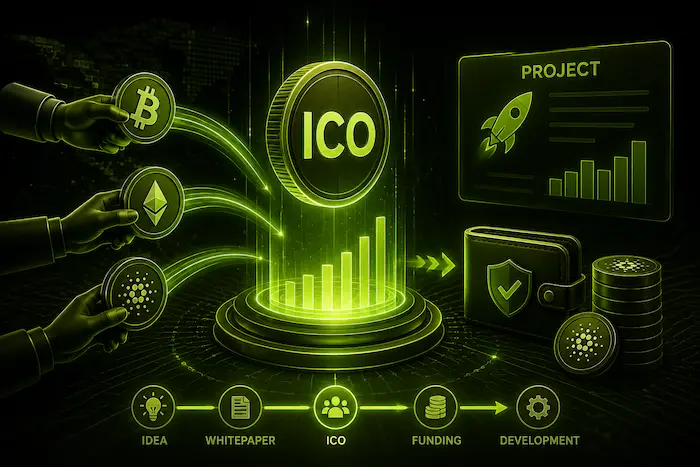
- Identification of investors: The project identifies its target audience for fundraising and prepares the necessary information about its product/service.
- Creation of tokens: Tokens based on blockchain are created that grant access to the product/service or functionality of the network. Tokens usually do not involve any share in equity.
- Marketing campaign: All marketing processes take place mainly online, but many popular online advertising platforms do not allow ICO advertisements.
- Distribution of tokens: After the fundraising process, tokens are distributed to participants, while the money is used for further product/service development.
Risks and Regulations
Initial Coin Offerings did not have dedicated regulatory requirements aimed at ICO funding. Nonetheless, those token sales which can be considered as securities according to the law will be regulated by securities legislation.
ICO funding is banned in several nations such as China, Nepal, Bangladesh, Macedonia, Bolivia, and Ecuador.
The lack of regulation makes it possible for ICO to have rather low entry barriers for starting a token sale. Consequently, scam fundraising programs appeared alongside with legitimate blockchain projects. New tokens get listed on cryptocurrency exchanges, marketplaces, and social networks as well.
Advantages and Disadvantages of Initial Coin Offering
The advantages and disadvantages of an Initial Coin Offering will depend on the particular project.
Advantages
- Investors will be able to buy coins at an early stage.
- Initial coin offerings are usually open for all.
- Companies can raise money without giving shares to other people.
Disadvantages
- Coins can fall in price or even projects may become non-functional.
- Low regulations make investors exposed to fraud.
- In most cases, investors need to have knowledge about cryptocurrency wallets and how to transfer coins.
Conclusion
With the advent of Initial Coin Offering, a new fundraising mechanism was created that operates differently from the existing conventional capital market system where the projects issue tokens rather than issuing company stocks. Starting from 2013 till now, it became widespread and raised billions of dollars through the fundraising process in 2017. Various types of participants, fundraising mechanisms, and token distribution mechanisms have been created in the process.
FAQs
What Is an Initial Coin Offering?
Initial coin offering is a way of crowdfunding through the blockchain where projects issue digital tokens to collect money for their launch.
How Does an ICO Differ from an IPO?
In the IPO, regulated stock is issued; in the ICO, blockchain tokens are issued without giving ownership in the company.
What Are Types of ICOs?
ICOs can be distinguished into two categories: private and public.
Is It Legal?
There are no regulations regarding ICOs except for those that may apply to the issuance of tokens considered securities.