

Crypto exchange rates have a significant impact on all transactions of digital assets since they determine the amount of one digital asset or fiat money to be swapped against another.
No matter whether the investor uses U.S. dollars to buy Bitcoin or exchanges Ethereum into Solana, the exchange rate determines the value of the trade at a certain point in time.
In contrast to the foreign exchange markets, crypto pricing is calculated autonomously on several exchanges that function with their own order books and liquidity. Therefore, although prices may slightly vary from one platform to another, they still change 24/7 depending on the market dynamics.
What Are Crypto Exchange Rates?
Crypto exchange rate means the ratio between one cryptocurrency and another cryptocurrency or a fiat currency. Some examples are BTC/USD, ETH/BTC, SOL/USD, and other pairs, in which one asset is compared to the other in terms of quantity needed for purchase.
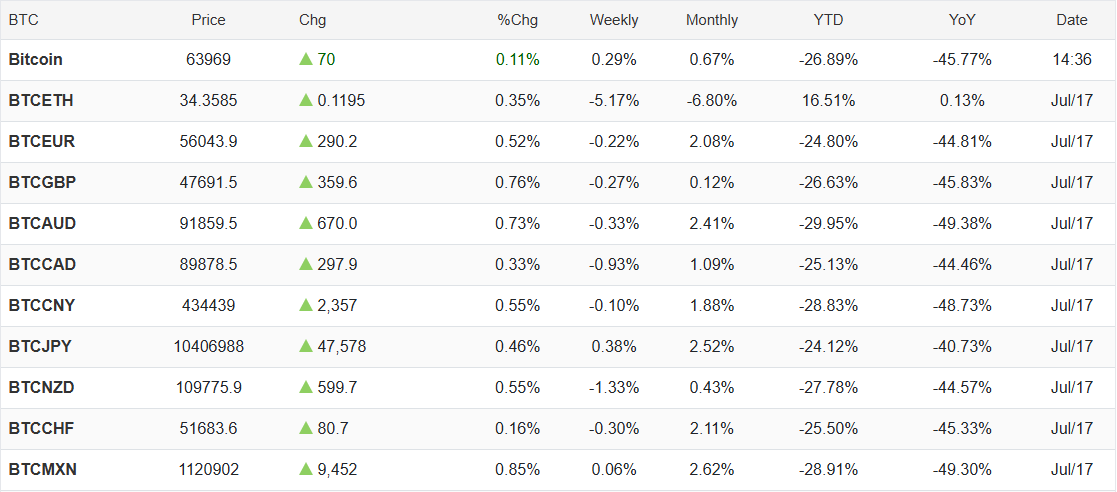
Source: Trade Economics
In contrast to the foreign exchange market, the cryptocurrency market does not have a reference price from all over the world.
Every exchange creates its own market in which buying and selling are carried out independently by each participant, and the last executed deal is considered the current market price of the exchange, thus explaining the different prices at various exchanges. Because cryptocurrency trading runs continuously, exchange rates change every second.
Determinants of Crypto Exchange Rates
The most important determinants of crypto exchange rates are market activities, where supply and demand still account for the greatest impact on the pricing.
Such determinants are:
- Supply and demand: When there are more buyers than sellers, the price tends to be high, whereas when the selling volume grows, the price falls down.
- Volume of transactions: All executed trades affect price discovery on the exchange platform.
- Token supply: The limited supply of tokens can have a different market performance compared to the tokens that are issued constantly.
The limited Bitcoin supply of 21 million coins serves as an example of how supply determines the market performance in the long run.
How Liquidity, Trading Volume, and Market News Can Impact Prices
Liquidity and trading volume affect the capability of cryptocurrencies to accommodate trade activity.
High-volume cryptocurrencies tend to have steadier price movements since higher liquidity tends to minimize the impact of any transaction on price movements. Bitcoin and Ethereum usually exhibit higher liquidity in comparison with other digital assets in major exchanges.
Additional factors that impact prices include:
- Market news: Adoption by institutional players, approval of ETFs, updates to the blockchain technology, and regulatory news have historically impacted trade volume.
- Market sentiment: Breach of security, problems at the exchanges, and any regulatory news can happen together with selling activities.
These factors may have an impact on trading activities, hence affecting exchange rates.
Supply Dynamics Impact Exchange Rates
A number of blockchain platforms incorporate a mechanism that impacts the supply of tokens in the system.
These mechanisms are:
- Token burning, which involves the elimination of coins or tokens from the market permanently.
- Staking and locking of tokens, which means temporarily reducing the supply of tokens in the market.
- Halving of Bitcoin, which reduces coin production.
- Introduction of new tokens in the market according to the blockchain system’s protocol.
Through the Ethereum upgrade, token-burning was included in order to lower the circulating tokens in the market, depending on the network’s conditions.
Reasons Behind Crypto Exchange Rate Differences
The crypto exchange rates do not remain the same for all exchanges since each of the trading platforms is an independent entity.
They have:
- Varied liquidity levels.
- Independent order book systems.
- Varied trading volumes.
- A varied number of buyers and sellers.
For instance, Bitcoin can be bought for $118,000 in one exchange, whereas it will be available for $118,400 in another. This difference in prices can be exploited through the technique of crypto arbitrage.
Traditional Exchange Rates and Cryptocurrency Markets
Traditional exchange rates are also dictated by supply and demand, but may be affected by central bank regulations based on whether the currencies follow floating, fixed, or pegged exchange rates.
Floating currencies are affected by a variety of determinants:
- Interest rates.
- Inflation.
- Trade balances.
- Geopolitical events.
The stablecoin is similar to a cryptocurrency equivalent of pegged exchange rates since it seeks a predetermined value, which is usually pegged to the U.S. dollar. The market conditions may sometimes result in a stablecoin trading higher or lower than its predetermined value.
Conclusion
Crypto exchange rates become the pricing system used to determine the cost of one cryptocurrency with respect to another cryptocurrency or a fiat currency. In contrast to foreign exchange markets, cryptocurrency prices are determined separately for each cryptocurrency exchange based on ongoing trade.
Price discovery involves factors such as supply and demand, liquidity, trading volume, token supply model, macroeconomic trends, and other market events.
FAQs
What is crypto exchange rate?
It is the price of one cryptocurrency compared to another cryptocurrency or to a fiat currency at any moment in time.
Why does a crypto exchange rate keep changing?
The reason for that is that crypto markets never close, and with every transaction, the price is updated.
Why are the prices of Bitcoin different on different exchanges?
Every crypto exchange has its own order book, liquidity, and trading volume.