
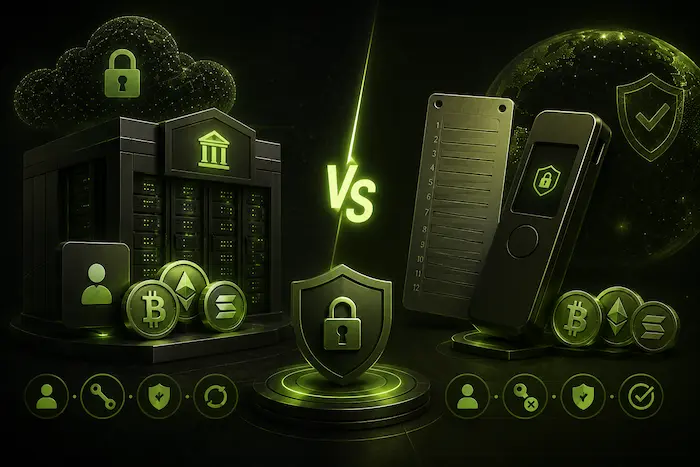
With the increasing adoption of cryptocurrency, storage of the digital currency has emerged as one of the most crucial concerns for investors. Crypto custody has become an integral part of the discussion since it involves having control of the private keys that provide access to the digital currency.
Self-custody has been linked with owning your money for many years, yet professional custody services provided by cryptocurrency exchanges have not lost their relevance.
The discussion gained renewed attention after Binance founder Changpeng Zhao (CZ) said cryptocurrencies may be safer on centralized exchanges than in self-custody because losses outside custodial platforms are difficult to measure.
According to his statements shared by analyst Willy Woo showing that approximately 1.57 million Bitcoin have been lost through self-custody compared with about 1.51 million Bitcoin lost on exchanges. The figures have renewed attention on how digital assets are stored and the responsibilities attached to each custody model.
Cryptocurrency Custody Determines Access to Private Keys
Cryptocurrency custody is the process that is used to protect private keys used for accessing digital assets. Contrary to traditional financial accounts, cryptocurrencies cannot be recovered through banks or payment service providers should there be permanent loss of private keys. Whoever controls these keys owns the digital asset.
The three main forms of cryptocurrency custody are as follows:
- Self-custody: The individual stores and controls his/her private keys using wallets.
- Custodial custody: In this scenario, the third-party firm acts as custodian for holding the private keys of customers, such as cryptocurrency exchanges and institutional custodians.
- Hybrid custody: Here, private key custody is shared (such as multi-sig wallets).
Each of the above custody types is designed to protect digital assets, but each one handles security risks differently.
Exchange Custody Offers Managed Security
Exchange custody transfers responsibility for protecting private keys to a custodial service. Usually, centralized exchanges and custodians adopt various levels of security to protect their customers’ funds.
The following are some of the security measures:
- Use of offline cold storage to avoid the risk of cyber threats.
- Multi-signature wallet and internal monitoring system.
- Access control and account recovery system.
Some custodian services also have insurance against certain security breaches, whereas regulatory compliance, which includes documentation and an auditing process, is adopted by institutional custodians.
Such characteristics have contributed to custodial storage becoming popular among new cryptocurrency users who wish for simpler account management procedures. Organizations also make use of third-party custodians since regulatory systems sometimes demand third-party custodianship solutions.
However, there are also issues with exchange custody that necessitate the customers’ trust in the security and stability of the provider’s operations. In case of a security breach or bankruptcy of the custodian, the customers’ funds can be compromised.
Cryptocurrency Ownership via Self-Custody Grants the Owner Full Control Over the Wallet
Self-custody ensures that cryptocurrency owners have sole access to their private keys without depending on any other third-party service provider. It is widely employed by either hardware wallet services or software wallets managed by the owners themselves.
The concept provides certain features:
- Users hold full ownership of the assets.
- The assets are accessible independent of the exchange.
- It enables users to communicate directly with DeFi services.
- Self-custody may also provide greater privacy because users generally do not need to submit personal information simply to access their wallets.
However, phrases and private keys should be safeguarded from being lost, stolen, or exposed. There is usually no way to recover the credentials in the event of any loss, as opposed to when one uses custodial services.
Recent Developments Still Influencing Storage Options
The debate about crypto custody has persisted after recent developments in the digital asset space. The collapse of FTX in 2022 revealed some of the risks that arise from custodial services. Since then, many exchanges have introduced proof-of-reserves reporting, stronger compliance programs, and improved segregation of customer assets.
Institutional participation has also expanded following the growth of spot Bitcoin and Ethereum exchange-traded funds. At the same time, regulators in the United States and Europe have continued refining custody requirements intended to strengthen customer asset protection within regulated custodial services.
Blockchain analytics have also recorded periods of significant exchange outflows as long-term Bitcoin holders transferred assets into cold storage. The trend has coincided with broader adoption of hardware wallets among users choosing to manage their own private keys.
Security Measures Apply Across Every Custody Model
Neither custody model removes risk. But in any case, the allocation of responsibilities will be determined by the owner of the private keys.
No matter what custody method you opt for, you should follow some simple security rules with regard to your crypto:
- Use 2FA for exchange accounts.
- Do not share your recovery phrases.
- Verify wallet addresses, update your wallet, and be careful about phishing scams.
Traders usually store some of their assets on the exchanges to facilitate transactions, whereas hodlers can opt for self-custody of their funds. Many employ both of these techniques, storing only trading amounts on the exchanges and keeping the majority of the balance in hardware wallets.
Conclusion
Cryptocurrency custody still remains an essential part of security for digital assets.
Custody on exchanges and self-custody present two ways to ensure safe keeping of private keys, where one way uses professional custodians and the other one makes the owner responsible for their funds. The recent debates concerning the comparisons between Bitcoin losses using these custody techniques prove that neither of them eliminates risks.
Frequently Asked Questions
What is crypto custody?
Crypto custody refers to the security of private keys that give you access to cryptocurrencies. Ownership of the private keys means ownership of the digital assets.
What is the difference between exchange custody and self-custody?
In exchange custody, the private key management is entrusted to a third-party service, whereas in self-custody, the user can handle their private keys using hardware and software wallets.
What is hybrid crypto custody?
With hybrid crypto custody, the responsibilities are shared between the users and the custodians using the help of multi-signature wallets or any other similar type of shared access solution.