

Key Insights:
- CFTC’s authority is put to a test with its argument that some Polymarket event contracts are regulated swaps.
- But the $409,881 alleged profit has raised insider-trading concerns, since prosecutors allege that Van Dyke had nonpublic information regarding one of the U.S. military’s operations.
- The decision might have a significant impact on the regulation of prediction platforms like Polymarket and Kalshi.
- The added pressure of the parallel civil case from the CFTC is because the agency has had its own lawsuit against Van Dyke for trading in the same activity.
- The September 9 deadline may just bring the legal battle to a head as Van Dyke’s defence answers the CFTC’s arguments before the court decides whether to dismiss the case.
Gannon Ken Van Dyke faces a new legal fight after a federal judge allowed the CFTC to address his criminal Polymarket case. The ruling could shape whether prediction market contracts qualify as swaps under federal commodities law.
Judge opens the door to CFTC arguments
Judge Margaret Garnett approved the CFTC’s request on August 24 in the U.S. District Court for the Southern District of New York. The agency can now file an amicus brief supporting its interpretation of event contracts.
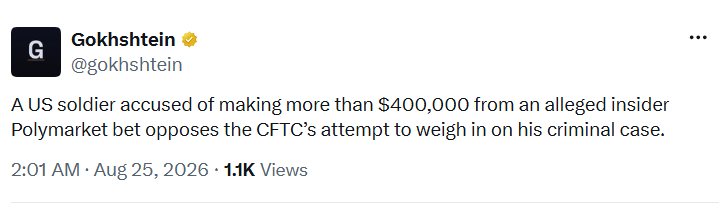
Gannon Ken Van Dyke’s lawyers had urged the court to reject the filing. They argued that the CFTC has a direct interest because it separately sued Van Dyke over the same trading activity.
The defense described the regulator as a party pursuing its own agenda. It said the CFTC should litigate its position in the civil case rather than use the criminal proceeding.
Garnett rejected the request to block the filing. However, she indicated that the court would give the CFTC’s arguments appropriate weight. Van Dyke can respond to new arguments by September 9, with a limit of ten pages.
Alleged trades followed military operation
Federal prosecutors charged Van Dyke in April after investigating trades linked to the January capture of former Venezuelan President Nicolás Maduro.
Prosecutors allege that Van Dyke participated in planning and executing Operation Absolute Resolve. They say he gained access to nonpublic information about the operation before placing trades on Polymarket.
According to the indictment, he made 13 wagers between December 27 and January 2. The trades covered Maduro’s removal, possible U.S. military action, an invasion scenario and presidential war powers.
The government says Van Dyke invested about $33,934 and generated roughly $409,881 in profit. Prosecutors also allege that he moved proceeds through a foreign cryptocurrency vault and sought to conceal related accounts.
Van Dyke has pleaded not guilty. The allegations remain unproven, and the court has not ruled on the government’s evidence.
The legal fight centers on swap status
The CFTC argues hat some event contracts can qualify as swaps when their value depends on events with financial, economic or commercial consequences. Its civil complaint says the Maduro contracts could affect Venezuelan bonds, oil prices and the country’s currency.
Gannon Ken Van Dyke’s defense disputes that interpretation. His lawyers characterize the contracts as geopolitical wagers rather than derivatives tied to financial instruments or commercial exposure.
That distinction carries major consequences. If the contracts fall outside the CFTC’s authority, prosecutors could face a tougher path on commodities fraud allegations tied to federal derivatives rules.The defense also challenges the use of CFTC Rule 180.1. That provision bars fraudulent conduct involving swaps, while prosecutors rely on commodities fraud charges connected to the alleged trades.
The judge’s decision to accept the brief does not resolve either issue. Instead, it places the regulator’s interpretation directly before the court as it considers the defense’s motion to dismiss.
A test for prediction market regulation
The case extends beyond one soldier and one series of trades. Prediction markets have faced growing scrutiny as platforms such as Polymarket and Kalshi expand event-based trading.
The CFTC filed its parallel civil action on April 23. It seeks restitution, disgorgement, monetary penalties, trading restrictions and an injunction.
A federal court has stayed that case until the criminal prosecution ends. That pause gives the criminal proceeding added importance because its outcome could influence the regulator’s separate claims.
Conclusion
The CFTC Gannon Ken Van Dyke case could be a big leap forward in federal control of prediction markets. The court will have to decide whether the event contracts on Polymarket are considered swaps and if the commodities fraud rules apply to the alleged trades.
The results may go beyond Van Dyke’s purported profit of $409,881. The decision on the CFTC’s authority may have implications for how Polymarket and other prediction-market sites must comply with the rules, as well as the definition of how the regulator will regard trades made with nonpublic information.