key Insights :
- Urgency continues to be a key lure in phishing—often it is the pressure that will cause users to refrain from checking links.
- Even if the attacker gets hold of your account credentials, withdrawal controls can help minimize damages.
- Even with security tools, independent verification will still be necessary because not all of them are deceptive messages.
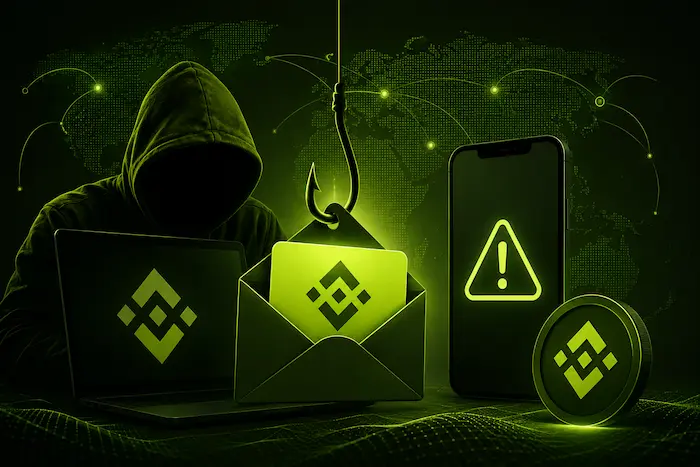
Binance has alerted crypto users on Sept. 3 about the increasing phishing attacks with fake security alerts. The campaign employs an urgent SMS and a shortened URL, which poses risks for users who share their credentials and authentication data.
Fake alerts leverage concerns about account security.
Binance stated that the fraudsters are sending text messages that mimic Binance security-related alerts. The messages are usually about changes to the account or possible login.
Phishing texts often look like urgent account alerts, but their goal is simple: get you to click before you think.
Learn the common warning signs and take 3 practical steps to better protect your account 👇 https://t.co/g9c5h5HxtV
— Binance (@binance) September 3, 2026
Then recipients are directed to confirm or retrieve their accounts via an embedded link. But such links may connect to counterfeit sites, which mimic Binance login or verification pages. The attackers rely on urgency to encourage immediate action. Consequently, users may click before checking the message through an independent channel.
Binance said it does not ask customers to authenticate or secure accounts through links sent by text message. Users should instead open the official Binance application or website directly.
The exchange did not disclose how many users received the messages. It also provided no specific figure for losses linked to this latest campaign.
Binance details safeguards against account theft
Binance phishing attacks can expose users to credential theft when victims enter information on fraudulent websites. Attackers may then attempt to access accounts or redirect cryptocurrency withdrawals.
Binance suggested a number of account safeguards to minimize those risks. Users can set up a Withdrawal Address allowlist that will only accept payments from addresses that have been approved previously.
This feature adds another layer of protection following an account compromise. But, the user should take care of the accounts and authentication procedure used to modify the allowlist. Binance also has an Anti-Phishing Cod. A distinctive code is generated by the user and is visible in a genuine Binance communication.
An early warning can be given with the help of a missing or incorrect code. However, users are advised to confirm suspicious messages via official means. These measures therefore work best when users combine them rather than rely on one protection.
Earlier campaigns show a persistent threat
The latest warning follows previous scams that used Binance branding to target cryptocurrency holders. Australian authorities reported spoofered messages in 2025 to look like messages from Binance in ongoing threads.
Those messages were misleading and said that there were security issues in customer accounts. The method illustrated the possibilities of scammers to use familiar communication channels to gain credibility.
In 2023, Binance was also a victim of impersonation scams in Hong Kong. Eleven users reportedly lost about $446,000 after receiving fraudulent messages demanding account verification.
The scams show why users should treat unexpected security warnings cautiously. A familiar logo, convincing wording or apparent message thread does not establish authenticity.
Binance phishing attacks are also a move towards smishing. This approach involves sending victims direct text messages rather than email messages.
The higher authentication requirement due to regulatory pressure
As the threat continues to grow, there has been increased focus on the need for better authentication on digital-asset platforms.
In July 2026, the Securities and Futures Commission (SFC) of Hong Kong has implemented a new authentication system for the securities and futures sector. Licensed cryptocurrency platforms and brokers received 12 months to replace vulnerable authentication methods.
The standards target methods based on SMS, email and application-generated one-time codes. Regulators instead want platforms to adopt phishing-resistant authentication.
For users of Binance, the biggest issue is to prevent themselves from falling for fraudulent links and ensuring access to their Binance accounts. If users have already filled data on a suspicious website, please reach out to Binance support using the official application.
They should also not send any more emails to the sender. Never disclose passwords, recovery phrases or authentication codes to anyone who asks for them.
Conclusion
Binance phishing attacks are an example of the fact that scammers are still exploiting fear of account security to trick cryptocurrency users. The new campaign features effective messaging, shorter URLs, and urgent calls-to-action to spur quick action.
Binance has advised users not to click on links in unsolicited messages and to log in directly to its platform. Extra safeguards such as withdrawal address control and anti-phishing properties can offer extra protection.
But verification of the users stays at the heart of the fight against account breaches. Cryptocurrency users are being increasingly pressured to become more security conscious with the regulators pushing exchanges to further implement authentication measures.