The crypto sector is witnessing an uptick in the demand for certain altcoins amid Bitcoin crossing the $80,000 mark in August 2026, though the altcoin season has not been officially declared yet.
Bitcoin continues to rule the roost, with its dominance hovering around 57%, with the Altcoin Season Index on CoinMarketCap standing at less than the 75 threshold.
The difference is relevant while choosing the most interesting altcoins for 2026, as the current conditions on the market suggest focusing on those coins that have sufficient liquidity, network activity, milestones in development, institutional presence, or particular use cases.
Market statistics show selected gains in altcoins.
The latest figures from CoinGecko suggest the crypto market capitalization is currently estimated at around $2.72 trillion. Bitcoin occupies 57.4%, while Ethereum takes approximately 10.8%. The total amount of stablecoins stands at around $306 billion, which makes up about 11.25%.
According to an article published by Reuters on August 25, Bitcoin rose to the level of $80,000, hitting the highest level in the last five months.
However, according to the Altcoin Season Index, this kind of participation still lacks breadth. The index measures the proportion of the top 100 cryptocurrencies whose price has shown superior performance relative to Bitcoin on a 90-day trailing basis. A minimum level of 75% is needed for an altcoin season designation, while recent levels have been close to 40%.
The point is that each individual cryptocurrency can see robust appreciation, while the majority of large-cap altcoins keep lagging behind Bitcoin. It means that the breadth of the market plays a role in evaluating the best altcoins for 2026.
Altcoins to watch in 2026 consist of existing and upcoming networks.
The August watchlist features big caps and upcoming networks.
| Altcoin | Key August metric or development |
| Solana | About $59.6B market cap and $3.6B daily volume |
| XRP | Nearly $93B market cap and $5.8B+ daily volume |
| BNB | About $94.2B market cap and Pasteur hard fork |
| Chainlink | About $8.92B market cap and $455M daily volume |
| Hyperliquid | About $18.3B market cap and $1.2B+ daily volume |
| Cardano | Van Rossem upgrade and Leios development |
| Sui | tZERO digital-securities infrastructure and quantum-safe work |
| Avalanche | About $3.2B market cap and tokenization activity |
| Hedera | About $3.44B market cap and enterprise-focused activity |
| Ethereum | Benchmark for ETH/BTC and broader altcoin rotation |
Solana and XRP retain significant market relevance.
Solana remains one of the largest smart-contract networks on the watchlist. CoinGecko’s August 27 data placed SOL’s market capitalization at approximately $59.6 billion, with about $3.6 billion in 24-hour trading volume. Its scale and liquidity make it relevant when evaluating whether capital is moving beyond Bitcoin and Ethereum.
XRP also remains prominent, with CoinGecko placing its market capitalization near $93 billion on August 25 and reported daily volume above $5.8 billion.
Ripple announced on August 3 that it had invested in ZILO and Licuido, adding regulated transfer-agency, issuance, and collateral-mobility capabilities to infrastructure built around the XRP Ledger.
BNB and Chainlink bring different catalysts.
BNB was another major asset to monitor following the Binance hard fork. BNB Chain scheduled the mainnet activation for August 25, with the upgrade including changes involving bridge security, staking, and governance.
BNB Chain also reported higher transaction-throughput benchmarks on its testnet. CoinGecko put BNB’s market capitalization at about $94.2 billion on August 27.
Chainlink represents a different type of infrastructure. LINK is concerned with oracle services and cross-chain interoperability, with its importance relating to applications of blockchains that can utilize outside information.
CoinGecko’s August 28 data showed a market capitalization near $8.92 billion, a closing price of $11.43, and a daily volume of approximately $455 million.
Hyperliquid, Cardano and Sui reflect newer developments.
Hyperliquid has emerged as a significant market asset despite being newer than several established networks. CoinGecko reported approximately $18.3 billion in market capitalization and more than $1.2 billion in daily volume on August 27.
However, in July, its Van Rossem hard fork was introduced via Protocol Version 11 after on-chain governance approval, and work on its Leios scaling roadmap proceeded in August.
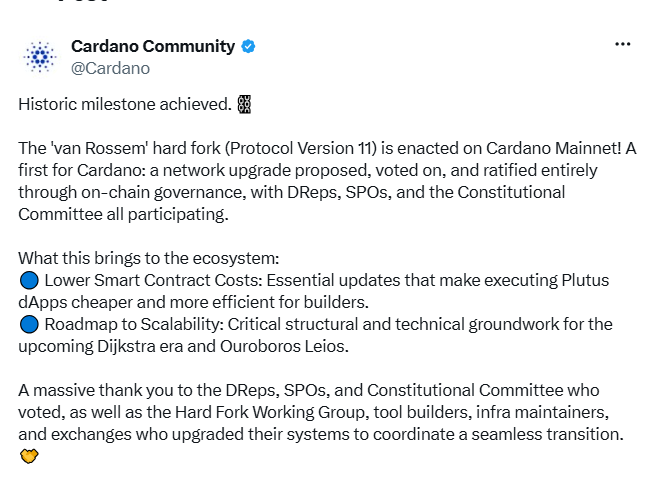
Source: Cardano Community
Cardano also reported an IBC connection with Injective on testnet. ADA’s market capitalization stood at about $8 billion in late August.
Sui has attracted attention from both developers and financial infrastructure providers. The Sui Foundation announced on August 25 that tZERO was bringing regulated digital-securities infrastructure to the network.
Sui has also outlined plans involving NIST-approved post-quantum security schemes, with quantum-safe vaults targeted for mainnet during 2026 subject to audits and testnet feedback.
Avalanche, Hedera, and Ethereum complete the picture
Avalanche remains relevant to tokenization and institutional blockchain activity. CoinGecko recorded a market capitalization of approximately $3.2 billion and daily volume near $173 million on August 27. Tokenization activity reported by Sui also involved Avalanche alongside Sui, Ethereum, and Solana.
Hedera offers a smaller-capitalization network with an enterprise-oriented focus. Its August updates included activity involving tokenized securities, digital identity, AI and regulated financial applications.
HBAR had a market capitalization of roughly $3.44 billion and a daily volume of approximately $66.6 million on August 27.
Ethereum is used as the benchmark instead of just another asset on the list. The ETH/BTC ratio is especially useful in determining whether altcoin rotation is occurring. Recent market analysis cited Ethereum’s weakness against Bitcoin as one reason the broad altcoin season remained delayed.
Three indicators remain central to the watchlist.
- Bitcoin dominance: A measure of BTC’s share of total cryptocurrency market capitalization.
- ETH/BTC ratio: An indicator of the relative strength of Ethereum compared to Bitcoin.
- Altcoin Season Index: Measures how many of the top 100 cryptocurrencies outperform Bitcoin over 90 days, with 75% required for an official altcoin-season reading.
These indicators help separate isolated rallies from broader market participation. Historical comparisons also require caution because today’s market includes spot ETFs, institutional custody, tokenized assets, mature derivatives markets, and thousands of protocols.
Conclusion
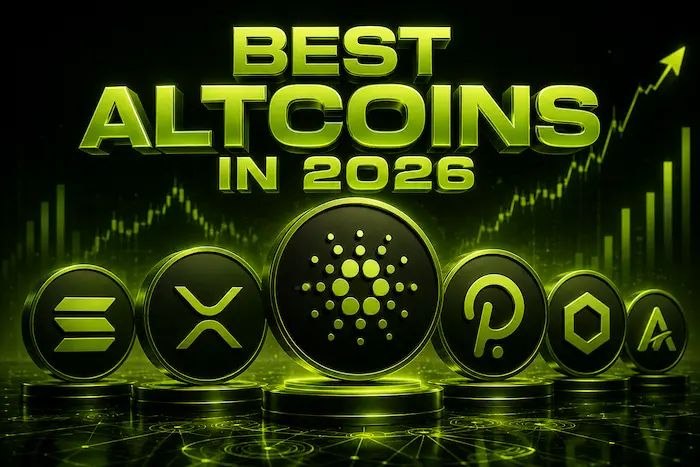
The best altcoin 2026 watchlist reflects a market where individual networks can attract attention without a confirmed broad altcoin cycle. Solana, XRP, BNB, Chainlink, Hyperliquid, Cardano, Sui, Avalanche, and Hedera each have identifiable developments or market activity, while Ethereum remains an important benchmark.
For August, Bitcoin dominance and the Altcoin Season Index continue to show that market strength remains selective rather than broadly distributed.
FAQs
What is the Altcoin Season Index threshold?
Altcoin season by CoinMarketCap is defined as 75 or more out of the top 100 cryptocurrencies outperforming Bitcoin for 90 days.
Does an altcoin season really happen in August 2026?
No. The source cites recent index readings in the Altcoin Season Index below 75, at around 40.
Why does the watchlist include Ethereum?
Ethereum acts as a benchmark for measuring altcoin rotation in general with regard to the ETH/BTC ratio.