
The history of altcoin seasons includes switching of cryptocurrency market leaders, with Bitcoin taking the lead first and then Ethereum, among others.
Data from 2017 and 2021 indicate phases when BTC dominance decreases due to capital flowing to ETH and other crypto tokens; however, 2025 has shown that a decline in BTC dominance on its own does not define market rotation.
Current indicators around mid-August 2026 similarly show why several measures need to be assessed together before describing market conditions as an altcoin season.
How Ethereum fits into an altcoin season
Ethereum has frequently occupied an intermediate position in the capital-rotation sequence. According to CoinMarketCap, this refers to an occurrence whereby Bitcoin moves first, followed by a move higher from Ethereum and then from other blockchain communities.
The ETH/BTC ratio is one of the ways used to identify such a situation. It indicates a high level of risk-taking beyond BTC when Ethereum starts outperforming Bitcoin. An improved ETH/BTC ratio can further confirm such a situation together with low Bitcoin dominance and altcoin participation.
Indicators which may be used to evaluate rotation
- Bitcoin dominance is the percentage of Bitcoin’s market cap in total cryptocurrency market cap.
- ETH/BTC is the relative strength of Ethereum against Bitcoin.
- Market breadth is the extent to which altcoins are outperforming Bitcoin.
2017 saw a quick expansion from Bitcoin
The year 2017 is an example from history where there was a decline in Bitcoin dominance in the expanding cryptocurrency market. CoinGecko recorded average Bitcoin dominance of 58.5% for the year, while the measure reached a low of 37.5%.
The decline occurred alongside rapid growth in the initial coin offering market. Capital flows went to Ethereum tokens and other blockchain projects, making markets beyond Bitcoin.
The market environment in 2017 was different from that in other cycles. The number of established crypto assets was smaller, institutional participation was less developed and derivatives markets were less mature. These conditions allowed capital to move quickly into newly issued tokens.
The historical episode therefore shows the relationship between declining Bitcoin dominance and broader participation without establishing that the same market structure will recur.
2021 delivered a broader modern rotation
The 2021 cycle produced another significant period of altcoin outperformance. CoinGecko reported that Bitcoin dominance stood at 69.5% at the beginning of the year before ending at 38.2%.
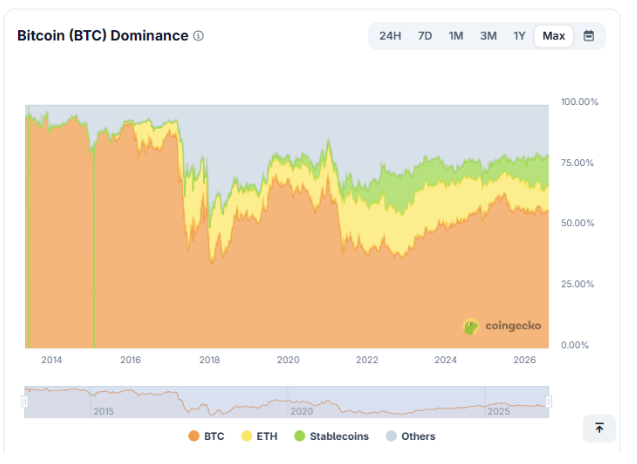
Source: Coingecko
Ethereum also significantly outperformed Bitcoin during the period.ETH ended the year 2021 at $3,715 with gains of 403% for the year, according to the CoinGecko annual report. Coinbase reported in July 2025 that altcoin market capitalization had nearly doubled from April levels, while Bitcoin dominance remained above 60%
CoinMarketCap analysis recognized the first half of 2021 as an altcoin season. The top 100 altcoins gained 174% during that period, compared with approximately 2% for Bitcoin. Bitcoin dominance declined from 61.9% in early February to around 40% in mid-May.
The data show that altcoins can outperform substantially even when Bitcoin remains part of a broader market advance.
2025 showed that declining dominance is not enough
The 2025 market provided a different pattern. Based on the data from CoinGecko, Bitcoin dominance increased to 59.1% in Q1, adding 4.6 percentage points owing to the fall of altcoins.
In Q2, Bitcoin dominance was 62.1%. The price of Bitcoin climbed back above $100,000 to reach a record high in its history.
Conditions changed in July. CoinDesk reported on July 21 that Bitcoin dominance had fallen from a June peak near 66% to approximately 61.75%. The report also identified increased attention toward Ether, XRP, Solana, and Dogecoin and noted a rebound in the ETH/BTC ratio.
Coinbase reported in August that Bitcoin dominance had fallen from approximately 65% in May to about 59%. However, the CoinMarketCap Altcoin Season Index remained in the low 40s, below its 75 threshold. At the same time, total market capitalization for altcoins rose by over 50% from early July to about $1.4 trillion on August 12.
Liquidity and leverage can shape the rotation
DeFi total value locked had also increased roughly 70% from April and exceeded $130 billion during July.
Derivative positioning provided another part of the market picture. Coinbase reported an altcoin open-interest dominance ratio of approximately 1.6, a level associated with previous market shakeouts.
Such classification differentiates growth in the spot market from price change driven by leverage. High exposure to derivatives may come along with quick price gains, but it could also lead to greater risks of liquidations upon reversal of prices.
Current numbers are below the levels associated with the altcoin season
Based on the latest global market data presented by CoinGecko, in mid-August 2026, Bitcoin accounted for around 56.85% of the total crypto market cap. Recently reported numbers related to the CoinMarketCap Altcoin Season Index were below 75.
These figures do not establish a broad altcoin season under the conventional index methodology. They instead show that selective altcoin strength and a market-wide period of relative outperformance are different conditions.
The 75-point threshold also reflects performance over a 90-day period rather than a forward-looking guarantee. Bitcoin dominance, ETH/BTC, altcoin market capitalization, and market breadth therefore provide separate measures for assessing whether capital rotation is broadening.
| Indicator | What the provided data show |
| Bitcoin dominance | About 56.85% around mid-August 2026 |
| Altcoin Season Index | Below the 75-point threshold |
| ETH/BTC | A measure of Ethereum’s relative performance |
| Altcoin market capitalization | About $1.4 trillion on August 12, 2025 |
FAQs
What is an altcoin season?
It refers to a period when a broad group of altcoins outperforms Bitcoin over the measured period.
Does falling Bitcoin dominance confirm an altcoin season?
No, the 2025 data demonstrated that Bitcoin dominance can drop even when the Altcoin Season Index is still under its 75 mark.
Why is ETH/BTC ratio important?
This ratio shows the performance of Ethereum against Bitcoin and could serve as an additional signal for capital moving up the risk curve.
What would prove broader rotation?
This set of criteria highlights declining Bitcoin dominance, a strong ETH/BTC ratio, growing altcoin market cap, and broader market participation as complementary signals.