

DeFi yield is increasingly linked to identifiable sources of economic activity, with major platforms generating returns through lending interest, Ethereum staking, treasury assets, institutional credit, and derivatives.
As of September 2026, Aave, Sky, Ethena, Pendle, Morpho, Maple Finance, Ondo Finance, Centrifuge, Lido, and Euler represent several distinct approaches to generating real yield protocols.
The core difference lies in the nature of returns. “Real yield” is considered the income generated via protocol operations, interest, staking rewards, transaction fees, or tangible assets rather than income generated mostly via issuance of governance tokens.
The platforms are also associated with different levels of risk. Lending protocols depend on borrowing requirements and collaterals, while Treasury protocols are related to traditional fixed-income assets. Other approaches rely on derivatives markets, loans from institutions, or proof-of-stake rewards offered by Ethereum.
How Real Yield Protocols Offer Income
Aave still constitutes one of the main lending protocols providing yield in the DeFi sphere. In this case, users provide assets to the lending pool, while borrowers offer collateral and earn interests.
According to the documentation of the Aave protocol, supply rates change based on utilization and thus depend on each specific market.
Euler uses a similar borrower-interest model but provides configurable credit markets. Its system allows market creators to establish parameters involving collateral relationships, interest rates, and loan-to-value levels. That flexibility means individual markets can have different lending conditions and associated risks.
Morpho also focuses on customizable lending markets. DeFiLlama currently reports more than $9 billion in Morpho TVL across multiple networks and more than $18 million in 30-day fees. The figures reflect activity across markets with different assets, collateral, and risk configurations.
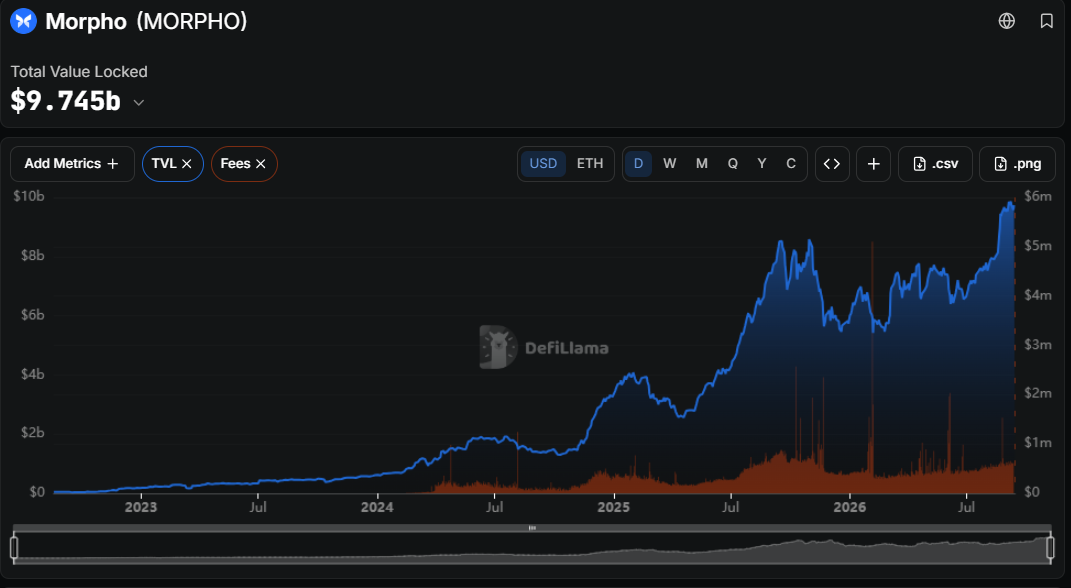
Source: DeFiLlama
Sky takes a different route through its sUDS product. Sky currently displays a 3.60% APY for its savings rate, which is funded from aggregate protocol surplus. The rate can change through governance decisions, distinguishing it from lending products whose returns are directly tied to borrower utilization.
| Protocol | Main yield source | Reported figure |
| Aave | Borrower interest | Variable supply rates |
| Sky | Protocol surplus | 3.60% APY |
| Morpho | Lending markets | More than $9B TVL |
| Maple Finance | Institutional credit | About $2.9B TVL |
| Ondo Finance | U.S. Treasuries and bank deposits | About $2.22B USDY TVL |
| Centrifuge | Real-world assets | About $1.53B TVL |
| Lido | Ethereum staking | Staking rewards |
Expansion of Treasury Assets and Institutional Credit
The Ondo Finance protocol ties on-chain yield to traditional fixed-income markets using USDY, which exposes users to short-term United States Treasuries and bank deposits. The total USDY TVL was ~$2.22 billion as of September 9, 2026, with the percentage of U.S. Treasury bonds underlying the USDY being approximately 96.4%.
Centrifuge takes a broader real-world asset approach, providing infrastructure for tokenized assets that include private-credit products. DeFiLlama reports approximately $1.53 billion in TVL, $5.91 million in 30-day fees and an average supply APY of about 8.91% across its listed pools.
Maple Finance focuses on institutional digital-asset lending. Its documentation says syrupUSDC and syrupUSDT primarily use overcollateralized institutional loans, while other strategies include futures basis trading and selected DeFi liquidity positions. DeFiLlama currently reports about $2.9 billion in Maple TVL.
These models demonstrate why real yield protocols cannot be compared solely through their advertised rates. Maple identifies smart contract, default, and loss risks, while tokenized real-world asset products remain connected to the assets and markets supporting their returns.
Staking and Derivatives Add Different Yield Sources
Lido’s stETH represents ETH deposited into Ethereum staking through the protocol. Lido says stETH holders receive rewards or penalties based on validator performance, with staking rewards reflected through the token’s rebasing mechanism. The resulting yield comes from Ethereum’s proof-of-stake network rather than governance-token distributions.
Unlike USDY, Ethena takes a crypto-native route via USDe and others. According to DeFiLlama, the total value locked and revenue generated by Ethena amount to billions of dollars. The profitability of Ethena may come from derivatives markets, funding, and the hedging process.
Pendle does not establish an independent yield source in the same way as a lending platform. Instead, it separates yield-bearing assets into principal tokens and yield tokens. Users can therefore trade exposure to principal and future yield, creating fixed or variable yield strategies around the underlying assets.
What Defines Real Yield in DeFi?
The common feature across these models is that returns can be connected to an identifiable economic source. The interest of borrowers drives Aave and Euler, Lido shares the rewards earned from staking Ethereum, and Ondo ties yields to assets from the Treasury.
The savings rate in Sky is a result of the protocol’s profits, while Maple relies on institutional credit. However, Centrifuge converts physical assets into tokens, and the approach for Ethena involves derivatives.
The distinction becomes particularly relevant when comparing advertised APYs. A stated yield does not by itself explain where the return originates or what risks accompany it. The underlying models can involve credit exposure, liquidity conditions, smart contracts, validator performance, or derivatives markets.
Conclusion
Real Yield Protocols now span several distinct sources of income, including lending, Ethereum staking, protocol surplus, institutional credit, Treasury assets, and derivatives. Aave, Sky, Ethena, Pendle, Morpho, Maple Finance, Ondo Finance, Centrifuge, Lido, and Euler illustrate how differently yield can be generated across DeFi.
The supplied data shows that each model connects returns to different economic activities and carries its own set of credit, liquidity, market, and smart-contract risks.
FAQs
How does Aave generate yield?
Aave generates supplier returns from interest paid by borrowers. Supply rates change according to market utilization.
Which yield protocol gets backing from the Treasury?
Ondo Finance’s USDY is an instrument for investment into short-term U.S. Treasuries and bank deposits, which has about 96.4% of its underlying positions invested in U.S. Treasuries.
How does the staking yield get generated from Lido?
Lido stETH is a token which represents ETH deposited in Ethereum staking.