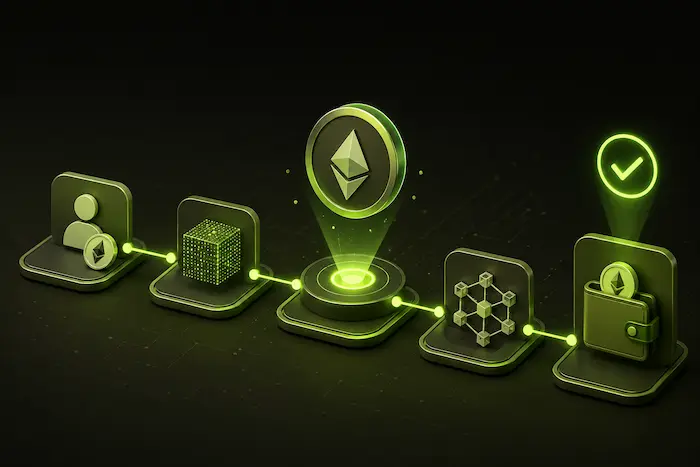
Cryptocurrency Transaction Verification refers to the process used by blockchain networks in verifying the transactions of cryptocurrencies without having to involve any banks or centralized institutions.
In every transaction involving cryptocurrencies, there is a need to ensure that there is verification in order to guarantee that there will be no double spending.
A wallet is used to create a transaction when a user sends cryptocurrency. The sender types the receiver’s wallet address, sets the amount, and sends the funds via a private key.
Once this is done, a digital signature is formed as evidence of the transaction being validated by the account holder.
Verification of Cryptocurrency Transactions
For any transaction to be added to the blockchain, there are several processes that have to take place on the computer systems linked to the system.
These include:
- Digital Signature Validation
- Available Funds Verification
- Adherence to Network Rules
- No Other Use of the Funds.
If the transactions qualify through this validation process, the transactions will be accepted by the network and the next process will follow.
The Mempool
When transactions have been validated, they will then be sent to the mempool or the memory pool, a queuing list for transactions awaiting inclusion in blocks.
Pending transactions can be submitted to the validators and miners for transaction verification. When there is limited availability, higher-returning transactions can be prioritized.
During increased usage of the network:
- The volume of transactions pending in the mempool increases.
- Confirmation time might become longer.
- Transaction fees may continue to increase.
Mempool aids in organizing the transactions before they are placed into the blockchain.
Methods for Cryptocurrency Transaction Verification
Consensus mechanisms help in reaching an agreement amongst the nodes in a blockchain network concerning the transactions it should accept and not accept. The network participants do not depend on a central authority to agree on actions, but follow rules that are agreed upon.
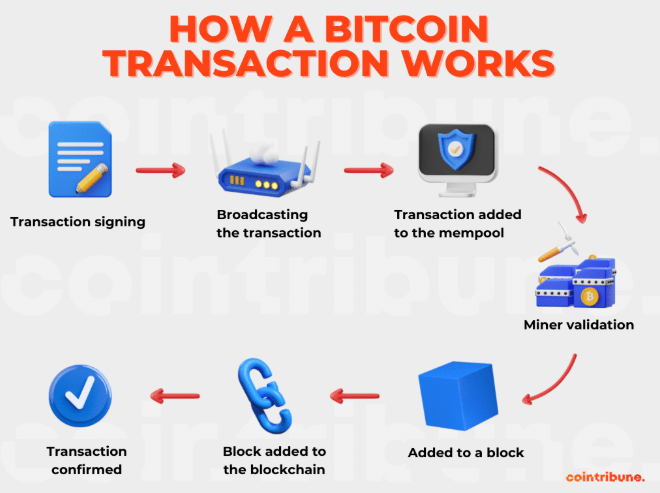
Source: Cointribune
The two most popular consensus mechanisms are Proof of Work and Proof of Stake.
| Consensus Mechanism | Verification Method | Examples |
| Proof of Work (PoW) | Miners solve mathematical problems to earn blocks | Bitcoin |
| Proof of Stake (PoS) | Validators validate blocks by committing cryptocurrency | Ethereum, Solana, BNB Chain |
Proof of Work
Bitcoin employs the Proof of Work (PoW) system.
Under this system:
- Miners collect pending transactions
- Miners race against each other to crack maths problems.
- A new block is formed by the miner who wins the mining process.
- Nodes evaluate the solution and accept the block provided that it clears their validation process.
The process offers network security without losing a permanent record of transactions.
Proof of Stake
Proof of Stake does not use miners, it uses validators.
Validators stake the cryptocurrency to the network and validate the blocks based on the protocol rules. Validators who do not comply with network requirements can be penalised by the process called slashing.
Ethereum, however, has adopted proof of stake since its September 2022 Merge. Another blockchain technology which uses the Proof of Stake validation mechanism includes Solana and BNB Chain among others.
How Blockchain Prevents Double Spending
Double spending is one of the key challenges faced by transaction validation in cryptocurrencies.
Double spending refers to spending the same cryptocurrency twice. Blockchain networks prevent such cases from happening through the maintenance of a history of the verified transaction.
Participants on the network check the history of transactions on the blockchain and approve only those that have never occurred before.
The transaction history is permanent, and therefore, it becomes harder to modify past transactions once they are verified.
Transaction Confirmations Explained
The inclusion of a transaction in a block signifies its first confirmation.
There are additional confirmations that come when new blocks are added on top of the block that contains that particular transaction. As more confirmations pass, the security of the transaction becomes better and also becomes much harder to reverse.
There are different confirmation demands by different blockchain networks.
| Blockchain Network | Confirmation Process |
| Bitcoin | For big transactions, there are usually between 3 and 6 confirmations. |
| Ethereum | some services are waiting for the blocks and others waiting for finality |
The number of confirmations needed is usually dependent on the value of the transaction and the service receiving the funds’ guidelines.
What is the significance of verifying cryptocurrency transactions?
Verification of cryptocurrency transactions will ensure that the blockchain network operates without any centralized authority for approving the transactions.
Functions of verification include:
- Making sure that the money belongs to the entity.
- Preventing double spending.
- Maintaining the records of transactions.
- Security of the blockchain networks.
- Ensuring the validity of the transaction.
All these functions combined enable the working of the decentralized blockchain networks.
Conclusion
Cryptocurrency transaction verification is a complicated task that requires various elements such as digital signatures, node validation, mempool verification, consensus, and transaction confirmation.
FAQs
What is the process of verifying cryptocurrency transactions?
The process of verifying cryptocurrency transactions takes place through a blockchain network before they are included in the blockchain.
What is Mempool?
Mempool is a storage area which holds valid transactions that have not yet been mined.
Why should there be confirmation for transactions?
Confirmation makes reversing the transactions included in the blockchain difficult, thus securing them.
How does blockchain avoid the double spending problem?
Blockchains are able to verify the transactions and accept only the cryptocurrencies that have not been spent.