
With the rise in popularity of Bitcoin currency worldwide, it becomes apparent that there is a need for fast and relatively cheap transactions. The Lightning Network may be seen as one of the most common scaling solutions that have been developed above the Bitcoin blockchain.
The Lightning Network is basically an extra layer added to the Bitcoin network. It was created as a Layer 2 protocol to solve one of the major problems of the blockchain, namely its ability to conduct only a certain number of transactions directly on it.
With time, the growth of the popularity of Bitcoin made people compete for space in its blocks, which caused congestion in some cases and led to an increase in transaction fees. The Lightning Network appeared as a way to make transactions faster without placing too many operations into the block itself.
By using payment channels, people can move their money away from the blockchain and then pay back the debt once all transactions are finished.
What Is Lightning Network?
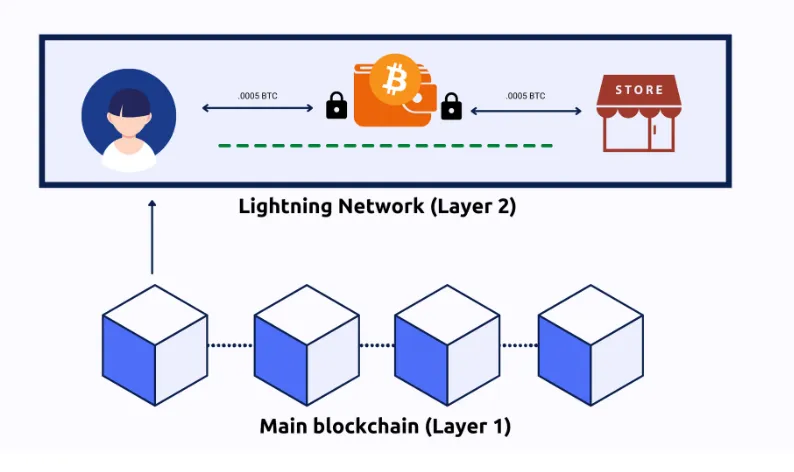
Lightning Network is an off-chain payments system independent of the Bitcoin blockchain network, yet linked to it.
Individuals join the network by creating payment channels through certain transactions that are registered on the Bitcoin blockchain.
Source: Bitpay
Within such channels, individuals can exchange assets without registering all their transactions on the blockchain. It’s just the opening and closing of these payment channels that will be registered on the blockchain.
The entire process involves smart contract systems, which allow participants to update balances without requiring any form of trust between them.
At any time, one can terminate the connection and settle the current balance on the Bitcoin blockchain.
Why Is There a Need for Lightning Network in Bitcoin?
New blocks in the Bitcoin network are created every 10 minutes and cannot accept more than a certain number of transactions. During times when there is an increase in demand, users tend to bid higher in order to get their transactions confirmed through payment of higher fees.
As per data from the Lightning Network statistics, the fees for carrying out a transaction during busy periods were estimated to exceed $50 in instances like 2017’s bull run and in April 2021.
Such transactions were too expensive for small-value transactions and were therefore not economical.
Lightning Network and Payment Channel
Lightning Network operates via a payment channel opened between participants. The initial amount of funds gets transferred to the multisig address controlled by both parties. Within the payment channel, each participant may change their balance as often as they wish without involving the blockchain network. This is possible through cryptography, like HTLC.
Should one of the participants reveal a stale state of the channel, then certain penalties are enforced so that the other participant is able to protect themselves from any fund loss. The penalty system ensures that people do not engage in cheating when using payment channels.
Channels may be shut down simultaneously by both parties or individually if one party stops responding.
Benefits of the Lightning Network
There are several features that separate the Lightning Network from other payment systems using Bitcoin:
| Feature | Bitcoin Blockchain | Lightning Network |
| Time for Settlement | Around 10 minutes per block | instant |
| Cost of Transaction | Variable | Lower transaction fees |
| Micropayments | Unfavourable | Supports small transfers |
| Transaction | On-chain | Off-chain |
| Scalability | Limited scalability | Better scalability |
The ability to use micropayments is one of the benefits of the Lightning Network. The cost of transactions on the main blockchain of Bitcoin can be high because of congestion, while the payments through Lightning channels can even include one satoshi.
In addition, the network provides even greater transaction privacy, as transactions through the channels do not appear on the blockchain like normal blockchain transactions.
Adoption and Latest Trends
By the beginning of 2025, the network had approximately 16,000 nodes and 75,000 payment channels. The number of routed transactions rose by 1,200% as compared to 2021.
The capacity of the network touched 5,637 BTC by the end of 2025. However, the capacity figures could be underreporting private or custodial channels. According to Coinbase, the Lightning Network accounts for about 15% of all Bitcoin withdrawals.
Platforms using the Lightning Network besides the ones mentioned include Binance, Kraken, OKX, Revolut, and Cash App. Another significant milestone was achieved by the deployment of Taproot Assets in January 2025.
As a result, the network acquired the ability to process transactions denominated in USDT over the network.In another highlight for the year, Lightning Network made 4,187 payments in just eight hours at the Bitcoin 2025 conference.
Challenges Faced by the Lightning Network
Even with developments, the Lightning Network still faces various challenges.Channel management is one such challenge, where users must ensure sufficient liquidity in channels, which is harder than regular Bitcoin transactions.
Another operational issue with the network is payment routing, which requires sufficient liquidity along the routes.
However, it is also possible that the network will rely more on large routing nodes with high liquidity. According to Lightning Network statistics , excessive concentration in large routing hubs can affect connectivity if such nodes are out of order.
Conclusion
The development of Lightning Network technology emerged as a solution to the issue of Bitcoin’s small transaction throughput by moving the transaction process from the blockchain into off-chain payment channels.
FAGs
What is the Lightning Network?
It is a Layer 2 payment protocol implemented atop the Bitcoin network using off-chain payments through payment channels
Why did the Lightning Network emerge?
The Lightning Network was created to increase the scalability of Bitcoin.
Is the Lightning Network based on Bitcoin?
Yes. Bitcoin is used to power the payment channels of the network.