The regulatory environment for cryptocurrencies continues to change as regulators seek to implement tighter rules for cryptocurrency exchanges and traders. A new demand increasingly being observed from virtual asset service providers and crypto exchanges is the verification of wallet owners before executing transactions. This is where the Satoshi Test has come into play as an important compliance tool.
As cryptocurrency transactions continue to gain more regulation, the Satoshi Test is becoming more relevant as a component of cryptocurrency compliance processes.
The purpose of the verification process is to ensure that the wallet belonging to a particular user is under his control before carrying out any transactions. The process does not involve requesting access to the user’s private key or any other sensitive wallet data but requires making a small cryptocurrency transaction instead.
Moreover, the process has been gaining popularity in recent times due to its compliance with the Travel Rule issued by FATF. More jurisdictions have aligned their legislation with the FATF standards and exchanges are introducing their wallet verification process to assist compliance reviews and transaction monitoring.
What is the Satoshi Test?
Satoshi Test is a cryptocurrency platform’s wallet ownership verification method. This process entails transfer of a very small amount of cryptocurrency to the wallet address given by the customer. The wallet owner has to then confirm the receipt of the precise amount he or she has received, or return the same amount to the site.
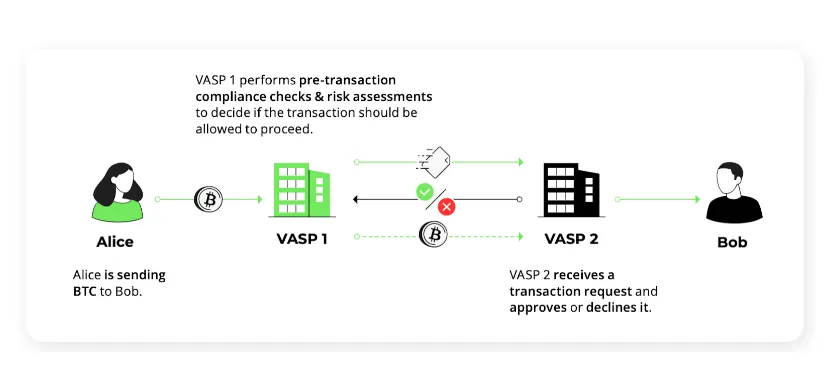 Source: Notabene
The smallest unit of bitcoin is “satoshi. To check the transaction, Bitcoin has a unit of 100 million satoshis, which allows users to send very small transactions.
How Does the Satoshi Test Work?
| Step | Action |
| Step 1 | The Customer requests a withdrawal to an external wallet. |
| Step 2 | Exchange sends a small cryptocurrency transaction |
| Step 3 | Customer acknowledges that the correct amount is received or returns. |
| Step 4 | Verification is now recorded in exchange as evidence of wallet ownership. |
Once verified, the exchange may keep a record of the exchange for compliance and audit purposes. The process offers a verifiable way to assert wallet ownership whilst preserving wallet security.
Why is the Travel Rule Important?
The Financial Action Task Force created the Travel Rule to enhance the transparency of digital asset transfers. The rule stipulates that financial institutions and crypto service providers report and collect information regarding transactors if they make transfers of a specific amount or more.
The information provided states that the Travel Rule is supposed to contribute to solving the following:
- Money laundering
- Terrorist financing
- Fraudulent transactions
- The transfer of funds is done anonymously.
This means that exchanges might require you to confirm the details of your identity and the ownership of your wallet before completing some transactions.
The Satoshi Test and how it aids Travel Rule compliance.
The Satoshi Test is a method of proving to an exchange that the exchange has the control of the wallet that it claims it has. This verification process assists the compliance process in several ways.
Wallet Ownership Verification
The process provides evidence that a user has direct access to the destination wallet.
Regulatory Documentation
Verification records provide documentation for exchanges to use during compliance reviews and during regulatory examinations.
Fraud Prevention
This wallet confirmation prevents the transfer of money being sent to wallets, which are not under the recipient’s control.
Audit Readiness
The verification history provides a history of verification that can be kept as compliance records. These records can be useful for previously regulated crypto businesses to ensure internal controls and compliance requirements.
With changing Travel Rule requirements, major cryptocurrency exchanges have implemented wallet verification processes. Binance has introduced wallet ownership verification in some regulated markets, as indicated in the information provided. For other transactions, Coinbase uses wallet verification checks.
Compliance technology companies like Notabene and TRM Labs are assisting exchanges in automating Travel Rule workflows and wallet verification processes. These systems are increasingly integral to the compliance framework in digital asset markets as expectations of regulators grow.
The main challenges encountering the SATOSHI TEST are as follows:
While this process has compliance advantages, there are some operational issues still to be resolved.
| Challenge | Description |
| Slower Transactions | First-time wallet verification can add extra processing time |
| User Experience | Some customers may be unfamiliar with verification procedures |
| Wallet Limitations | Certain wallets may not offer simple micro-transaction tracking tools |
| Fraud Risks | Additional compliance measures may still be required |
In addition, there may be additional compliance requirements that must be implemented to address fraud risks. This restriction makes exchanges in most cases to be tied with other identity verification and blockchain monitoring systems as well as wallet verification.
Conclusion
Satoshi Test is a useful technique for verifying wallets that is applied by cryptocurrency exchanges and compliance companies. It allows proving the ownership of the wallets through test transactions.
FAQs
Is Satoshi Test a cryptocurrency transaction?
Yes. It includes sending you some amount of cryptocurrency to verify the ownership of the wallet.
Do you need to disclose your private key for Satoshi Test?
No. You don’t need private keys to conduct the verification process.
Why is Satoshi Test used by cryptocurrency exchanges?
This test is carried out to prove ownership of wallet and meet the regulations such as Travel Rule.