

AI infrastructure is not limited to developing models but is expanding into the area of computing and data and indexing needs. In September 2026, blockchain-based projects are addressing different parts of the infrastructure stack, including GPU capacity, cloud computing, private inference, web data, and blockchain indexing.
CoinGecko currently places the broader artificial-intelligence crypto category at about $17.1 billion in market capitalization. Bittensor and NEAR are among the largest infrastructure-oriented projects in the category, although the networks covered here serve different functions rather than competing within a single market.
The projects span decentralized GPU marketplaces, cloud infrastructure, and specialized data networks. Their roles include supplying hardware for training and inference, coordinating distributed computing resources, protecting sensitive AI requests, and delivering structured data to applications and AI agents.
AI Infrastructure Projects Target Different Network Needs
Bittensor and Render Network address computing requirements through different approaches. The BitTorrent network is based on a subnet design, whereby miners deliver services and validators judge their performance. Its Dynamic TAO model allows subnet value to be determined through market-based staking.
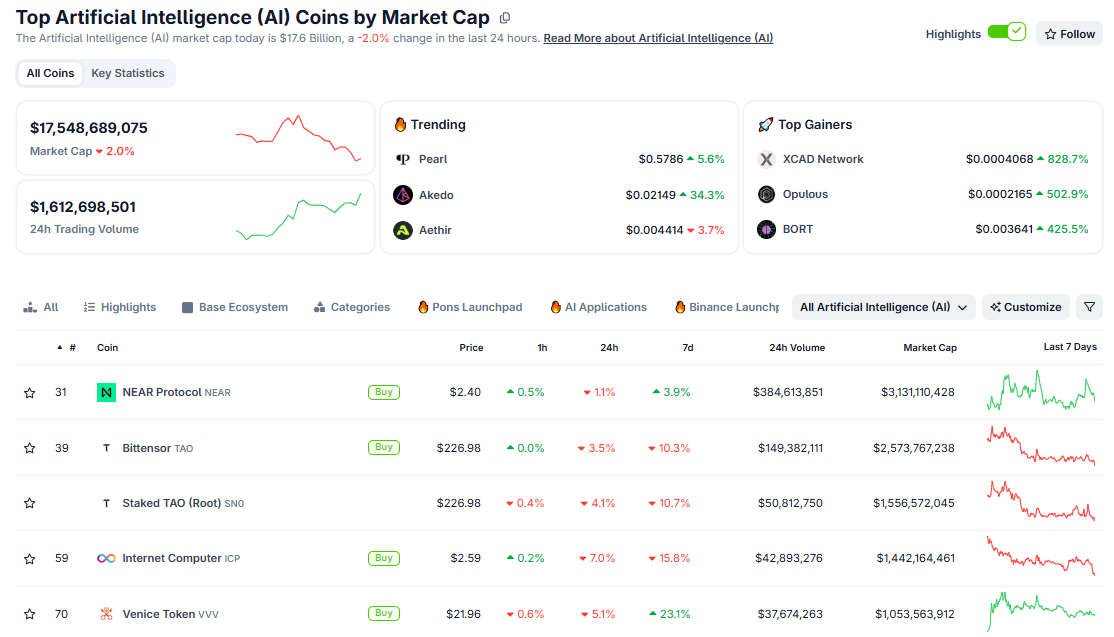
Source: CoinGecko
Individual Bittensor subnets can focus on areas including machine learning, data, and compute. This gives the network a structure in which different digital resources can be evaluated within specialized markets.
Render Network, meanwhile, was developed around decentralized GPU rendering and connects users with distributed computing resources. Its platform uses idle GPU capacity for scalable rendering infrastructure, while the same class of accelerated hardware can also support computational workloads beyond graphics.
Akash Network takes a broader cloud approach by connecting customers that need computing resources with independent providers. Its infrastructure supports GPU deployments for AI training, inference, rendering, and machine-learning workloads.
| Project | Primary infrastructure role | Supplied or supported use |
| Bittensor | Decentralized subnet markets | Machine learning, data and compute |
| Render Network | Distributed GPU capacity | Rendering and computational workloads |
| Akash Network | Decentralized cloud marketplace | AI training and inference |
| io.net | Distributed GPU computing | AI workloads and development |
| Aethir | Distributed cloud compute | AI, gaming and virtualized computing |
Akash also supports NVIDIA GPU configurations ranging from consumer hardware to enterprise accelerators. Its marketplace is designed around competition among providers rather than dependence on one cloud infrastructure provider.
GPU Networks Build Capacity for AI Workloads
Several AI infrastructure projects focus specifically on aggregating GPU resources. io.net combines hardware from data centers, mining operations, and independent providers into a unified computing marketplace, using blockchain-based coordination for matching, verification, and payments.
The network’s published specifications include enterprise GPUs such as H100s and A100S, as well as consumer GPUs. This allows io.net’s infrastructure to address different computing requirements across AI workloads, including larger workloads and lower-cost inference or development tasks.
Aethir uses another distributed cloud model, aggregating enterprise GPU resources for AI, gaming, and virtualized computing. Its architecture includes compute containers, checkers, and indexers that help match workloads and monitor service quality.
Aethir Earth provides bare-metal GPU resources for AI training, fine-tuning, and inference. The project also requires cloud hosts to meet hardware and performance standards, placing service quality alongside access to distributed computing resources.
Theta Network’s EdgeCloud adds another model by combining community-operated edge nodes with cloud and enterprise resources. The platform supports AI model inference, training, containerized applications, persistent storage, and distributed GPU clusters.
Data, Privacy, and Indexing Add Other Layers
Not all AI infrastructure projects focus on hardware. NEAR AI addresses privacy and verifiability through an architecture that uses Intel TDX and NVIDIA confidential-computing hardware to isolate AI requests inside trusted execution environments.
This approach targets workloads where protecting information during inference is a central infrastructure requirement. Unlike GPU marketplaces, it focuses on private and verifiable computation rather than just increasing computing power.
Livepeer has extended its decentralized infrastructure to AI inference. The AI network from Livepeer connects to the network through nodes called AI Gateway nodes and executes the inference jobs on-chain.
Grass addresses another requirement by providing a decentralized layer for accessing public web data. The network facilitates collection of information that can be used by AI systems, placing it on the data side of the infrastructure stack.
The graph focuses on structured blockchain data. Its indexing infrastructure operates across more than 60 networks, while subgraphs and substreams transform blockchain activity into structured information that applications, analysts, and AI agents can query.
The Graph has also introduced AI-native tooling, including MCP-based access that allows AI agents to interact with indexed blockchain data through natural-language interfaces.
FAQs About AI Infrastructure Projects
What are AI infrastructure projects?
They are blockchain-based networks targeting infrastructure requirements such as compute, GPUs, data privacy, inference, and indexing.
How does NEAR AI differ from GPU marketplaces?
NEAR AI focuses on private and verifiable inference using trusted execution environments and confidential-computing hardware.
What role does the graph play in AI infrastructure?
The Graph indexes blockchain data and provides structured information that applications AI agents analysts and other users can query.
Conclusion
AI infrastructure projects are targeting separate layers of the computing and data stack as decentralized networks develop services for AI workloads.
The supplied projects cover GPU capacity, cloud computing, privacy, inference, web data, and blockchain indexing, while CoinGecko’s $17.1 billion category valuation shows the broader AI crypto segment remains substantial in September 2026.