- The monthly Consumer Price Index in August climbed 0.3%, higher than expected, raising chances of a Fed interest rate hike in September to 81%.
- A rising interest rate could limit liquidity and also impact Bitcoin because the yield from treasuries will be more attractive to investors.
- Stress in the treasury market may reinforce Bitcoin’s hedge case in the medium term.
The Bitcoin price is facing renewed pressure from shifting U.S. monetary policy expectations after August inflation data came in hotter than economists expected.
Kalshi prediction-market odds for a Federal Reserve rate hike at the September Federal Open Market Committee meeting rose to 81%, an increase of about 20 percentage points in one day.
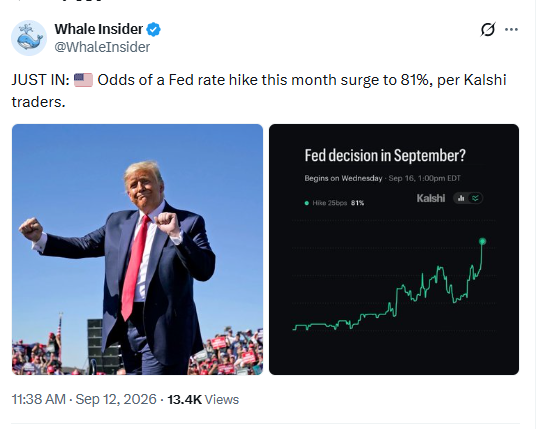
Source: Whale Insider
The action came after figures from the Bureau of Labor Statistics revealed that U.S. consumer prices rose 3.4% compared to the previous year during August. Excluding food and energy, core consumer prices rose by 0.3% in comparison to the previous month, surpassing estimates by economists for an increase of 0.2%, with annual core CPI rising 2.4%.
The release of the inflation data came a day after a better-than-expected rise in the producer price index figure for August. Moreover, oil prices had risen above $100 per barrel due to tensions in the Middle East region.
The markets are currently pricing in a 25 basis point interest rate hike at the FOMC meeting in September. This was a stark contrast to the earlier perception that there would be a potential move towards easier monetary policy.
Why Does the Price of Bitcoin Move with Increased Interest Rates?
An increased interest rate set by the Fed might tighten fiat liquidity and make relatively safer securities more attractive than before, like U.S. Treasuries. In such a scenario, there is less room left for risky assets, such as Bitcoin, to move higher in the near term.
According to the provided market analysis, Bitcoin often faces resistance at $80,000. The combination of persistent inflation and expectations for tighter monetary policy therefore creates a near-term constraint for the cryptocurrency.
The latest inflation figures also challenge expectations that price pressures would continue easing without additional action from the Federal Reserve. Inflation has remained above the central bank’s 2% target for 5½ years, according to the supplied material.
Seema Shah, chief global strategist at Principal Asset Management, said the latest core CPI reading, combined with rising energy prices and tensions involving Iran, made a rate increase at the next meeting highly likely. She also argued that policymakers could require more than one increase to restore price stability.
| Indicator | Latest reported figure |
| August overall CPI, year over year | 3.4% |
| August core CPI, month over month | 0.3% |
| August core CPI, year over year | 2.4% |
| Economists’ expected monthly core CPI | 0.2% |
| Kalshi September rate-hike odds | 81% |
| Expected rate increase | 25 basis points |
| Federal funds target range | 3.50%–3.75% |
| Fed inflation target | 2% |
Bitcoin Price Gets a Different Signal From Treasury Stress
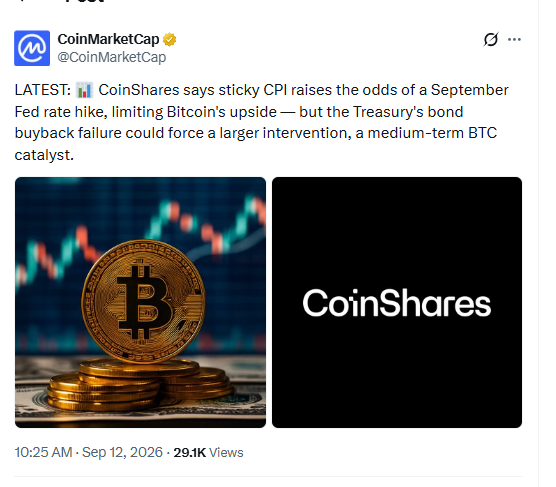
While higher rates create a short-term headwind, developments in the U.S. Treasury market provide a different narrative for the Bitcoin price over a medium-term horizon.
The Treasury has expanded its bond buyback initiative, but those purchases have struggled to push long-term borrowing costs or yields significantly lower. According to the above analysis, any ongoing problem in stabilizing the bond markets would raise more pressure for large-scale market intervention.
Source: CoinMarketCap
The large-scale market intervention is believed to be a source of fiscal dominance and currency debasement worries, according to the market experts. In such a case, the decentralized nature of Bitcoin makes it an excellent hedge against any worries of fiat currency and sovereign debt.
This is contrary to the monetary policy pressure that is exerted on Bitcoin. Higher rates can make Treasuries more attractive and tighten liquidity, while concerns about extensive intervention in government debt markets can reinforce the case for assets viewed as alternatives to fiat-based financial systems.
The Federal Reserve’s own recent communications have added to expectations of tighter policy. The central bank has kept its policy rate between 3.50% and 3.75% throughout the year, including a 9-3 vote in July that showed increasing support within the Fed for higher rates.
At the Kansas City Fed’s annual Jackson Hole gathering last month, Fed Chairman Kevin Warsh said policymakers might need to act if they lacked confidence that underlying inflation was moving toward the 2% target clearly and quickly enough.
Economists cited in the supplied material said the August inflation data did not appear to provide that confidence. Inflation Insights founder Omair Sharif described the latest situation as a test of the Fed’s previous messaging. His comments followed Warsh’s Jackson Hole remarks and focused on whether policymakers would support a rate increase at the upcoming meeting.
FAQs
Why have expectations of an interest rate hike risen?
Expectations have risen after the core CPI rose by 0.3% month-over-month in August, surpassing economists’ expectations of a 0.2% increase.
What does the market expect for September?
Markets are heavily pricing a 25-basis-point Federal Reserve rate increase, while Kalshi odds reached 81%.
Why could higher rates pressure Bitcoin?
Higher benchmark rates may reduce fiat liquidity and raise yield on safer assets like US Treasuries.