The metaverse industry is witnessing a change in perspective as there is an increasing focus on the creation of games and economies through the blockchain.
According to data compiled by CoinGecko, as of September 5, 2026, the total value of the metaverse token classification was $1.98 billion, which suggests that the industry is still quite small.
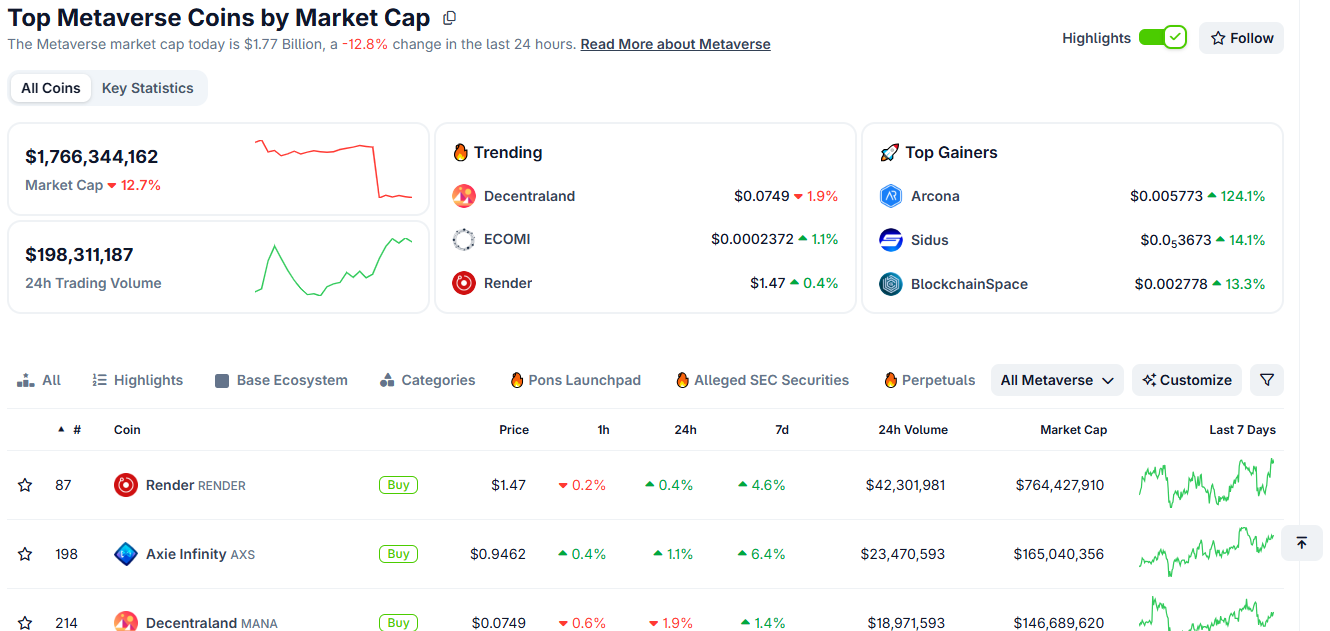
Source: CoinGecko
This change can be observed in the projects under development as well. While some projects are still oriented towards virtual worlds and socializing, others develop blockchain games, creator economies, interrelated digital worlds, and blockchain gaming infrastructure.
The following are notable metaverse projects that can be distinguished not by their market capitalizations but by their current products and activities.
Decentraland is the leading example of community-oriented virtual worlds.
Decentraland is one of the best examples of a blockchain-native virtual world. Created in 2020, the project gives its users an opportunity to own LAND, develop it, build experiences, and use avatars. The project has its governance that is based on DAO, which controls major aspects of the ecosystem.
Development has moved beyond its initial desktop environment. The decentralized land’s website highlights mobile usage with over 400,000 downloads to date.
The platform has also documented its governance proceedings in 2026 in areas such as marketplace, creation of content, grant management, and DAO management. The market capitalization of MANA was approximately $144 million in September 2026.
Expanding Sandbox’s Creator and Game Model
Sandbox incorporates virtual LAND and user-generated content, digital assets, and games. Its model focuses greatly on the creator creating an experience as opposed to virtual real estate ownership.
A notable 2026 development was The Sandbox NEXT. Registration opened in March for a mobile multiplayer game playtest built with Unreal Engine, representing a move away from its historically Unity-based development.
The company said player identities, progression, and assets could connect with the broader ecosystem. SAND’s market capitalization was about $115 million.
Otherside and Axie Infinity Focus on Interactive Worlds
Yuga Labs’ Otherside has increasingly emphasized gameplay and persistent environments. The project developed from the Bored Ape Yacht Club ecosystem and now uses creator tools, playable environments, and digital assets as part of its metaverse model.
Its Koda Nexus is planned as a social hub, while developer documentation shows updates in 2026 involving multiplayer challenges, daily tasks, and other interactive features.
Axie Infinity takes a broader gaming approach, combining collectible characters, player-owned assets, land, and multiple games.
In February 2026, Sky Mavis introduced Bonded AXS, or bAXS, alongside plans for Terrariums to replace Homeland as the next evolution of land gameplay. Several reward mechanisms also shifted toward bAXS.
Star Atlas and Illuvium Build Connected Gaming Ecosystems
Star Atlas combines blockchain ownership with a persistent science-fiction setting. Built on Solana, its ecosystem includes space exploration, combat, and resource management and digital assets. It also includes SAGE, a browser-based on-chain strategy game, alongside an Unreal Engine 5 experience.
Illuvium takes another approach by connecting several games within a shared science-fantasy universe. Its ecosystem includes Illuvium: Arena, Overworld, Zero and Beyond. Development continued through 2026, with Arena update 1.18.1 published on September 1 after an August 26 update.
Newer Metaverse Projects Emphasize Playability
Wilder World is developing Wiami as an open-world environment where users can race, fight, explore, and complete missions while owning digital assets. Its official site lists open-world multiplayer in May 2026, followed by Season Zero in June and further gameplay updates in July.
Somnium Space represents a different segment of the sector by emphasizing virtual reality. Users can acquire land, build spaces, use avatars, and interact in persistent environments. Its economy documentation describes an open and social VR world with support across desktop, mobile, and VR platforms.
Immutable Provides Infrastructure for Blockchain Games
Immutable differs from most of the other metaverse projects because it operates primarily as infrastructure rather than as a single virtual world. Its Immutable Chain is a gaming-focused layer-2 network designed to support blockchain games, NFTs, and digital economies.
The company says more than 700 games are building on its ecosystem and reports more than 220 million total transactions.
Immutable also transitioned its infrastructure in 2026, saying its original Immutable X rollup was merged into Immutable Chain before the older infrastructure was deprecated. Its Passport product is designed to simplify player onboarding into blockchain-enabled games.
| Project | Primary Focus | 2026 Development |
| Decentraland | Virtual world and DAO | Mobile access and governance activity |
| The Sandbox | Creator economy and gaming | Sandbox NEXT mobile playtest |
| Otherside | Interactive metaverse | Multiplayer and social features |
| Axie Infinity | Blockchain gaming | bAXS and Terrarium developments |
| Star Atlas | Space MMO | SAGE and UE5 ecosystem |
| Illuvium | Connected games | Continued Arena and Overworld development |
| Wilder World | Open-world gaming | Multiplayer and Season Zero |
| Somnium Space | Virtual reality | Cross-platform virtual world |
| Immutable | Gaming infrastructure | Immutable Chain transition |
What These Metaverse Projects Show
The current direction of the sector places less emphasis on virtual real estate alone and more on experiences that users can actively participate in. Gaming, social interaction, creator tools, identity, and digital economies have become recurring elements across the projects examined.
The market data provides additional context. With the overall metaverse-token category at roughly $1.98 billion, token values and NFT prices alone do not establish whether a virtual world has achieved lasting participation.
The supplied material also notes that blockchain ownership does not automatically mean an asset can be used across different platforms because access, moderation, and technical compatibility remain controlled by individual platforms.
Conclusion
The leading metaverse projects in 2026 reflect a sector increasingly focused on playable worlds, connected games, creator participation, and blockchain infrastructure.
Decentraland, The Sandbox, Otherside, Axie Infinity, Star Atlas, Illuvium, Wilder World, Somnium Space, and Immutable each represent different approaches, while the overall sector remains relatively small at roughly $1.98 billion in metaverse-token market capitalization.
FAQs
What are metaverse projects?
They are blockchain-based platforms that can focus on virtual worlds, gaming, social interaction, creator tools, digital ownership, or persistent online economies.
Which metaverse project uses a DAO?
Decentraland uses a DAO to govern important aspects of its ecosystem.
What is The Sandbox NEXT?
It is an online game that has been developed by The Sandbox. This game’s mobile test version can be signed up for from March 2026 onwards.
What is the role of Immutable in the metaverse industry?
Immutable provides gaming technology through the use of Immutable Chain rather than developing a virtual world.