The crypto industry came into being in September 2026, and the current focus points in the crypto world have been regulation, stablecoins, tokenization, and decentralized finance.
According to CoinGecko, the overall cryptocurrency market capitalization is losing 12.6% of its value in Q2, reaching $2.1 trillion. Stablecoins continue to be a key segment of the crypto world, with a value of about $305 billion.
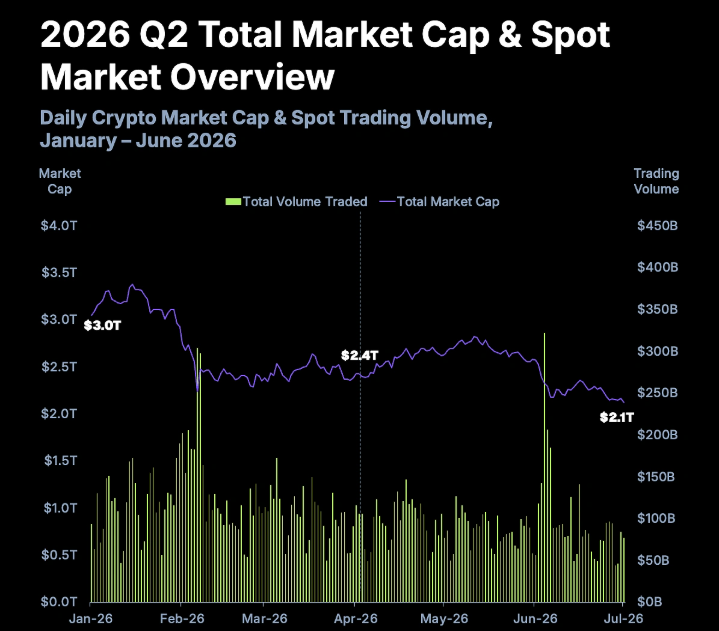
Source: CoinGecko
1. Blockchain Ensures the Common Ledger
Blockchain is the common ledger that captures all transactions in a network as opposed to a single database that keeps track of them. The white paper on Bitcoin that was published in 2008 talked about a peer-to-peer network meant to capture transactions without going through any financial middleman.
It employs the use of data recording and consensus. Users will verify the transactions and reach a consensus on the shared ledger. While Bitcoin has proof-of-work, Ethereum has proof-of-stake from 2022.
2. Wallets Handle Asset Access
Crypto wallets don’t actually store your coins; rather, they handle cryptographic keys that permit transactions related to blockchain addresses.
Private keys are important because the control of the assets usually relies on having those private keys. SEC filings by crypto companies have highlighted the issue with inaccessible assets due to lost keys.
Custodial and non-custodial wallets could exist. The centralized exchange can retain keys for the users. Non-custodial means user-controlled keys.
3. Consensus Establishes Network Agreement
Consensus mechanisms let blockchain participants reach an agreement about the state of the network. In proof-of-work for Bitcoin, the computational work is required, whereas proof-of-stake for Ethereum demands staking of ETH.
Presently, Ethereum asks the validator to lock up 32 ETH. There is an opportunity to earn money for participating in blockchain processes and penalties for some actions.
4. Smart Contracts Make Blockchain Programmable
Smart contracts are programs that are implemented in blockchain and operate based on the set rules. Ethereum states that smart contracts are programs with functions and state that they can be manipulated by users using transactions.
Applications like decentralized exchanges, lending systems, and non-fungible token markets use smart contracts. Nevertheless, as stated by Ethereum documentation, any interaction is generally irreversible and can have bugs. Verification of code does not guarantee that there are no errors.
5. Stablecoins Bridge Crypto and Currency
The stablecoin is a type of cryptocurrency that ensures relatively constant value in comparison with certain reference assets, such as U.S. dollars.
According to CoinGecko, the market capitalization of stablecoins declined 1.6 percent to $305.1 billion in Q2 2026. This is the first time that such a decline has been observed quarter-on-quarter since Q3 2023.
According to Circle, USDC is wholly backed by highly liquid cash and cash equivalents and can be swapped on a 1-to-1 ratio for U.S. dollars. In March 2026, the Financial Action Task Force reported more than 250 stablecoins as of mid-2025.
6. DeFi Offers Financial Services Onchain
DeFi, or decentralized finance, is an approach that applies blockchain technology and smart contracts to perform financial operations like trading, lending, and borrowing.
On decentralized exchanges, token swaps are performed through smart contracts, while in lending protocols liquidity providers may be matched with borrowers and collateral may be required. It should be noted that CFTC warns about significant volatility in the crypto market, as well as about various risks associated with DeFi products.
7. Tokenization Is On-chain Representation Of Asset Rights
These assets can include government securities, funds, equities, commodities, and other financial claims.
CoinDesk Data’s 2026 research tracks tokenized real-world assets, including commodities, equities, and treasuries. Its February report placed the stablecoin market at $309 billion and reported growth in tokenized equity markets.
Tokenization does not automatically remove legal, custody, or settlement requirements linked to an underlying asset.
8. Gas Prices Blockchain Computation
Gas is the way to measure computational costs on Ethereum. Gas is paid in ETH for using network resources in the form of transactions or smart contracts.
ETH transferring usually requires less network resources than contract creation or interaction with a sophisticated smart contract. According to Ethereum, creating a contract can cost considerably more gas than the basic transferring.
9. Supply Influences Market Capitalization
Market capitalization is usually measured by the multiplication of circulating supply and the price of the token. The figure allows comparing the relative size of the asset but doesn’t reflect the investment.
Factors like circulating supply, maximum supply, emission rates, and unlock rate can impact the calculation of price. The CFTC states liquidity, adoption, competition, and technology as the other factors affecting digital-token prices.
10. Leverage Amplifies Trading Outcomes
Using leverage, traders can trade a position size beyond what they have invested in the deal. In crypto derivatives trading, this could result in amplification of gains as well as losses.
Moreover, the CFTC informs the investors that virtual currencies are leveraged instruments, which means that more margin calls and/or liquidations might follow as a consequence of increasing losses that are possible, besides the investment amount. According to CoinGecko, the trading volume for perpetual futures on centralized exchanges is down by 10% compared to the previous quarter and totals $12.7 trillion for Q2 2026.
Key Points
- The process of storage and protection of digital assets is determined by blockchain, wallets, and consensus.
- Stablecoins, DeFi, and tokenization enhance the utilization of the blockchain in financial and physical assets.
- Gas fees, supply, and leverage reveal the costs involved in blockchain and cryptocurrency world.
| Concept | Main function | Source |
| Blockchain | Records transactions | Bitcoin white paper |
| Wallets | Management of cryptographic keys | SEC filings |
| Consensus | Network agreement | Bitcoin and Ethereum |
| Smart contracts | Programmed functions | Ethereum |
| Stablecoins | Track reference assets | CoinGecko and FATF |
| DeFi | Provides onchain finance | CFTC |
| Tokenization | Represents asset rights | CoinDesk Data |
| Gas | Prices computation | Ethereum |
| Market capitalization | Combines price and supply | CFTC |
| Leverage | Controls larger positions | CFTC |
FAQs
What is blockchain?
Blockchain is one of the digital systems that records transactions on the blockchain.
What is a cryptocurrency wallet?
Cryptocurrency wallets are a type of wallet that holds the cryptographic keys that are needed to authorize transactions on the blockchain.
What are stablecoins?
Stablecoins are cryptocurrencies, and their value remains stable with reference to the asset.