AI applications are being designed in such a manner that they can operate autonomously, including ownership of assets, making API calls, executing transactions, and interacting with other agents.
Some of the networks as of September 2026 include Ethereum, Solana, Base, NEAR, Bittensor, Sui, Internet Computer, Polygon, Avalanche, and Arbitrum. The available data shows that no single blockchain leads across every requirement.
The choice depends on what an AI application needs to do. Developers may prioritize transaction costs, throughput, liquidity, interoperability, security, developer tooling, persistent state, or specialized AI infrastructure. These factors have become more important as autonomous applications move beyond simple interfaces toward software capable of taking onchain actions.
Ethereum Leads Among the Best Blockchains for AI Applications
Ethereum remains the strongest general-purpose option for applications that require mature smart contracts, liquidity, and composability. In the Electric Capital’s 2024 Developer Report, Ethereum was rated the best ecosystem based on developer activity on all continents, whereas its 2026 ecosystem statistics still reflect considerable developer involvement.
Ethereum’s relevance to autonomous software also extends to agent infrastructure. Ethereum.org documentation describes agents that can control wallets, execute smart-contract transactions, interact with liquidity, and participate in agent-to-agent commerce. ERC-8004 provides registries covering agent identity, reputation, and validation across Ethereum and other networks.
The network can also serve as a settlement layer for applications that do not need to conduct every computation directly on the mainnet. Ethereum documentation reported approximately $46 billion in DeFi value on the network as of May 2026.
Solana and Sui Target High-Throughput AI Activity
Solana is suited to applications requiring frequent transactions, low-cost execution, and fast interaction with on-chain markets.
Electric Capital identified it as the leading ecosystem for new developers in 2024, with new-developer activity rising 83% year over year. Its current ecosystem data lists more than 2,200 monthly active developers and 667 full-time developers.
AI development tools are also becoming part of Solana’s stack. The Solana Foundation provides a Developer MCP that gives AI coding systems access to Solana and Anchor documentation, program examples, and Stack Exchange material. Its Agent Registry is designed around verifiable identity, reputation, and validation for autonomous agents.
In May 2026, the Solana Foundation announced Pay.sh with Google Cloud. The service allows autonomous agents to access and pay for APIs using stablecoins on Solana, supporting use cases involving frequent payments for data, computing, and other services.
A third high-throughput protocol worth considering is Sui, whose move-based framework implements an asset-centric programming framework, while the Sui Agent Skills facilitate AI code frameworks.
The latest DefiLlama snapshot states that Sui has recorded over 20 million transactions per day as well as over 150,000 addresses per day, but its liquidity is lower than that of Ethereum and Solana.
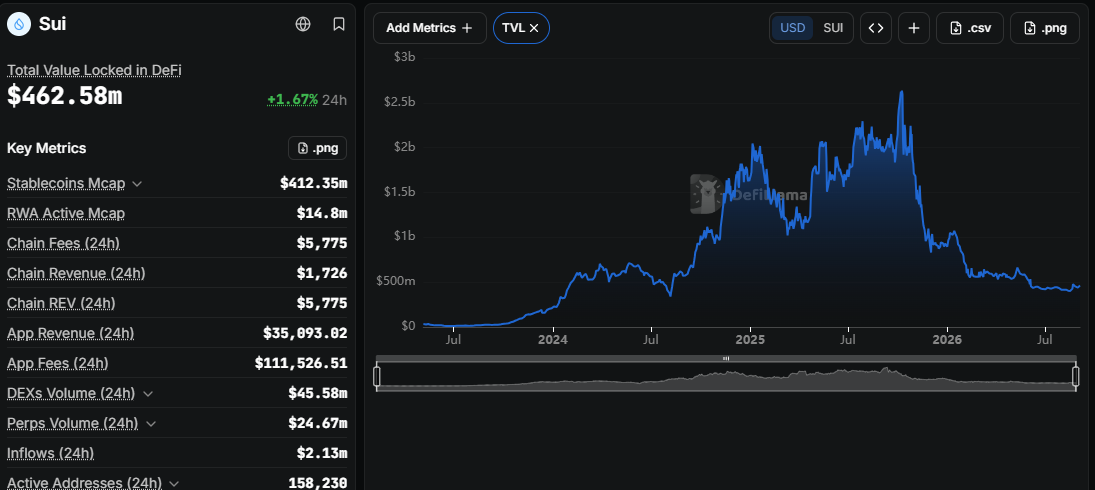
Source: DefiLlama
Infrastructure Development for Agent Economies
Base has built infrastructure focused on AI agents, especially in payment and trading. Base 2026 plans have agent native smart accounts, CLI, and MCP and x402 standard support. Its agent platform also includes agent wallets, spending controls, MCP connectivity, and x402 payments.
Polygon is similarly focused on machine-to-machine payments. Polygon Labs introduced its Agent CLI in March 2026, combining agent wallets, stablecoin payments, bridging, identity, and other transaction functions.
Polygon said in June that it was among the ecosystems supporting Mastercard’s Agent Pay for Machines initiative. It also reported that 95% of x402 transactions were settling through Polygon, representing more than 15.5 million agent payments. The figure was a Polygon-reported ecosystem statistic rather than an independently audited measure of all AI activity.
NEAR takes a different approach by explicitly targeting autonomous and cross-chain agents. Its architecture combines sharding, confidential execution, private inference, and cross-chain transaction capabilities. Its Chain Signatures system allows NEAR smart contracts to authorize transactions across other blockchain environments through a multi-party computation network secured by NEAR validators.
Bittensor and ICP Offer Specialized AI Infrastructure
Bittensor is focused more directly on decentralized AI than general-purpose applications. Its subnet architecture allows networks to specialize in digital commodities, with miners and validators participating in mechanisms designed to evaluate network output.
Its Dynamic TAO design uses subnet tokens and market-based mechanisms to determine how emissions are distributed.
The Internet Computer Protocol provides another specialized environment. Its canister smart contracts can run application logic directly, while its developer platform supports AI-assisted development and persistent decentralized computation.
Developer projects have also explored persistent agent memory, registries, payments, and autonomous coordination, although those projects should not be treated as evidence of protocol-level adoption.
Avalanche and Arbitrum add EVM-compatible alternatives. An avalanche blockchain is able to give specific environments for execution because of its subnet-based design, but Arbitrum gives access to Ethereum’s EVM environment and application because of a Layer 2 structure.
Conclusion
The best blockchain options for AI applications depend on the job which autonomous system must do. Ethereum gives universal infrastructure, Solana and Sui care about high throughput, Base and Polygon concentrate on agent fees, NEAR is for cross-chain solutions, Bittensor works on decentralized AI, and ICP is about persistency. Avalanche and Arbitrum provide additional EVM-compatible options.
FAQs
Which blockchain is strongest for general AI applications?
Ethereum is identified as the strongest general-purpose choice because of its smart contracts, liquidity, and composability.
Which networks focus on AI agent payments?
Base and Polygon have different systems for agent wallets and M2M payments. Solana has an automated payment API system, using Pay.sh.
Which blockchain is designed for decentralized AI?
Bittensor is focused specifically on decentralized AI with its subnet system.