
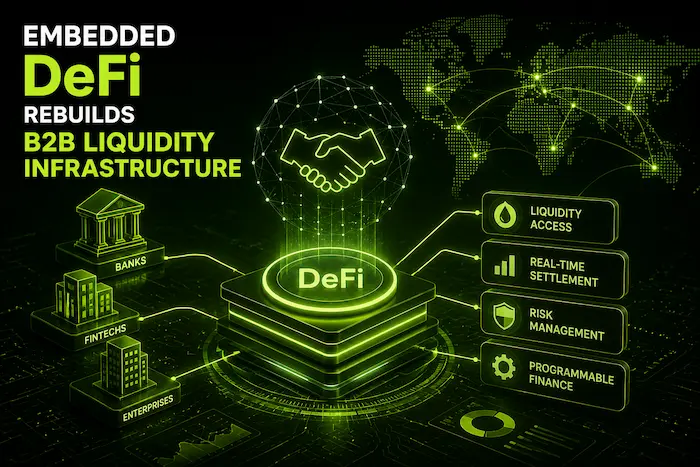
Aave, 0x, and 1inch are developing blockchain solutions that allow businesses to embed lending, yield, swaps, and liquidity services within applications. The trends mark a move towards infrastructure that can be used behind customer-facing financial solutions rather than needing users to use separate DeFi apps.
Aave has been concentrating on embedded lending and yield services, and 0x and 1inch have built infrastructure for liquidity aggregation, routing, and trading. The difference is significant, as one can provide a DeFi-based financial service without running liquidity and execution infrastructure.
Embedded DeFi Integrates Financial Services into Existing Software Applications
Embedded DeFi refers to the integration of financial services through blockchain into the existing application. Users no longer need to be redirected to different decentralized exchanges or lending platforms; instead, such services can be embedded into the existing applications.
Aave described this approach in October 2025 as an extension of embedded finance used by fintech companies. The protocol said blockchain-based lending, savings, and payments could be presented through simpler interfaces that abstract some technical requirements associated with wallets, gas fees, and seed phrases.
Aave Labs expanded this model on July 9, 2026, when it introduced Stable Vaults. The smart-contract vaults are designed to help businesses integrate stable-rate stablecoin yield into their products.
According to Aave, the vaults handle functions including rebalancing and cross-chain operations between an on-chain yield strategy and the rate presented to users. This allows an application to remain the primary customer interface while the underlying DeFi infrastructure operates behind it.
The approach can therefore separate the customer experience from the underlying financial technology. Users may interact with a familiar application while the application connects to blockchain-based lending or yield infrastructure in the background.
How Embedded DeFi Differs From Liquidity Infrastructure
B2B liquidity infrastructure addresses a different part of the financial stack. Rather than defining the customer-facing product, it provides businesses and developers with tools for liquidity access, pricing, routing, transaction construction, or settlement.
0x provides an example through its APIs. Its documentation describes the platform as a unified interface for liquidity aggregation, token pricing, and on-chain trading. Developers can use the infrastructure to integrate swaps without maintaining separate connections to individual decentralized exchanges.
The 0x Swap API documentation states that the service aggregates liquidity from more than 373 sources across more than 20 supported chains. Those sources include automated market makers and professional market makers.
Cross-chain transactions introduce additional infrastructure requirements. The 0x Cross-Chain API documentation states that its system queries multiple bridge providers and liquidity sources before returning routes and transactions for users to sign. The service covers EVM, Solana, HyperCore, and Tron environments, according to the documentation.
This means embedded DeFi and liquidity infrastructure can operate together. A fintech application could provide the customer interface, use a DeFi protocol for a lending strategy, and connect to a liquidity aggregator for token conversions.
Aave, 0x and 1inch Target Different Infrastructure Layers
Aave’s Stable Vaults bring the protocol closer to the financial-services layer by providing businesses with infrastructure for stablecoin yield products. The July 2026 launch also includes functions such as rebalancing and cross-chain management.
Aave’s governance proposal for its mobile application in July 2026 described a self-custodial interface intended to provide access to Aave’s lending infrastructure without requiring users to manage gas or establish a conventional digital asset wallet.
Additionally, on July 28, 2026, 1inch unveiled additional access to Aqua via its API, SDK, and MCP server. According to 1inch, Aqua is a shared liquidity layer, which makes it possible for liquidity providers to distribute virtual balances of tokens across several trading strategies without dividing capital into separate pools.
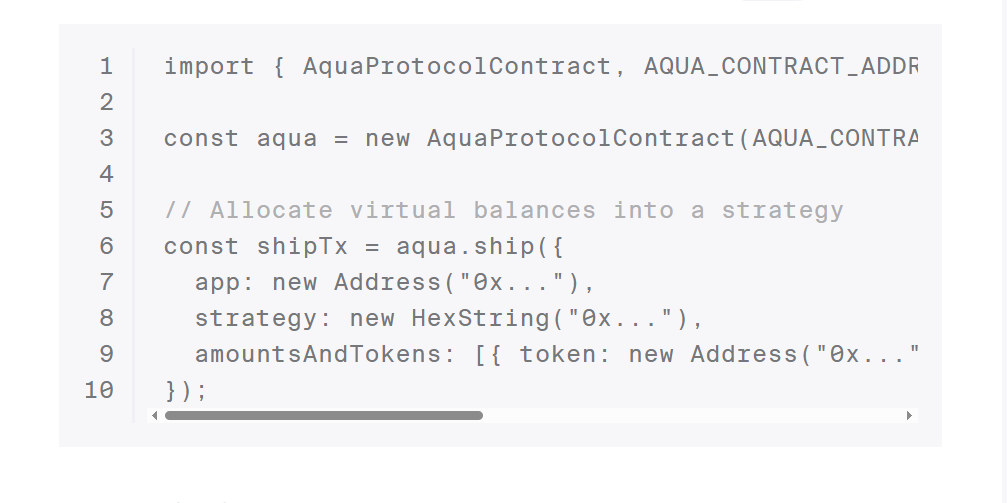
Aqua TypeScript SDK, Source: 1inch
The company’s documentation includes API endpoints for measuring shared and pullable liquidity across open strategies. This positions Aqua as a liquidity-management infrastructure layer rather than simply another consumer-facing trading interface.
| Company | Development | Primary infrastructure role |
| Aave | Stable Vaults | Embedded stablecoin yield |
| 0x | Swap and Cross-Chain APIs | Liquidity aggregation and routing |
| 1inch | Aqua access through API, SDK and MCP server | Shared liquidity infrastructure |
Liquidity Aggregation Addresses Fragmented Trading Sources
The need for liquidity infrastructure is linked to fragmented digital-asset markets. Tokens can trade across multiple decentralized exchanges, liquidity pools, and market-making systems, creating a need for systems that can compare available sources.
0x’s routing engine searches available liquidity sources and constructs executable swap transactions, according to its documentation. Developers can therefore use a single integration point rather than connecting to each supported venue separately.
The Cross-Chain API adds another layer by incorporating bridge providers alongside liquidity sources. Its documented process covers quoting, authorization, bridging, and transaction-status tracking.
1inch’s Aqua development approaches liquidity from a different angle by enabling virtual balances to support multiple strategies. The system is designed to address liquidity fragmentation that can occur when capital must be allocated separately across different strategies.
These products demonstrate the distinction between delivering financial services and supplying the infrastructure needed to execute them. An application can use one or several underlying services while maintaining its own customer experience.
Embedded DeFi Still Depends on Underlying Infrastructure
The abstraction created by embedded DeFi does not remove the technical dependencies beneath an application. A product spanning multiple blockchains can depend on smart contracts, APIs, bridges, liquidity providers, and wallet systems.
The 0x Cross-Chain API documentation illustrates this operational structure. After an originating transaction is submitted, bridge providers deliver assets to the destination chain, with completion times varying by the selected bridge.
Security remains another consideration. Aave Stable Vaults are smart-contract vaults that were launched on July 9, 2026, to enable companies to incorporate stable-rate stablecoin yield into their product. The study also found that many analyzed attack paths fell outside the scope of identified public audits.
The findings do not establish that embedded DeFi products are inherently unsafe. They do show that simplifying the customer interface does not eliminate security considerations associated with the underlying protocols and infrastructure.
For businesses, the separation between interface and infrastructure can therefore involve several operational dependencies. A simple customer-facing product may rely on multiple backend systems to provide its financial functionality.
FAQs
What is Embedded DeFi?
Embedded DeFi is described as the integration of decentralized finance products like lending, yield, and payments within an already existing application.
What is provided by 0x?
0x provides APIs for liquidity aggregation, token pricing, on-chain trading, and cross-chain transaction routing.
What are Aave Stable Vaults?
The Aave Stable Vaults are contract vaults that were developed on July 9, 2026, in order to aid firms in integrating stable rate stablecoin yields in their offerings.