
The management of digital assets on the exchanges, in the wallets, in the blockchains, and via DeFi is becoming difficult as the market for crypto has expanded.
According to CoinGecko, by August 30, 2026, the crypto market has over 19,000 cryptocurrencies that are being tracked, and there are also 1,400 exchanges available in the crypto market.
The latest generation of portfolio trackers of crypto has evolved from just showing token prices. The current generation of best crypto portfolio trackers combines both the features of the wallet and exchanges along with P&L analysis and other features.
However, their approaches differ substantially, particularly around data connectivity, privacy, tax functionality, and on-chain coverage.
This ranking evaluates 10 widely used trackers based on their documented features, integration coverage, portfolio analytics, DeFi capabilities, tax tools, privacy architecture, and suitability for different types of crypto users. The ranking is not financial advice, and a higher position does not mean a platform is suitable for every portfolio.
Why Crypto Portfolio Trackers Matter
Crypto portfolios can span centralized exchanges, hardware wallets, software wallets, DeFi applications, and several blockchain networks. Manual management of such assets might make it difficult to keep track of all transactional details and evaluate overall performance.
Additionally, the volatility of the markets makes the recording process even more vital. According to the CoinGecko Q2 Crypto Industry Report of July 2026, the overall market capitalization of cryptocurrencies witnessed a decline of 12.6%, which resulted in $2.1 trillion. The market capitalization figure is about 52% less than the market capitalization in October 2025.
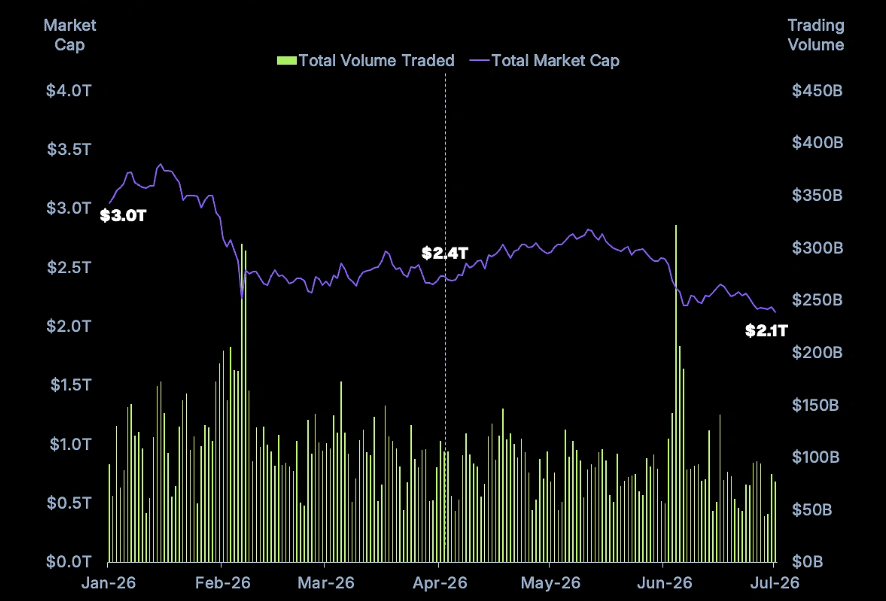
Source: CoinGecko
The portfolios will allow consolidation of deposits, withdrawals, trades, and other financial activity; however, the precision of tracking relies on the quality of integrations and categorization of transfers, DeFi positions, and other transactions.
Security should be mentioned too. According to the report State of Crypto Security by CoinGecko on August 27, 2026, there have been losses amounting to $3.63 billion from 245 crypto events between January 2025 and July 2026. Tracking services do not remove the underlying risks associated with exchanges, wallets, or blockchain applications.
Crypto Portfolio Trackers Compared
| Tracker | Main Strength | Best For |
| CoinStats | Broad integrations | Multi-platform portfolios |
| CoinTracker | Tax reporting | Portfolio and tax tracking |
| CoinGecko | Market data | Beginners |
| CoinMarketCap | Free monitoring | Basic portfolio tracking |
| Zerion | Multi-chain DeFi | On-chain users |
| Delta | Multi-asset tracking | Crypto and traditional assets |
| CoinTracking | Accounting | Advanced investors |
| Koinly | Tax calculations | Tax-focused users |
| DeBank | On-chain visibility | DeFi users |
| Rotki | Local data storage | Privacy-conscious users |
CoinStats ranks first in this ranking for users managing assets across numerous platforms. Its documentation lists support for more than 300 wallets and exchanges, more than 10,000 DeFi protocols, and over 50 blockchains. It can combine crypto, DeFi, and NFT holdings through a single portfolio interface.
CoinTracker is more focused on combining portfolio monitoring with tax functionality. Its tracker supports more than 800 exchanges, wallets and blockchains, more than 600 decentralized applications, over 50,000 smart contracts and 10,000 crypto assets. Its integration directory lists 632 integrations.
CoinGecko offers a simpler portfolio experience alongside its broader market-data platform. Its portfolio tool provides real-time prices for more than 19,000 coins, along with individual-asset profit and loss tracking, multiple portfolios, unlimited lists, alerts, and mobile access.
CoinMarketCap similarly targets straightforward portfolio monitoring. Users can manually add transactions, create multiple portfolios, and connect supported wallets or exchanges.
The platform clarified in January 2026 that its portfolio feature is informational and does not hold funds or execute transactions.
DeFi and Multi-Chain Trackers
Zerion is designed for users holding assets directly on blockchain networks. It supports more than 40 EVM blockchains and tracks tokens, NFTs, and DeFi positions. Its documented network coverage includes Ethereum, Solana, Arbitrum, Base, BNB Chain, Polygon, Optimism, and Tron.
DeBank also emphasizes on-chain portfolio visibility and DeFi activity. In contrast to concentrating on exchange wallets, it tracks blockchain portfolios as well as wallet transactions, enabling its users to see their positions, which do not show up as exchange wallets.
Delta has taken a more wide-spectrum approach, including crypto along with stocks, funds, currencies, indices, and NFTs. Its crypto tracker supports more than 10,000 altcoins and provides portfolio performance, gains, losses, and alerts. Delta’s documentation states that it is a read-only tracker and does not hold, deposit, withdraw, buy, or sell assets.
Tax and Privacy Features Set Other Trackers Apart
CoinTracking focuses on detailed transaction records and accounting. It connects with more than 400 exchanges and wallets and provides portfolio balances, gains, real-time prices, and tax reports for more than 100 countries.
Koinly combines portfolio tracking with tax calculations. Its platform supports more than 900 integrations and tracks DeFi, NFTs, futures, and margin trades while providing realized and unrealized gains, return-on-investment information, and portfolio growth data.
Rotki uses a different architecture. According to its June 2026 documentation, information about portfolios is saved in a locally stored database encrypted with SQLCipher with AES 256-bit encryption. The exchange connections use read-only API keys, while information about blockchains can be found via RPC endpoints or chosen data providers.
Key Takeaways
- CoinStats supports wallet, exchange, blockchain, and DeFi integrations for diverse portfolios.
- CoinTracker and Koinly offer portfolio tracking along with tax-related transaction analysis.
- Zerion, DeBank, and rotki provide options centered on DeFi, on-chain activity or local data control.
Conclusion
The top cryptocurrency portfolio trackers will depend on what you want to track. CoinStats is the best in multi-network tracking, while CoinTracker and Koinly would be ideal for tax purposes.
Zerion and DeBank are ideal for DeFi and on-chain activities, Delta supports different asset types, and Cointracking focuses on accounting. Integration reliability, security permissions, privacy, and portfolio complexity remain important factors when selecting a tracker.
FAQs
What is the best crypto portfolio tracker?
CoinStats takes the first place in the following ranking due to its extensive coverage in terms of wallets, exchanges, DeFi platforms, and blockchains.
What tracker will help me pay my crypto taxes?
CoinTracker, Koinly, and CoinTracking offer tax-specific features along with portfolio and transaction tracking.
What trackers concentrate on DeFi?
Zerion and DeBank are focused explicitly on DeFi wallets on multiple chains.
What tracker cares about privacy?
Rotki stores all the data locally and keeps your portfolio information encrypted.