

Venture capital firms are investing billions of dollars into blockchain, stablecoins, tokenized finance, and related technologies in 2026, despite the drop in the number of crypto venture deals. Venture capital firms are making investments totaling billions of dollars in blockchain, stablecoins, tokenized finance, and related technologies despite the drop in the number of crypto venture deals in 2026.
This move benefits those venture capital firms that have large pools of money, technical knowledge, and are capable of helping startups at various financing stages.
Venture investment in the crypto domain is currently much more picky compared to when the period of fundraising boom started in 2021-2022. According to CryptoRank, businesses have raised $12.86 billion through 271 deals in Q2 2026, including $4.99 billion through 218 venture funding deals.
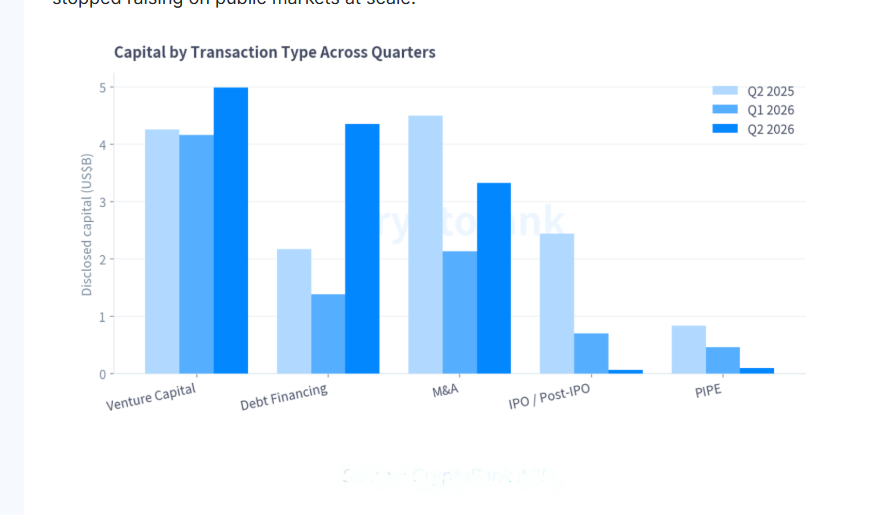
Source: CryptoRank
The Block has also independently reported that crypto venture capital deals per month have dropped to around 50, which is the lowest since before 2021.
Against that backdrop, fund size and the ability to provide capital beyond an initial round have become important characteristics among leading investors. The ranking below considers disclosed fund size, crypto specialization, portfolio breadth, recent investment activity, and the ability to support companies across multiple financing stages. It is not a ranking of investment returns.
The leading crypto VC firms in 2026
a16z Crypto stands in first position after making its fifth cryptocurrency fund worth $2.2 billion in May 2026. This fund wants to invest in startups that deal in stablecoins, on-chain finance, real-world usage, and crypto infrastructure. Some of the startups in this venture include Coinbase, Uniswap, Solana, Optimism, OpenSea, EigenLayer, Morpho, LayerZero, and Phantom.
Paradigm has closed its $1.2 billion fourth fund in July 2026. The vehicle will invest in crypto, artificial intelligence, robotics, and other frontier technologies. The Block reported that Paradigm had nearly $12 billion in assets under management at the end of 2025.
The firm previously raised an $850 million crypto venture fund in 2024 and has investments in Uniswap, Coinbase, Optimism, Fireblocks, Monad, StarkWare and Phantom.
Dragonfly Fund IV closed on $650 million in February. They invest in crypto startups internationally, from seed to later rounds, typically deploying between $3 million and over $30 million per investment. Its portfolio includes Monad, Ethena, MegaETH, Rain and Agora. In July, Dragonfly led a $65 million Series A for Venice AI at a reported $1 billion equity valuation.
Pantera Capital has invested in digital assets and blockchain companies since 2013. As of March 31, 2026, it reported approximately $3.5 billion in assets under management, alongside 100 venture investments and 110 early-stage token investments.
Its strategy covers venture equity, early-stage tokens and liquid digital assets, with a portfolio focused on infrastructure, exchanges, custodians, institutional trading technology, DeFi and payments.
Haun Ventures raised $1 billion in May for early- and later-stage investments. The capital targets crypto companies alongside startups working across financial services, artificial intelligence and alternative assets. Its portfolio includes Fireblocks, Chainalysis and Aptos Labs.
Crypto VC firms expand their investment mandates
The investments from Coinbase Ventures have spanned Layer 1 networks, Web 3.0 infrastructure, DeFi, NFTs, metaverse tech, and development tools for hundreds of projects. Some of the investments made by Coinbase Ventures include Optimism, StarkWare, Uniswap, and Zora.
The venture fund invests at an early stage and provides operational experience, distribution, and strategic partnerships via its connection to Coinbase.
Galaxy Ventures invests across crypto infrastructure, protocols, financial applications and consumer use cases. Its portfolio includes Monad, Ethena, Celestia, Fireblocks, Polygon, EigenLayer, Pyth, Superstate and Talos.
Galaxy describes its approach as stage-agnostic and gives portfolio companies access to its broader platform and industry expertise.
Multicoin Capital, founded in 2017, manages venture funds alongside a hedge fund and invests in public and private markets. Its categories include Layer 1 networks, stablecoins, DeFi, real-world assets, payments, DePIN, zero-knowledge technology, fully homomorphic encryption and crypto-AI applications.
In March 2026, Spencer Applebaum and Shayon Sengupta were promoted to general partners and co-heads of venture.
Framework Ventures launched a fourth fund of $400 million in June and expanded into the robotics and AI space. The venture capital firm is renowned for blockchain gaming, Web3, and DeFi bets. According to the firm, its average check is in the $5 million to $40 million range, and it usually takes the lead in seed rounds.
Variant raised a $222 million fourth fund in June 2026. The vehicle targets companies at the earliest stages while maintaining liquid and growth investments as companies mature. Its thesis now includes permissionless markets, open-source software, decentralized systems, artificial intelligence and technologies focused on user control of assets, data and infrastructure.
Key figures across selected firms
| Crypto VC firm | Fund or reported capital | Focus |
| a16z crypto | $2.2B | Stablecoins and onchain finance |
| Paradigm | $1.2B | Crypto and frontier technologies |
| Dragonfly | $650M | Crypto investments |
| Pantera Capital | $3.5B AUM | Digital assets and blockchain |
| Haun Ventures | $1B | Crypto and financial services |
| Framework Ventures | $400M | Crypto, AI and robotics |
| Variant | $222M | Crypto and autonomous systems |
Why crypto venture capital is becoming concentrated
The scale of these crypto VC firms comes as overall deal activity has weakened. CryptoRank recorded $4.99 billion across 218 venture rounds in the second quarter of 2026, while The Block reported monthly activity of roughly 50 deals in May.
Tiger Research and RootData reported $13.3 billion in crypto investment capital during the first half of 2026, roughly matching the full-year total for 2024. The funding rounds, however, were greatly reduced compared to the peak levels seen in 2022. The capital was getting more and more concentrated on crypto-native funds and investment arms of exchanges.
A larger fund can help with follow-on financing and provide technical expertise. At the same time, greater concentration can make fundraising harder for smaller startups without established traction.
The investment mandates also increasingly overlap with artificial intelligence, robotics, payments and tokenized financial assets. This diversification can be observed in some of the major companies, with crypto playing a crucial role in their investment approach.
Key Takeaways
- a16z crypto had the largest new crypto fund in May 2026, raising $2.2 billion.
- Even with the significant decrease in the number of deals, crypto venture funding is still quite high.
- Top crypto VCs are venturing into AI, robotics, payments, and other forms of technology.
Conclusion
The leading crypto VC funds are diversifying into other sectors such as artificial intelligence, robotics, and payments technology among others. The largest new funds include a16z crypto’s $2.2 billion vehicle, Paradigm’s $1.2 billion fund and Dragonfly’s $650 million fund.
Investment practices are increasingly venturing into sectors such as artificial intelligence, robotics, payments, and other frontier technologies as consolidation within crypto venture capital firms increases.
Frequently Asked Questions
Which crypto VC firm has raised the most amount of money for its newest fund in 2026?
a16z crypto started a $2.2 billion fifth crypto fund in May 2026.
Who is moving beyond traditional crypto?
Paradigm, Haun Ventures, Dragonfly, Framework Ventures and Variant have mandates covering areas including AI, robotics, financial services or autonomous systems.
Is the ranking based on investment returns?
No. It considers disclosed fund size, specialization, portfolio breadth, recent activity and the ability to support companies beyond an initial financing round.