
key insights
- Specialized enterprise models may outperform general frontier models when trained on proprietary operational data.
- Open-weight AI gives organizations greater flexibility to customize deployment without exposing confidential information.
- Crypto companies increasingly view AI infrastructure as part of their long-term competitive strategy.
Nvidia open-weight AI received strong backing from Coinbase CEO Brian Armstrong after Nvidia CEO Jensen Huang published his first-ever post on X supporting open-weight artificial intelligence models. Armstrong argued that specialized enterprise AI systems could outperform frontier models in targeted business applications, adding momentum to an industry-wide push for broader AI access.
For my first post, I’m sharing a letter @NVIDIA signed on why open models matter.
AI will transform every industry, power every company, and be built by every country.
Open models strengthen safety and cybersecurity, accelerate innovation and diffusion, and enable sovereignty.… pic.twitter.com/t02bi51N4C
— Jensen Huang (@JensenHuang) July 24, 2026
Huang shared an open letter titled Open Weights and American AI Leadership, signed by Nvidia alongside Meta, Microsoft, IBM, Palantir, Hugging Face, Andreessen Horowitz, the Linux Foundation, and other technology organizations. The document argued that open-weight models promote innovation, competition, and long-term American leadership in artificial intelligence while encouraging stronger security through greater transparency.
Key developments at a glance
Development Details
Nvidia announcement Jensen Huang published his first post on X supporting open-weight AI
Coinbase position Brian Armstrong endorsed open-weight models for enterprise use
Industry support Meta, Microsoft, IBM, Palantir and other firms signed the letter
Security stance Signatories argued transparency strengthens AI security over time
Missing signatories OpenAI and Anthropic did not sign the initiative
Coinbase outlines enterprise case for specialized AI
Following Huang’s announcement, Armstrong said Coinbase already uses more open-weight models across its operations. He argued that businesses can achieve better performance by training AI on proprietary company data instead of relying only on general-purpose frontier models.
Armstrong explained that a model trained on roughly 100,000 Coinbase compliance cases could become a stronger regulatory specialist than a frontier model without similar experience. Customers will also gain more accuracy with customized systems, and the same businesses will be able to keep their sensitive operational data within their own systems, he added.
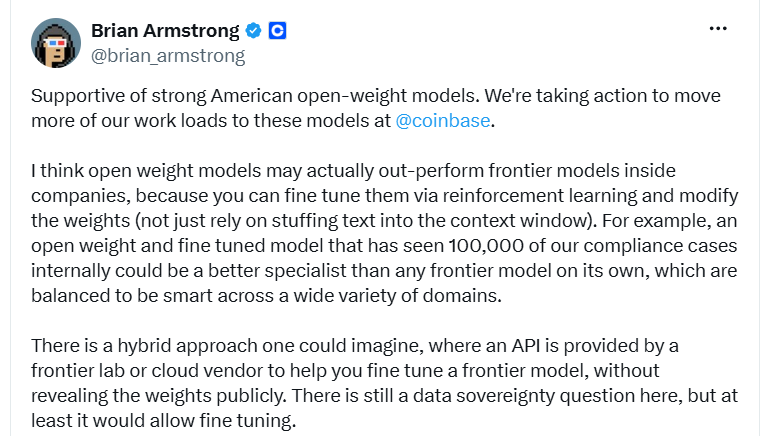
His remarks brought the conversation beyond the realm of accessibility to AI. They marketed their open-weight models as viable enterprise solutions with a solution to a problem particular to a specific industry, notably in the highly regulated financial services and cryptocurrency sectors.
The industry group says that opening up would benefit innovation.
The letter explained that open-weight AI is the future stage in technological development, similar to open-source software in the 1980s. Huang contended that access to a broader community gives developers, researchers and businesses the opportunity to develop on common technology and to drive innovation.
The coalition also criticized plans to curb open-weight AI development. The letter says that such access restrictions would hurt the United States’ competitive position, not enhance the nation’s security. However, transparent models enable independent researchers to discover vulnerabilities more quickly and make improvements to the security measures in place before the threat becomes widespread, the signatories stated.
The document admitted the risks of open-weight AI, such as misuse. It, however, said that wider participation would help to increase resilience by constantly testing and collaborating with security experts.
The debate also extends to AI distillation. The coalition described distillation as a legitimate method for improving models and argued that policymakers should focus on genuine intellectual property violations instead of broad restrictions on open-weight development.
Broader industry debate continues over AI leadership
Nvidia open-weight AI has become a focal point in the wider debate surrounding global AI competition. Huang recently argued that American companies should remain free to use advanced Chinese AI models, rejecting concerns that such systems automatically pose security threats.
His comments followed the release of Moonshot AI’s open-weight Kimi K3 model, which claims frontier-level performance at significantly lower cost. The timing has intensified discussions over whether open development or closed proprietary systems offer the strongest path for future innovation.
Several influential technology leaders quickly endorsed Huang’s initiative. Tesla CEO Elon Musk offered his full support, while OpenAI CEO Sam Altman said the United States should continue leading both open-source and proprietary AI development. Block co-founder Jack Dorsey also welcomed the proposal.
Interestingly, OpenAI and Anthropic were not among the list of signatories. Both firms have voiced concerns about the problems of some open source AI models before, reflecting an increasing split over the development of advanced AI.
Conclusion
With the backing of tech giants and cryptocurrency giants, Nvidia open-weight AI has garnered attention for enterprise adoption, leaving the wider AI scene up for debate. The endorsement by Coinbase adds credibility to the case for having a specialized open-weight model that can provide tangible business benefits without losing control over operations. Policymakers still grappling with the regulation of AI are likely to see a future where development models differ between open and closed as the defining characteristic of the industry.