
Decentralized finance users providing liquidity to automated market makers continue to face impermanent loss when paired assets move differently in price. The risk affects liquidity providers on platforms such as Uniswap because automated market makers rebalance pool holdings as traders buy and sell assets.
While LPs can earn trading fees and token incentives, the value of their positions can fall behind a simple hold strategy when relative token prices diverge.
Impermanent loss does not necessarily mean an LP has lost money from the original deposit. Instead, it measures the difference between the value of assets held in a liquidity pool and what those same assets would have been worth if they had remained outside the pool.
The distinction is important when evaluating liquidity-pool yields because advertised returns do not account for every change in the underlying assets.
How Impermanent Loss Changes an LP Position
The mechanics of impermanent loss are closely connected to automated market makers. In a conventional constant-product pool, the interaction of the two assets works according to the equation x × y = k.
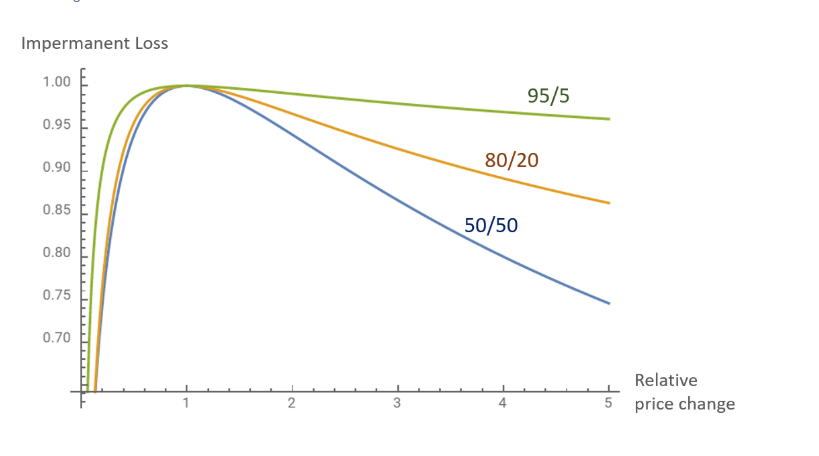
Source: CoinGecko
As users make swaps of one asset to another, the amounts of both tokens fluctuate while preserving the mathematical correlation.
Moreover, it allows changing the composition of the LP’s portfolio automatically. If one of the assets gains a considerable advantage against its counterpart, arbitrage traders will buy the undervalued token in the liquidity pool until the price is back to parity with the market price. The result will be a decreased amount of the more successful asset.
An illustrative example of ETH/USDC will follow. An LP depositing 1 ETH worth $2,000 and 2,000 USDC starts with $4,000. If ETH doubles to $4,000, holding those assets outside the pool would produce a $6,000 position.
Under the constant-product model, the LP would instead hold approximately 0.7071 ETH and 2,828.43 USDC. At $4,000 per ETH, that position would be worth about $5,656.85. The difference from simply holding the original assets is approximately $343.15, or 5.72%.
That 5.72% is the classic impermanent-loss result for a 2x relative price move in a 50/50 constant-product pool. The calculation excludes trading fees, gas costs and external incentives, which can change the overall economics for an LP.
Fees and Pool Design Affect DeFi Returns
Trading fees can offset part of the loss created by changing asset prices. The liquidity providers get these fees because they offer capital for the swapping processes.
Uniswap v2 historically used a 0.30% trading fee, while Uniswap v4 introduced hooks that can support static or dynamically managed swap fees. These designs give pools more flexibility but do not remove exposure to price divergence.
DefiLlama tracks DEX volumes, fees, yields and liquidity across more than 6,000 protocols and more than 400 chains, with data refreshed hourly. Its information can therefore be used to assess pool economics beyond headline APYs.
Concentrated liquidity also changes how LP capital is deployed. Uniswap v3 allows providers to select a price range where their liquidity remains active. This will increase the efficiency of capital use; however, liquidity may be unutilized when the market changes beyond the selected range.
Uniswap v4 will give more flexibility via hooks that can change pool parameters and enable multiple systems, such as fee dynamics. The additional flexibility changes how liquidity can be managed, but it does not eliminate impermanent loss or the other risks associated with providing assets to DeFi pools.
Stablecoin Pools Can Have Lower Relative Price Divergence
The magnitude of impermanent loss depends on how differently the paired assets move. Pools of assets that have relatively similar values will thus have less relative price divergence than pools with significantly different assets.
An example of such a pool is the USDC/USDT pool since both assets attempt to reach the same dollar value. The price divergence between these two assets could thus be less than ETH/USDC.
However, stablecoin liquidity does not remove other risks. Stablecoins have separate risks involving reserves, issuers, smart contracts, liquidity and their ability to maintain their intended value. Coinbase identifies software, token, regulatory and gas-fee risks among the broader risks associated with DeFi investments.
The comparison with staking also highlights why APY alone is insufficient. Staking Ethereum includes the use of validators who lock up their ETH and earn rewards by participating in the consensus process of the network. An ETH/USDC LP also experiences changes in the composition of the position as market prices move.
Key Takeaways
- Impermanent loss increases when paired token prices diverge significantly.
- Trading fees and incentives can offset some or all of the relative loss.
- Concentrated liquidity can improve capital efficiency while requiring closer management.
| Relative Price Change | Approx. Impermanent Loss |
| 1.25x | 0.6% |
| 1.50x | 2.0% |
| 2x | 5.7% |
| 3x | 13.4% |
| 4x | 20.0% |
| 5x | 25.5% |
These figures apply to the traditional 50/50 constant-product model and exclude trading fees, incentives, gas costs and other factors.
Conclusion
Impermanent loss remains a central consideration for DeFi liquidity providers because an LP’s returns depend on more than advertised yields.
Asset price divergence can leave a pool position worth less than simply holding the same tokens, while trading fees and incentives can offset part of that difference. Comparing an LP position with a hold benchmark provides a clearer view of the actual economic outcome.
FAQs
What is impermanent loss?
Impermanent loss is the difference between the value of assets in a liquidity pool and their value if the provider had simply held those assets outside the pool.
When does impermanent loss increase?
It generally increases as the relative prices of the two assets diverge. If the assets are highly correlated, then there is a smaller price risk associated with them.
Does the trading fee offset the impermanent loss?
Yes. The trading fee could offset the impermanent loss depending on the activity of the pool and its economics.