The cost of using the Ethereum blockchain to move assets and execute smart contracts has reduced significantly when there is low usage of the network.
Every operation executed by the Ethereum Virtual Machine requires some amount of gas, which is then paid by the user in the form of ETH. For example, just sending a transfer of ETH costs 21,000 gas, but in case of token transfers or swaps on the DEX platform, the gas consumption may increase substantially.
How Gas Fees in Ethereum Work
Calculation of gas fees:
Transaction fee = gas used x (base fee + priority fee)
For instance, if a user needs to send 21,000 gas ETH and the base fee is 1 gwei while the priority fee is 0.1 gwei, the fee is 23,100 gwei, equivalent to 0.0000231 ETH. The worth of the fee will be dependent on the price of ETH in the market.
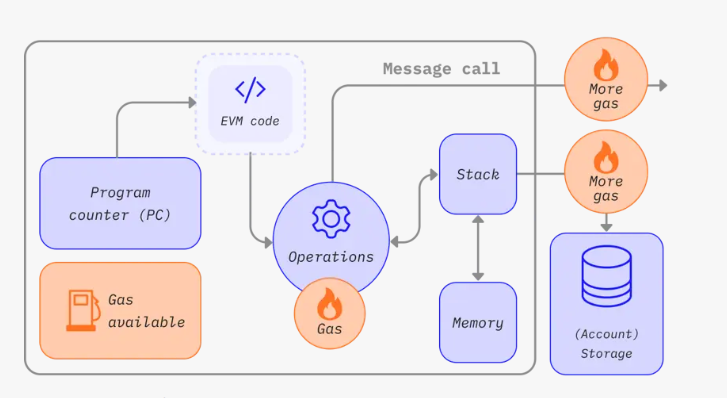
Source: Ethereum
Users may not always have control over how much gas they use due to the nature of smart contracts. However, transaction timing, priority fees, and the choice between Ethereum mainnet and Layer 2 networks can affect the final cost.
EIP-1559 Reshaped Ethereum Gas Fees
EIP-1559 became part of Ethereum’s London upgrade in August 2021. It replaced the previous first-price fee auction with a system based on a dynamically adjusted base fee.
The base fee is determined by the protocol and is burned rather than paid to validators. Tip fee is another term for priority fee, which is received by the validator in order to provide extra motivation for processing the transaction.
Type 2 transactions make use of maxFeePerGas and maxPriorityFeePerGas. Maximum fee refers to the highest amount that can be paid by a sender for each unit of gas. However, it doesn’t indicate the total amount charged.
Two key points apply to EIP-1559 transactions:
- The actual payment depends on the applicable base fee, priority fee and gas consumed.
- An unused portion of the maximum fee is not charged to the sender.
EIP-1559 improved fee predictability and introduced the burn mechanism, but it did not remove Ethereum’s capacity constraints.
Recent Data Shows Much Lower Gas Prices
Recent network data included in the source material shows how significantly Ethereum gas prices can vary. The CoinGecko ETHGas indicator, based on the Etherscan information, indicated that the cost of gas was at 0.096 gwei for regular transactions and at approximately 0.106 gwei for fast transactions.
According to the Etherscan information, there was an Ethereum transaction in July 21, 2026 using 21,000 gas at 0.058 gwei; the transaction paid approximately 0.00000122 in fees. There was another transaction on July using gas at
The documentation for the Ethereum Foundation released in May 2026 mentioned that the average cost of gas was about 0.15 gwei on May 5 and 0.5 gwei per day throughout
| Transaction detail | Figure provided |
| Basic ETH transfer | 21,000 gas |
| July 21 gas price | ~0.058 gwei |
| July 21 transaction fee | ~0.00000122 ETH |
| Another July gas price | 0.0436 gwei |
| Another July transaction fee | ~0.00000092 ETH |
These figures reflect actual recorded data and do not predict future gas prices.
Layer 2 Networks Lower Mainnet Fees
There are also layer 2 networks that process transactions off-chain and use Ethereum for settlement and security.
Dencun, launched in March 2024, enabled blob transactions via EIP-4844. The change was designed to provide cheaper data availability for rollups and reduce an important cost for Layer 2 networks.
L2BEAT tracks costs that rollups pay to Ethereum for data, proofs and state updates. Its data covers networks including Base, OP Mainnet, Arbitrum One, Starknet, ZKsync Era and Scroll.
Layer 2 costs paid to Ethereum are different from the transaction fees ultimately charged to users. Users therefore need to check the actual fee displayed by their wallet or application.
Smart Contracts Require Different Amounts of Gas
The 21,000-gas figure applies to a basic ETH transfer and does not represent every Ethereum transaction. Ethereum’s official gas guide provides examples of approximately 65,000 gas for an ERC-20 transfer, 84,904 gas for an NFT transfer and 184,523 gas for a Uniswap swap.
The gas limit also differs from the gas price. Gas limit refers to the total amount of computation allowed in a transaction, whereas gas price refers to the amount that will be paid per gas unit. However, any unused gas is not charged but having a low gas limit may make the transaction fail.
Ethereum Gas Fees Management Techniques
It is possible to observe gas situation prior to transaction submission and compare gas prices for standard, fast, and slower transactions. Transactions that are not urgent can be postponed during periods when the network is less used.
Other methods include:
- Verification of application support and asset support on a Layer 2 service.
- Estimation of gas costs prior to signing smart-contract transactions.
- Avoidance of excessive priority fees if inclusion is not necessary.
Glamsterdam Could Change Future Costs
Ethereum developers are preparing the Glamsterdam upgrade for the second half of 2026. The upgrade includes work related to higher Layer 1 capacity and transaction processing.
EIP-2780, which remains a proposal associated with the upgrade, could reduce intrinsic transaction gas and make a standard ETH transfer between existing accounts up to 71% cheaper if implemented as described.
The Ethereum Foundation also reported in May that developers had established a post-Glamsterdam gas-limit floor of 200 million during interoperability work. These developments do not guarantee a specific future transaction fee.
FAQs
What is gas on Ethereum?
Gas is the accounting unit used to measure computational work performed by the Ethereum Virtual Machine.
Why do smart contract transactions use more gas?
They may involve significantly more computations compared to an ordinary transaction of ETH.
Will users have to pay the maximum fee set?
No, since it is the highest fee they are ready to pay and excess payments will be free of charge.