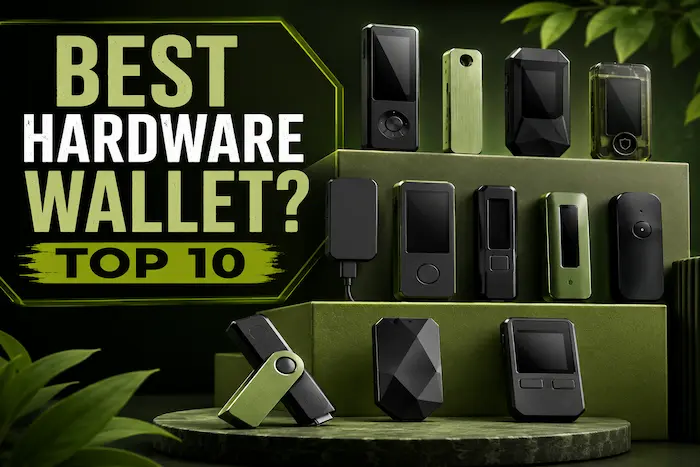
The Top 10 Hardware Wallets in 2026 feature security aspects, open-source firmware, and air-gapped signing & transaction validation. Today, manufacturers implement various designs that will ensure the safety of private keys from potential online attacks. Hardware wallets operate in such a way that signing processes are separated from internet-connected devices.
Ranking Criteria
The ranking takes into account the security architecture of each wallet, as well as verification, connectivity, support for various types of assets, transparency, backup capabilities, and usability.
Current information on the security of each wallet and the specifications of manufacturers are taken into account in the assessment of each wallet.
- Trezor Safe 7 Leads With Layered Security
Trezor Safe 7 ranks first because it combines open-source software with three independent hardware security layers. Trezor says Safe 7 uses TROPIC01, an auditable secure element, alongside an EAL6+ OPTIGA secure element. An STM32U5 microcontroller provides another security layer for the device’s architecture. Trezor also introduced post-quantum protection for firmware verification, boot security, and authentication.
However, Trezor disclosed a June 2026 TROPIC01 vulnerability involving laser fault injection. Trezor said the vulnerability did not expose wallet funds or backups because the chip represents only one security layer.
- Ledger Flex Balances Security With Usability
Ledger Flex ranks second as it combines a Secure Element with a large E Ink touchscreen. According to Ledger, the Secure Element ensures that all display data is handled securely, allowing users to confirm the details of transactions before sending their approval.
The touchscreen and compatibility across ecosystems make Flex an excellent choice for self-custody. Ledger’s proprietary security architecture remains a distinction compared with more extensively open-source competitors.
- BitBox02 Nova Combines Transparency With Hardware Protection
BitBox02 Nova ranks third because its firmware remains open source while using dedicated secure hardware. BitBox says Nova uses an EAL6+ certified secure chip for protecting sensitive wallet operations.
The company also offers a Bitcoin-only version for users who want reduced functionality. This makes Nova attractive to holders prioritizing transparency, straightforward backups and focused security.
- Keystone 3 Pro for Air-Gapped Users
Fourth is the Keystone 3 Pro because it features several security features along with QR-based air-gapped transaction signing. Transactions can be transferred without keeping the link established between the hardware wallet and the connected device.
It features a huge touchscreen to improve transaction visibility and external wallet integration for different blockchains. The size may not attract regular travelers despite the advanced air-gapping technology.
- Blockstream Jade Plus for Bitcoin
Blockstream Jade Plus is the fifth-best hardware wallet for Bitcoin users who value open-source software and air-gapped transaction signing. It does not use the traditional secure element technology but instead relies on blind-oracle architecture.
Transactions are performed without using USB or Bluetooth technologies, and SeedQR enables backup work in an offline environment. This is a Bitcoin-centric hardware wallet which lacks versatility.
- SafePal S1 Provides Air-Gapped Protection
SafePal S1 ranks sixth with an EAL6+ secure element and QR-based air-gapped signing. SafePal says the device supports more than 200 blockchains while providing passphrase protection and additional physical security features.
The S1 offers broad functionality at a relatively accessible level, although users should verify current network compatibility.
- Tangem Emphasizes Portability
Tangem ranks seventh because its card-shaped design removes the need for screens, batteries, and charging cables. The device uses NFC communication with compatible smartphones while storing private keys inside a secure element.
Tangem reported that Cure53 completed a mobile-wallet security assessment in March 2026. The simple design is ideal for those who consider mobility and easy-to-manage self-custody via their mobile device.
- OneKey Pro Meets Needs of Multi-Chain Users
OneKey Pro comes in eighth place due to its combination of touchscreen transactions, biometric login, and air-gapped signing. The focus on multi-chain support makes this wallet an option for those using multiple chains and dApps. But buyers should not rely on the number of features when selecting a wallet.
- NGRAVE ZERO Prioritizes Physical Isolation
NGRAVE ZERO ranks ninth because it removes several conventional communication methods from transaction signing. The wallet uses QR-based communication rather than USB data, Bluetooth, Wi-Fi or NFC for transaction transfers.
This approach can reduce certain remote attack surfaces, but it sacrifices convenience for frequent users. ZERO therefore fits long-term holders who prioritize physical isolation.
- COLDCARD Mk5 Remains Specialized For Bitcoin
COLDCARD Mk5 remains relevant for advanced Bitcoin users because it supports air-gapped workflows, MicroSD signing, and multisignature configurations. Its dedicated design to Bitcoin makes it unnecessary for those who are interested in BTC alone to have unnecessary features.
Seed generation security issues that were recently disclosed concerning older COLDCARD systems further justify the need to check out official notices. Security in hardware is determined by the randomness, hardware, and the procedures involved, together with physical security.
Security Is Dependent On The Whole Self-Custody Process
A hardware wallet will not be able to secure assets when users share their recovery phrase, sign a fraudulent transaction, or buy a counterfeit hardware wallet.
Phishing attacks, compromised software, and poor backup processes may result in weak hardware security. The best hardware wallet is thus only one part of the overall self-custody security process.
Frequently Asked Questions
How does a hardware wallet ensure safety of cryptocurrencies?
A hardware wallet maintains separation of private keys from connected devices and needs a physical confirmation before signing a transaction.
Why is a hardware wallet safe?
A number of factors play a role in ensuring the safety of a hardware wallet, including safe hardware, firmware security, transaction validation, backup, and protection from attacks.
Are open-source hardware wallets more secure?
An open-source wallet gives researchers an opportunity to review a code that is publicly available code and look for vulnerabilities. Open-source software doesn’t mean it’s 100% safe.