A lot of progress has been made since the creation of Bitcoin in terms of blockchain technology, with numerous blockchain solutions available that provide different approaches to handling transactions, scalability, and payments.
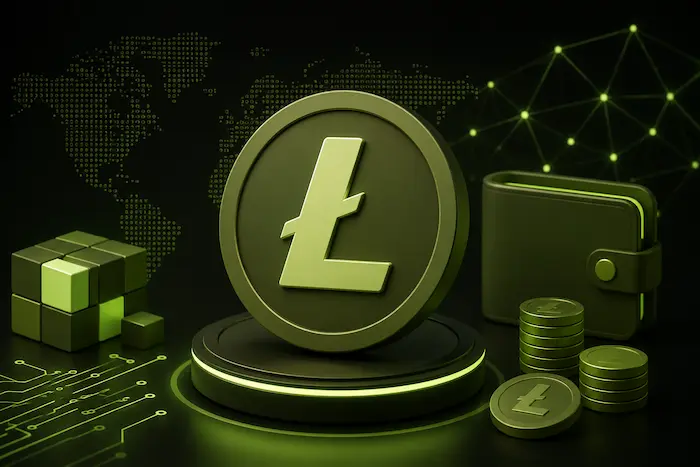
Litecoin (LTC) is one of the first cryptocurrencies that was developed in 2011 and aimed at providing fast transaction verification and lower transaction costs while preserving the principle of decentralization of Bitcoin.
In spite of the appearance of thousands of digital currencies, Litecoin has succeeded in becoming an actively used platform.
Unlike a centralized financial institution, the digital currency uses the decentralized mining system, and due to the fact that the currency has a predetermined money supply and a prolonged period of existence, it has become one of the well-established digital currencies on the cryptocurrency market.
What is Litecoin (LTC)?
Litecoin (LTC) is a decentralized p2p crypto-currency that enables people to make transactions without using banks or any other financial institutions. All the transactions made through the cryptocurrency are recorded in the blockchain database, where miners verify them by using the Proof-of-Work (PoW) consensus algorithm.
Litecoin was invented by Charlie Lee, an engineer from Google, who decided to create a digital currency based on Bitcoin. This project has many similarities to Bitcoin but still has some technical changes.
New Blocks Generation in a Shorter Time
The creation of a new block takes about 2.5 minutes on Litecoin, while the same process in Bitcoin takes about 10 minutes.
How Litecoin Works (LTC)?
Similar to Bitcoin, Litecoin depends on miners racing against each other to solve mathematical puzzles and get rewarded with newly generated Litecoin tokens for doing that.
The maximum capacity of the LTC network is set at 84 million, while the maximum supply of Bitcoin is limited to 21 million coins. Additionally, Litecoin utilizes the Scrypt algorithm for mining as opposed to the SHA-256 used for mining Bitcoins. From the data provided, the use of the Scrypt algorithm helps in making large-scale mining pools unattainable.
Features of Litecoin
The shorter block generation time in Litecoin facilitates the faster confirmation of transactions compared to that in the Bitcoin network. In conjunction with lower transaction fees, this makes Litecoin useful in making small payments and transfers between countries.
Limited Supply
A total of only 84 million Litecoins can ever be created. From the provided information, it is clear that about two-thirds of the entire supply has been mined, and the rest will be mined in approximately a century from now.
Wide Support Network
Litecoin has had strong support from cryptocurrency exchanges and payment processors since it was launched in 2011. Some important historical events include the software launch on October 7, 2011, the network launch two days after that, and achieving market capitalization of $1 billion in November 2013.
Advantages of Litecoin and Its Current Drawbacks
The currency provides faster transaction verifications, lower mining costs, liquidity, and an extensive history of operations.
However, unlike the Ethereum network, for instance, Litecoin is not capable of facilitating smart contracts. The currency is still affected by the fluctuations of the market.
Supply, Mining, and Distribution
The mining process of Litecoin works according to the procedure adopted in the Bitcoin protocol, where miners have to solve mathematical problems before earning their rewards in the form of newly minted LTC coins.
According to Token Terminal, 66 Litecoin wallets hold about 40% of the total Litecoin supply.
There is another significant event related to Litecoin that took place in 2017, when Charlie Lee, Litecoin’s creator, sold out all of his Litecoin holdings in order to avoid any conflicts of interest.
Recent Litecoin News
Despite ongoing protocol updates, Litecoin remains a well-supported payment-oriented cryptocurrency. The high-speed transactions and low fees have helped maintain Litecoin’s popularity among payment companies, merchants, and exchanges.
Discussions regarding regulation have also put Litecoin back in the spotlight, as investors keep an eye out for any potential future cryptocurrency ETFs that could be approved, other than those involving Bitcoin and Ethereum. Based on the data available, there have been no U.S. spot Litecoin ETFs approved until mid-2026.
Conclusion
Litecoin is still functioning as one of the oldest cryptocurrencies in the digital assets market. It uses blockchain technology that is capable of offering faster transactions, lower transaction fees, a limited amount of 84 million LTC, and a Proof-of-Work consensus algorithm.
Although the new blockchain networks have more sophisticated functionalities, Litecoin sticks to digital payments and constantly updates its protocol.
Frequently Asked Questions
What is Litecoin (LTC)?
Litecoin is a separate cryptocurrency established in 2011, enabling digital peer-to-peer payments through blockchain technology that operates on the basis of the Proof-of-Work protocol.
Why does Litecoin process transactions faster than Bitcoin?
The time required to create a block in Litecoin is 2.5 minutes, whereas Bitcoin takes 10 minutes to generate a block.
How many Litecoins will ever be made?
The maximum number of Litecoins possible is set to 84 million LTC, and, according to the data given, about two-thirds of them have already been mined.