
The healthcare sector has been in search of ways through which it can make the process of collecting, exchanging, and protecting data on the medical records of patients more efficient.
Hospitals, insurance companies, drug stores, and other stakeholders involved in research are dealing with problems associated with scattered records, cybersecurity risks, administrative issues, and exchanging data among various organizations. The necessity of addressing all those issues makes technologies that could help with managing data securely and transparently desirable.
Blockchain technology in healthcare has become a topic of discussion since many organizations consider its ability to help them with patient records management, cybersecurity, administration, and cooperation within the field of healthcare.
Present initiatives have focused on incorporating blockchain technology in the existing healthcare infrastructure through secure information transfer, unalterable data storage and automation, with several case studies demonstrating the use of the same while satisfying the demands for compliance and efficiency.
Blockchain in Healthcare Addresses the Problem of Dispersed Patient Records
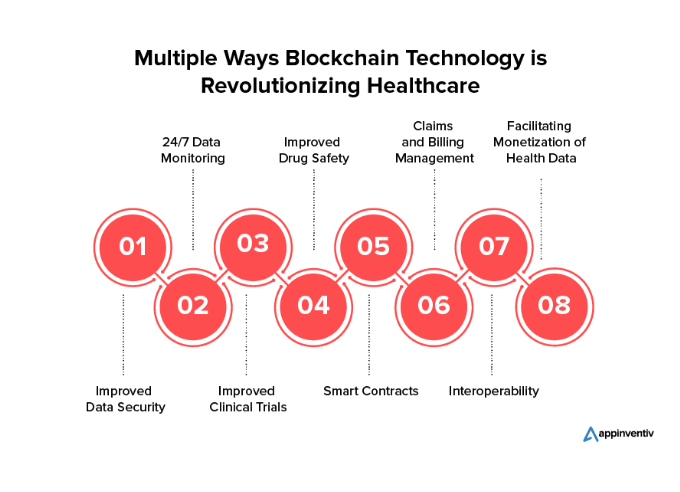
The problem that is encountered in healthcare organizations is that of dispersed patient records in hospitals, clinics, laboratories, and EHRs.Patient history tends to be scattered across different database systems, making it hard for healthcare professionals to access the full information about the patient.
Source: appinventiv
From the provided details, it is stated that one hospital can create about 50 petabytes of data per year related to healthcare, but most of it is not interoperable across systems. It leads to problems for patients who receive care from different healthcare providers since it hinders continuity of care.
The technology of blockchain has been suggested as a potential way of solving this issue by providing a secure database where healthcare workers are allowed to access the history of patients without compromising their privacy.
In most cases, instead of recording a full medical history in the blockchain system, links are recorded in the system, and permissions to access information stored in external systems are provided. The patient controls access to his/her information via cryptography.
The Role of Blockchain Technology in Healthcare Security and Administrative Efficiency
Healthcare institutions remain bound to stringent privacy laws, handling personal data which is extremely sensitive and confidential. Personal medical data contains personal identifiers, health insurance data, medication information, etc., which have to be secured.
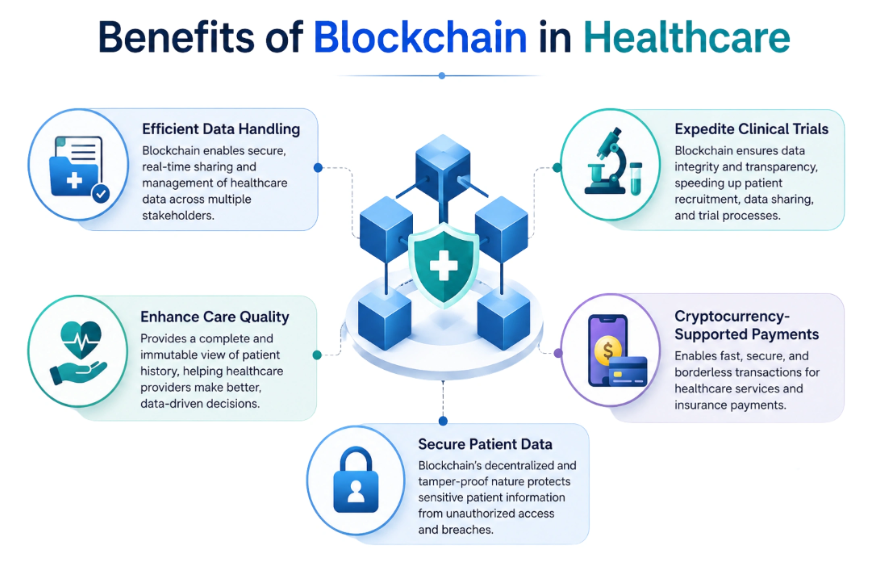
Blockchain technology ensures security as all the operations are not carried out via a central node but via several network nodes. All the requests to access personal information, as well as all changes to the data, are recorded for audit purposes.
Source: SparxIT
The other benefit of smart contracts is that they automate administrative functions. The processes of claim submission, payment verification, and reimbursement are automated upon meeting certain conditions.
There would be no need for paperwork and delays associated with traditional healthcare payment processing methods. Insurance claims can be tracked in real-time since all stages of their processing can be verified using blockchain technology.
Clinical Trials and Pharmaceutical Chains Extend the Scope of Blockchain Technology
Blockchain technology has found its use not only for patient data management but also for pharmaceutical chains and clinical trials.
Medical institutions need reliable channels to guarantee that their products stay real during transportation processes. By using blockchain technology, one can create an immutable chain that will keep track of all the stages of transportation starting from production to healthcare institutions and distributors. This includes all information about the product’s origin, handling process, and transportation route.
Blockchain technology is also useful for clinical studies. For example, the use of distributed ledgers is vital in maintaining the integrity of data associated with clinical trials because such data should not be tampered with while sharing the data anonymously between organizations.
In addition, smart contracts can help ensure protocol compliance and manage patient consents within research operations.
Healthcare Organizations Test Blockchain Solutions
Some organizations have already implemented blockchain pilots in the field of healthcare.
MedRec:M, a solution developed by MIT Media Lab, represents a decentralized platform for managing medical data where patients can control access to their own medical records. Smart contracts are used for automatic handling of consents and ensure HIPAA-compliant data accessibility among healthcare providers using the platform.
Blockchain has also been applied in the pharmaceutical logistics domain. An initiative combining IBM and Walmart created a blockchain platform aimed at tracking drugs throughout the whole supply chain, including transportation conditions, checking drug authenticity, tracking temperature control, and creating permanent records facilitating the speedy identification of the affected goods during recall.
Other healthcare providers and tech companies have examined using blockchain platforms for managing patient consent, enhancing prescription drug traceability, and increasing data security in healthcare through pilot projects. Even the U.S. Food and Drug Administration examined blockchain initiatives related to the enhancement of prescription drug traceability.
Operational Challenges to Blockchain Implementation in Healthcare
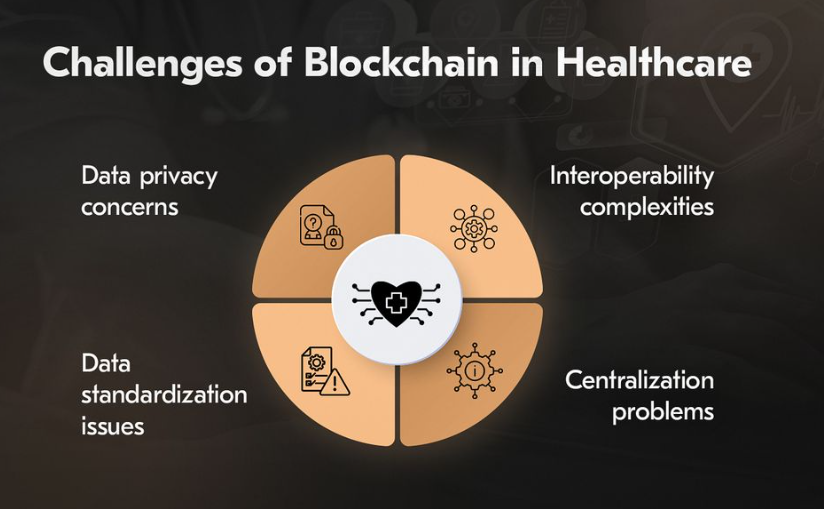
Despite further development, there are still some limitations to blockchain adoption in healthcare.
Much investment has been made in electronic health record system technology within the healthcare industry over the last twenty years. These older systems are extensively used in clinical practice, making any changes to them expensive and difficult.
Healthcare organizations will also have to consider whether blockchain can meet HIPAA standards and the latest privacy rules concerning medical information.
Source: Savvycom
Another issue is the structure of the United States healthcare industry, where there are many independent hospitals, insurance companies, technology companies, pharmacies, and healthcare providers that use their own standards and systems.
Implementation costs also pose a major issue, especially for small healthcare facilities working on a budget. The scalability issues in public blockchains have prompted many organizations to consider permissioned or private blockchains that would be more appropriate in the context of healthcare transactions.
Key Blockchain Applications in Healthcare
| Application | How Blockchain is Being Used | Benefit Identified |
| Patient Records | Develops secure ledgers with encrypted access permissions for selected providers | Continuity of care with protection of the patient’s privacy |
| Insurance Claims | Smart contracts automate claim validation and the payment process | Reduces administrative hassles |
| Health Information Exchange | Health Information Exchange facilitates the exchange of validated information about patients between healthcare providers | Enhances the interoperability of organizations |
| Pharmaceutical Supply Chain | Records and tracks medicines starting from their manufacture till healthcare provider | Helps ensure authenticity and facilitates recalls |
| Clinical Trials | Develops tamper-proof records for clinical trial data and patient consent | Helps improve data integrity and collaboration between institutions |
Main Advantages of the Implementation of Blockchain in the Healthcare Industry
Better Accessibility of Patients’ Information
- The healthcare provider authorized to access the patient’s record will be able to do so when allowed.
- The patients retain control over their personal medical information due to encryption and permission.
- Sharing of secure information will result in decreasing fragmentation of medical history.
Further Development of Blockchain Technology in the Sphere of Healthcare Goes on with Healthcare Projects. Present initiatives in the sphere of healthcare point to the fact that blockchain technology is viewed as an additional element to the present healthcare system.
Conclusion
Blockchain technology in healthcare keeps advancing from the stage of theoretical applications towards practical solutions aimed at managing patient data, ensuring cybersecurity, dealing with insurance claims, handling pharmaceutical chains, and conducting clinical research.
The examples of pilot programs implemented by the MIT Media Lab, IBM, Walmart, and the U.S. Food and Drug Administration show how distributed ledger technology is applied in different healthcare-related areas.
Frequently Asked Questions (FAQs)
What is blockchain in healthcare?
Blockchain in healthcare is a distributed digital ledger that provides a secure way of managing healthcare data, permissions, audit trail, and transactions while making sure that only authorized entities have access to the verified data.
How does blockchain help with patient data management?
Blockchain technology helps authorized healthcare practitioners to have access to the verified information about their patients while the patients themselves can control the permissions using encrypted authentication techniques.
Does blockchain reduce healthcare administration costs?
Using blockchain technology and smart contracts may help to cut down healthcare administration costs.