Decentralized finance has created alternative methods of accessing financial services without the need for banks or other middlemen institutions. Smart contracts have taken over most procedures that involve paperwork, collateral, and third-party approvals, leading to lending mechanisms that run solely on the blockchain. One such innovation is flash loans, a borrowing process unique to conventional lending schemes and even to typical DeFi lending systems.
While the conventional lending schemes involve collateral or credit scores as preconditions for lending, flash loans do not need such preconditions and are lent against the condition that the borrowed amount will be returned during the same blockchain transaction.
What Are Flash Loans?
Flash loans are uncollateralized crypto loans that happen completely via smart contract transactions. Contrary to lending protocols that are collateralized and where lenders have to lock in collateral of greater value than what they borrow, flash loans remove the requirement of collateral through blockchain transaction rules.
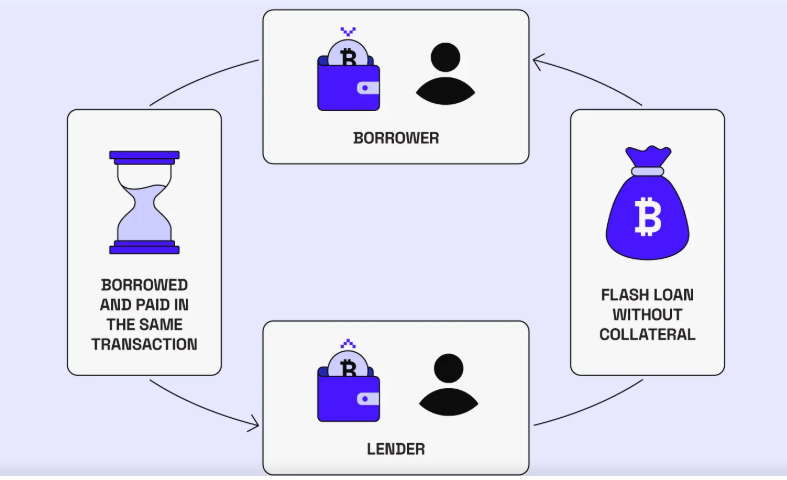
Source: webopedia
The entire lending operation is conducted using a single blockchain transaction whereby the loan is given, the operations are completed, and the assets are returned before the completion of the transaction. Failure to repay the loans before the completion of the transaction means that all actions done will be undone by the blockchain.
Such atomic transactions eliminate any requirement for evaluations of creditworthiness and trust from borrower to lender, since payments will be enforced via the mechanism of smart contracts without the need for external agreements.
Flash Loan Mechanism
Flash Loans leverage the concept of atomic blockchain transactions, where all actions in the transaction must be completed in order to record the transaction itself.
It is mostly done in three steps:
| Stage | Description |
| Borrow | Money is borrowed from a DeFi lending platform for a temporary period. |
| Execute | The borrower executes his on-chain transactions using the money. |
| Repay | The borrower repays the borrowed money along with a fee (if applicable). |
In case the borrower cannot repay the loan, the transaction is cancelled by the blockchain. This results in the blockchain being unable to complete the transaction because of non-finalization.
Common Applications of Flash Loans
Flash loans are designed for blockchain-based financial operations that can be completed within one transaction. They are not intended for off-chain purchases or conventional payments.
Several on-chain activities make use of this lending model.
Arbitrage Trading
Arbitrage remains one of the most common uses. Traders can borrow funds, purchase an asset on one decentralized exchange where it is priced lower, sell it on another exchange where the price is higher, repay the loan, and retain any remaining difference after fees.
Available profit margins may be affected by network transaction costs, competition from automated trading bots, protocol fees, and price slippage.
Collateral Management
Flash loans can be used for efficient collateral management by facilitating the exchange of one collateral security for another in a single transaction. The same mechanism can also be used to help borrowers conduct self-liquidation in order to avoid penalties from outside liquidators.
Debt Refinancing
Flash loans can also be used by borrowers to transfer their position between protocols with differing debt refinancing conditions without injecting any additional funds. The temporary liquidity supplied by the flash loan allows the transition to occur without interrupting the borrowing position.
Advantages and Operational Features
Several characteristics distinguish flash loans from other lending products available in decentralized finance.
The need for collateral does not exist because repayment is made mandatory by automatic means.
- Transactions can be executed through one blockchain transaction.
- Borrowers acquire temporary liquidity without using their assets.
- Arbitrage activities may help in lowering the price discrepancy in decentralized exchange platforms.
All this is possible solely because of the functioning of smart contracts and transaction processing in blockchain.
Flash Loan Attacks and Protocol Vulnerabilities
Though flash loans are not seen as security threats themselves, they have often been exploited in attacks on vulnerabilities in decentralized finance protocols.
A popular approach is for hackers to manipulate the prices of tokens in liquidity pools that have little liquidity. This is accomplished when the hackers take loans worth a lot of money from the flash loans, manipulate the prices in the markets, and then use the protocols that are based on wrong price information provided by vulnerable oracle networks. The loans are paid back before the transaction ends.
There have been several attacks that used this approach.
| Protocol | Year | Outcome |
| bZx Protocol | 2020 | The two flash loan attacks manipulated the prices to steal around $1 million. |
| Euler Finance | 2023 | Through a contract logic vulnerability, the attackers stole about $197 million, which was then partly retrieved. |
| Polter Finance | 2024 | The manipulation of the BOO token prices helped in stealing $12 million. |
It has been observed that these attacks happened due to the deficiencies in the protocol rather than any vulnerability in flash loan technology.
Security Mechanisms Adopted by DeFi Protocols
Several security mechanisms have been developed by developers to minimize flash loan attacks.
The time-weighted average price (TWAP) oracle helps mitigate dependency on block prices by determining asset prices over long periods. A multi-source oracle takes into account several prices instead of a single liquidity source.
In addition, protocols are subjected to security analysis of their smart contracts in order to identify any problems caused by possible programming errors. Some protocols have certain restrictions or even fees for flash loans to prevent manipulation.
Who Uses Flash Loans and Future Development
Flash loans remain primarily suited for users with experience in blockchain development, automated trading systems, or smart contract programming. Many transactions require custom scripts capable of borrowing funds, interacting with multiple decentralized applications, and repaying the loan within one blockchain transaction.
Developers continue expanding potential applications beyond arbitrage into areas including automated portfolio management, cross-chain liquidity strategies, decentralized derivatives, and institutional decentralized finance
Conclusion
Flash Loans have introduced a lending mechanism that operates differently from conventional borrowing by allowing users to access temporary liquidity without collateral. The model depends entirely on smart contracts, which require borrowing, execution, and repayment to occur within a single blockchain transaction.
While flash loans support activities such as arbitrage, collateral swaps, debt refinancing, and self-liquidation, they have also been used to amplify vulnerabilities in poorly designed DeFi protocols. functionality of the technology.
Frequently Asked Questions (FAQs)
What is a flash loan?
Flash loans are loans in the cryptocurrency space that should be borrowed and paid back in a single blockchain transaction. In case of non-payment, the blockchain reverses the whole transaction.
Is there any need for collateral in flash loans?
Collateral does not have to be provided for flash loans since the smart contract automatically repays the loan before the completion of the transaction itself.
What are some typical applications of flash loans?
Some of the typical uses of flash loans are arbitrage, collateral swap, refinance, and self-liquidation.