
key insights
- Federal oversight will add more layers to the regulatory review of Circle’s custody systems, but not make it a commercial bank.
- The charter sets the groundwork for future OCC-supervised U.S. DCU reserve management.
- There is the potential to grow institutional custody beyond Circle if regulatory and operational conditions are met.
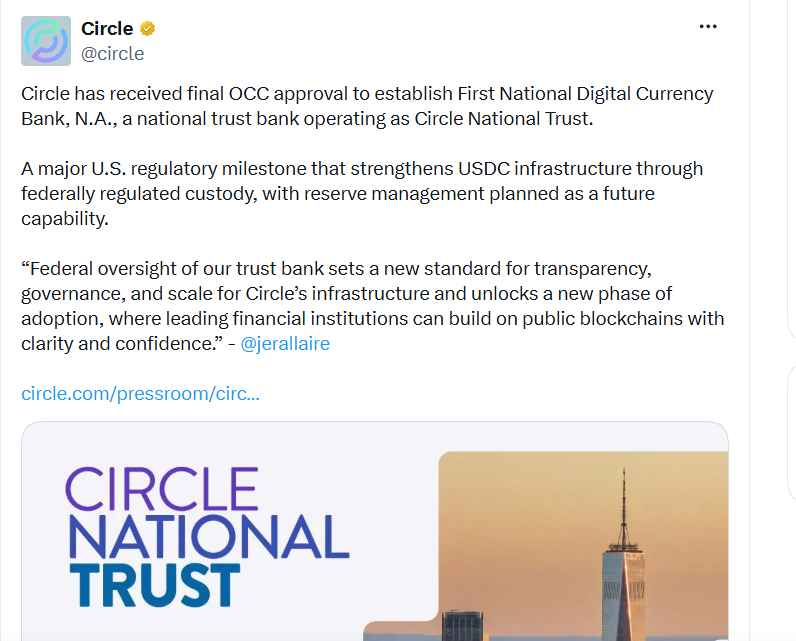
The approval from Circle, which was granted the final nod from the U.S. Office of the Comptroller of the Currency to launch First National Digital Currency Bank, N.A., is a significant regulatory milestone. Office of the Comptroller of the Currency to open First National Digital Currency Bank, N.A. The institution will be a direct federal entity called Circle National Trust and will have a number of critical digital asset custody functions placed directly under federal oversight, enhancing the infrastructure supporting USDC.
The approval further fuels Circle’s long-term regulatory plan and puts the stablecoin issuer in the company of select crypto companies to receive national trusts as banks. The charter also establishes a long-term avenue for managing USDC reserves by the OCC, but the process won’t start right away.
Circle is fully authorized, up from being conditionally approved.
On June 30, 2025, Circle filed its OCC application to become a national trust bank. The company has opened after the regulator in December 2025 gave it conditional approval, imposing various operational and compliance requirements on the firm before it was allowed to open.
The company confirmed it has now met those requirements and received final authorization.
Circle National Trust will begin by providing fiduciary digital asset custody services for Circle and its affiliated businesses. Unlike commercial banks, the institution cannot accept customer deposits or issue consumer loans. Instead, it will operate under the fiduciary framework used by national trust banks to safeguard client assets.
Jeremy Allaire, Circle’s co-founder and chief executive, said the approval represents an important step toward integrating blockchain infrastructure into the U.S. financial system. He added that direct federal oversight would strengthen governance, transparency, and confidence for institutions building on public blockchain networks.
Key developments
| Item | Details |
|---|---|
| Regulator | U.S. Office of the Comptroller of the Currency |
| New entity | Circle National Trust |
| Legal name | First National Digital Currency Bank, N.A. |
| Initial service | Fiduciary digital asset custody |
| Future capability | USDC reserve management under OCC oversight |
| Consumer banking | Not permitted |
Federal oversight strengthens USDC infrastructure
The new charter allows Circle to place custody operations within the federal banking framework. However, USDC issuance and its existing reserve structure will continue under current regulated entities until any future transition receives regulatory approval.
Circle said the trust bank could later offer custody services to a limited group of institutional customers. Those clients may include banks, financial institutions, and regulated derivatives organizations if market demand supports expansion.
The company also stated that future management of USDC reserves remains part of its long-term business plan. Those reserves consist primarily of cash and short-term U.S. government securities that support the stablecoin’s one-dollar value.
Wider regulatory shift reshapes the stablecoin market
Circle OCC approval arrives as U.S. regulators continue building a clearer framework for stablecoins. The recent introduction of the GENIUS Act established reserve, reporting, and compliance standards for payment stablecoin issuers, increasing regulatory certainty across the sector.
The OCC has also expanded national trust bank approvals for digital asset companies. Circle joined Ripple, BitGo, Paxos, and Fidelity Digital Assets among firms that secured conditional approval during the same regulatory cycle. BitGo later obtained final approval, while Anchorage Digital remains another crypto-focused company operating with a national trust charter.
Circle has consistently expanded its regulatory footprint beyond the United States. The company became the first crypto business to receive a New York BitLicense in 2015. It’s also conforming to the Markets in Crypto-Assets (MiCA) framework of the European Union, and is registered in the United Kingdom, Singapore, Bermuda, Canada, and in Abu Dhabi.
The licenses are further bolstering Circle’s standing as governments around the globe introduce greater regulation on digital asset firms and stablecoin issuers.
The road to institutional blockchain adoption
The move to get OCC approval for the project could prompt more institutions to join in with blockchain payments and settlement under a well-known federal banking program. The trust bank does not provide traditional banking services, but has a regulated structure that many financial institutions are familiar with.
Circle’s near-term priority is digital asset custody for the benefit of its own business. The company has, however, left the door open for wider institutional services and potential for future reserve management when regulation will permit.
Circle’s OCC approval puts it in the mix of some of the most closely regulated digital asset infrastructure in the United States as the stablecoin sector evolves and sees the regulatory framework maturing. The ruling also reflects the increasing integration of blockchain technology with the traditional financial system as Circle OCC approval is poised to be crucial for the next step in the institutionalization of digital assets.