Blockchain technology is rapidly evolving, and people are developing various blockchains that seek to achieve efficiency in transaction processing and offer more types of decentralized services.
Most modern blockchains are developed to increase scalability, reduce transaction costs, and make the use of blockchain technology available for ordinary users. In addition, there is an ongoing trend towards integration between messaging applications and blockchain networks, thus opening up new possibilities for asset transfer and decentralized services.
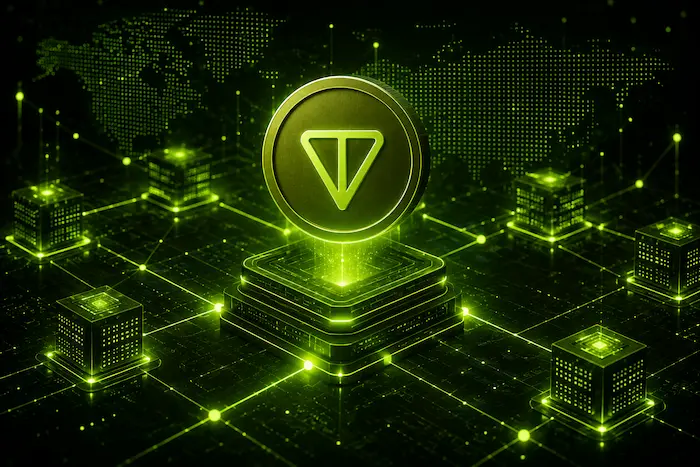
TON Blockchain serves as a good illustration of such platforms. Developed by the founders of Telegram at first and then maintained by the independent community, TON Blockchain makes use of a proof-of-stake consensus algorithm, multi-chain architecture, and Telegram integration to offer payments and dApps services.
What Is TON Blockchain?
TON Blockchain is a layer-1 blockchain that allows fast transactions with minimal transaction fees.TON Blockchain is aimed at ensuring scalability through the multi-chain structure rather than using a single blockchain for processing transactions.
Originally, Telegram announced the project as Telegram Open Network, which was stopped due to legal problems, but development continued because of an open-source community that took on the code of the project.
Currently, The Open Network is maintained by developers and contributors rather than a single controlling organization.
Key Facts About TON
- Originally developed by Telegram in 2018.
- Continued by an independent open-source community after 2020.
- Uses a Proof-of-Stake (PoS) consensus mechanism.
How TON Blockchain Works
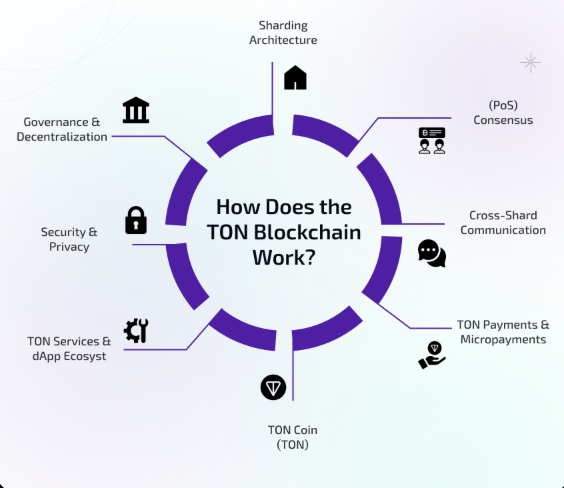
In order to validate transactions, TON Blockchain operates on the basis of a proof-of-stake consensus protocol. Validators of the TON Blockchain network use GRAM tokens to stake and get their rewards once the transactions are validated and new blocks are generated.
Source: Blockchain
Contrary to proof-of-work blockchains, no need for mining in order to validate transactions on the TON network. The smart contract language used by TON Blockchain is called FunC.
Main Components of the Network
- Masterchain: Controls validators, protocol updates, and communication within the blockchain.
- Workchains: Separate blockchains that are capable of functioning under their own rules.
- Shard Chains: They are small chains used in parallel to perform transactions for increased scalability.
TON Blockchain Characteristics
Certain technical characteristics make TON Blockchain different from other blockchains.
Dynamic Sharding
TON generates new shard chains automatically when there is increased activity. Transactions in the shard chains are performed separately for a portion of the transaction load, and this helps in scaling the blockchain without impacting its normal operation.
Fast Transactions
This is because transactions are confirmed within seconds during the normal operations of the blockchain.
Telegram Integration
A self-custodial wallet that allows interaction with decentralized Mini Apps is accessible right through Telegram.
TON Blockchain Overview
| Feature | Details |
| Type of Blockchain | Layer-1 |
| Consensus Algorithm | Proof-of-Stake (PoS) |
| Language for Smart Contracts | FunC |
| Initial Creators | GRAM (formerly Toncoin) |
| Original Developers | Pavel Durov and Nikolai Durov |
| Current State | Independent open-source community |
| Architecture | Masterchain, Workchains, and Shardchains |
| Access to Wallets | Telegram self-custodial wallet |
| Key Objective | Fast transactions and scalability |
GRAM Supersedes Toncoin
The native currency of the blockchain network is going through an identity transformation.
After the governance process ended on June 8, 2026, around 81% of voting power favored renaming Toncoin to GRAM. The move reinstated the initial identity that was meant to be assigned to the cryptocurrency since its inception by Telegram.
The rename involves not only changing the name but also the token’s ticker.
What Has Changed?
- Toncoin will be renamed to Gram (GRAM).
- Ticker is changed from TON to GRAM.
- Interfaces of exchanges and wallets will be updated gradually.
What Has Not Changed?
- Open Network will stay as the blockchain.
- Addresses of wallets will not change.
- Balances will automatically get converted with a 1:1 rate.
- Smart contracts, staking positions, NFTs, and DeFi tokens stay the same.
- There is no need for any swap, migration, or claiming.
What can the TON Blockchain be Used For?
TON Blockchain allows using the following blockchain-based services via smart contracts.
Current examples of applications include:
- Cryptocurrency payments
- Decentralized finance (Defi)
- NFT markets
- Telegram Mini Apps
- Blockchain games
- International remittances
- Decentralized storage
- Digital identity services
TON additionally includes blockchain bridges that allow for transferring assets from TON to any other blockchain network. Moreover, TON DNS allows converting lengthy wallet addresses into more user-friendly names, whereas TON Storage allows for decentralized file storage.
Why the Network Architecture Matters
The TON Network relies on a multichain architecture instead of running all the transactions on one blockchain.
Such an architectural design allows the network to split all the activities among several workchains and shardchains, while the masterchain manages the interaction and protocol updates. When the demand for the network grows, new shards may appear automatically.
It is scalable while at the same time being able to process transactions at fairly high speeds.
Conclusion
TON Blockchain has progressed from being a blockchain project spearheaded by Telegram to becoming an independent layer-1 blockchain that has been built on the basis of an open-source community. Proof-of-stake consensus algorithm, multi-chain structure, dynamic sharding, and Telegram integration make up the very basis of the infrastructure.
The recent switch from Toncoin to GRAM has affected only the name of the coin but not its balances, wallet addresses, staking, or the workings of the blockchain itself.
FAQs
What is TON Blockchain?
TON Blockchain is a Layer 1 blockchain running on a Proof of Stake consensus and multi-chain architecture, which facilitates fast transactions and decentralised applications.
Why did Toncoin get renamed to GRAM?
Because the decision on renaming was made through a vote by the community, which happened on June 8, 2026.
Is there going to be any token migration because of renaming to GRAM?
No, the tokens will remain the same, the balance of TON will be converted to GRAM at a rate of 1:1.