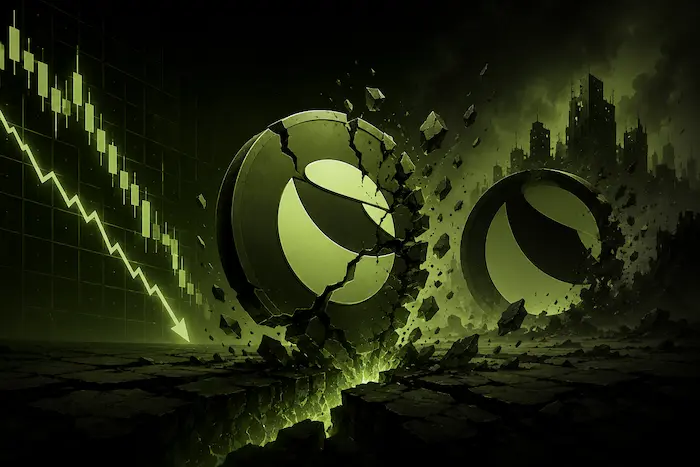
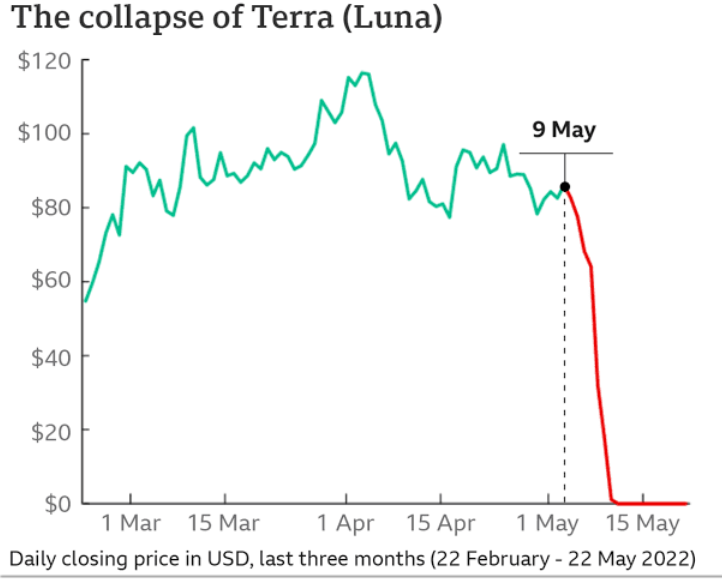
The Terra collapse can be considered one of the most significant events in cryptocurrency history. The market capitalization losses amounting to billions of dollars occurred within a matter of days in May 2022 due to the depreciation of an algorithmic stablecoin, TerraUSD (UST), against the US dollar. Meanwhile, the native token of the Terra blockchain, LUNA, suffered one of the fastest devaluations of all time.
Besides, the event introduced some new aspects concerning the story of algorithmic stablecoins, DeFi, and risk management in the cryptocurrency market. Moreover, there are lawsuits against Terraform Labs and its co-founder, Do Kwon, following the fall, which led to the formation of a new blockchain network after the fall.
The fall of Terra LUNA was dependent on the algorithmic stable coin, TerraUSD (UST), whose mission was to maintain a 1:1 peg with the U.S. dollar via a mint-and-burn mechanism using LUNA. Contrary to other stablecoins, which are backed up by either cash reserves or treasury bonds, UST was backed up entirely by the markets themselves.
Terraform Labs was established in 2018 by Do Kwon and Daniel Shin and created the Terra blockchain as a platform for decentralized finance. The ecosystem grew quickly in size due to the popularity of UST, primarily driven by the Anchor Protocol providing returns up to 20% per year on UST investments.
The system, however, depended on continuous trust. When the trust disappeared, the process of stabilizing the cryptocurrency sped up instead of bringing stability back.
How the Terra LUNA Collapse Happened
The fall occurred in May 2022 when huge amounts of UST tokens were pulled out of the Anchor Protocol and traded on exchanges such as Curve and Binance. As the sell-off pressure grew, UST lost its target value of one dollar.
Source: Binance
The falling out caused Terra to launch the stabilizing mechanism that enabled investors to exchange UST for newly issued LUNA tokens. Rather than fixing the peg, the network created an enormous amount of LUNA and, thus, increased its circulation immensely.
An increasing amount of supply led to a fast fall in the token’s price that would be referred to as a death spiral. Within a few days, both UST and LUNA had become practically worthless.
Timeline of the Crash
| Event | Effect |
| Large UST withdrawals from Anchor | The selling pressure was rising |
| UST dipped below $1 | The stablecoin failed to maintain the peg |
| Investors exchanged UST for LUNA | Massive issuance of LUNA |
| Circulation of LUNA soared | The price of the token crashed |
| Response of major exchanges | The trading of the tokens was halted |
Why Did Anchor Protocol Matter
One of the reasons that facilitated Terra’s growth was the Anchor Protocol, which generated large UST deposits because of its high yields.
However, as UST withdrawals increased ahead of the crash, the need for UST fell, while more of the stablecoin got into circulation. It made the process of maintaining Terra’s peg harder.
Reasons for the Collapse
- Large-scale UST withdrawals weakened confidence within the Terra ecosystem.
- The mint and burn process greatly increased the supply of LUNA.
- Pressure from the sell-offs was more than the protocol could handle.
Legal Actions After the Fall
There were legal actions initiated against Terraform Labs and its management. Over 1,600 people brought their complaints against Do Kwon after the crash in the market.
Kwon was arrested in Montenegro in March 2023 as he was trying to leave for Dubai. Later in December 2024, he was extradited from there to the US, where he was charged with federal offenses of securities fraud, commodities fraud, wire fraud, and conspiracy.
Separately, the U.S. Securities and Exchange Commission alleged that Terraform Labs and Kwon misled investors and arranged transactions intended to support UST’s market price. Terraform Labs later agreed to a $4.47 billion civil settlement with the SEC.
How Terra Changed After the Collapse
In light of the collapse, Terraform Labs reshuffled the blockchain. The original network became Terra Classic, with its token renamed LUNC. A separate blockchain, known as Terra 2.0, launched with a new version of LUNA but without the algorithmic stablecoin UST.
Many developers and users also moved to other blockchain networks, including Ethereum, Solana, and Cosmos.
Impact on the Crypto Market
Immediate impact
- More than $40 billion in market value was erased.
- UST and LUNA rapidly became nearly worthless.
- Major exchanges removed the impacted tokens from their platforms.
Long-term implications
- More regulatory attention towards stablecoins was received.
- Terraform Labs and its leaders faced legal inquiries.
- Two new blockchains were created: Terra Classic and Terra 2.0.
Lessons for Investors
Some of the documented risks associated with Terra include:
- Learning about the workings of the stablecoin system prior to making your investments.
- Considering whether or not the protocol is highly dependent upon a specific application.
- Analyzing token issuance processes during times when the market experiences stress.
Conclusion
Despite some recent positive developments, the failure of Terra LUNA is widely recognized as one of the biggest failures of the crypto industry because of the inability of UST to maintain its dollar parity and the unexpected increase of the issuance of LUNA.
However, it resulted in the loss of more than $40 billion of market capitalization, lawsuits against Terraform Labs and Do Kwon, and the creation of Terra Classic and Terra 2.0.
FAQs
Why did Terra Luna Collapse?
The fall began with the loss of the dollar parity of UST, which resulted in the massive redemption of the coin and an increase in the issuance of LUNA, leading to its fall in price.
What is UST?
UST was a stablecoin whose value should be kept at the level of $1 through its connection to the LUNA token and not through the reserves of cash.
What is the difference between LUNA and LUNC?
LUNC is the name of the token of the Terra Classic chain, while LUNA is the native token of the Terra 2.0 that appeared after the collapse of UST.