

Key Insights :
- The rise in ownership has changed digital assets into a commonplace financial topic over a niche investment area.
- The more encompassing demographics also suggests that adoption is growing among working and middle-class Americans.
- The outcome of the Senate’s vote on the CLARITY Act may shape the future trajectory of the regulatory landscape for digital assets in the United States and the involvement of institutions.
Crypto ownership has reached an estimated 67 million American adults, strengthening calls for lawmakers to establish clear federal rules for digital assets. Ripple Chief Legal Officer and National Cryptocurrency Association President Stuart Alderoty said Washington should stop treating digital asset users as a small political group because they now represent one of the country’s largest constituencies.
His comments were made on July 7, when debate has heated up regarding the CLARITY Act. Recent polling has indicated public buy-in is low on the proposal, but Alderoty said this is not the case as ownership data demonstrates the rise of the digital asset economy.
The ownership growth changes the discourse.
According to a Politico poll, 27% of Alderoty supports the CLARITY Act. He argued that the figure closely matches the percentage of Americans who already own digital assets, making it evidence of the industry’s scale rather than its weakness.
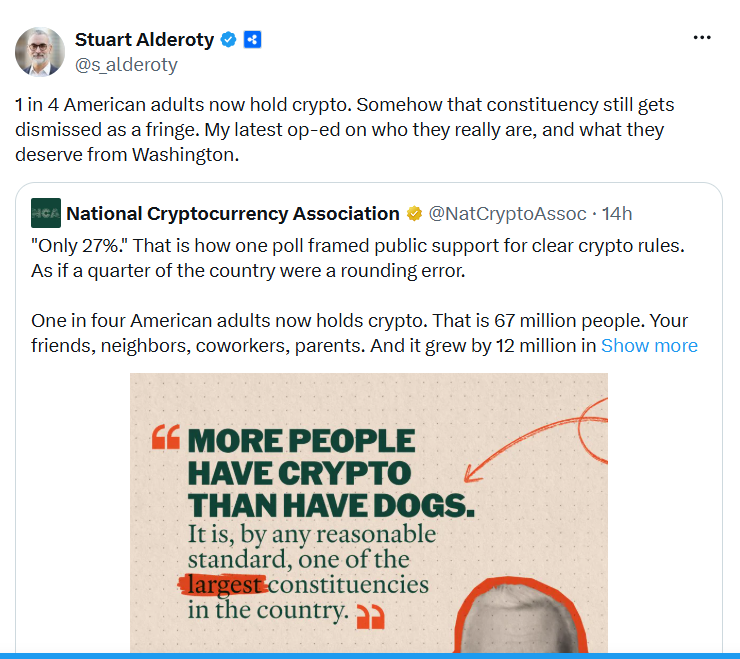
According to data from the National Cryptocurrency Association, one in four American adults now owns digital assets. The organization estimated that about 12 million new holders entered the market during the past year.
He also challenged long-standing assumptions about who participates in the market. Alderoty said ownership now extends well beyond wealthy technology professionals and speculative traders.
The association’s 2026 State of Crypto Holders Report found that women represented 42% of new holders during 2025 and 2026, compared with 34% among earlier participants. Nearly one quarter of holders earn $75,000 or less annually, while construction and manufacturing workers account for more than 21% of the ownership base.
Alderoty emphasized the industry’s scale by noting that more Americans now own digital assets than own dogs. He argued that such figures make it difficult to classify digital asset users as a fringe community.
Metric Figure
American adults holding digital assets: 67 million
Share of U.S. adults: One in four
New holders added in one year: 12 million
Women among new holders: 42%
Holders earning $75,000 or less: Nearly 25%
Construction and manufacturing workers: More than 21%
Public support for CLARITY Act: 27%
Senate negotiations enter a critical stage
Attention has now shifted to Capitol Hill as lawmakers continue work on the CLARITY Act. The legislation missed its July 4 target and now faces an August 7 deadline before the Senate begins its summer recess.
The bill seeks to establish federal rules for digital asset markets. It has already cleared important committee stages, but lawmakers must still combine separate versions from the Senate Banking and Agriculture committees before a final vote.
The Senate Banking Committee approved the legislation in May by a 15-9 vote. However, the measure still requires at least 60 Senate votes for passage.
Several issues remain unresolved
- Much of the ethic’s debate over ethics remains unresolved.
- The implementation of anti-money laundering is being discussed.
- There is still a need to agree on regulatory responsibilities among federal agencies.
Alderoty said that there is no need for legislators to approve any particular token. Instead, he says Congress should create clear market rules that foster innovation and ensure consumer protection.
Politics is not the only factor that drives market activity
The debate over the policy rages on, even with conflicting public sentiment. According to a new Politico and Public First poll, just 4% of voters view a candidate’s stance on digital assets as an important election factor.
Meanwhile, voters on both sides of the aisle agree that digital asset companies should be held to the same standards as traditional finance firms, and that the companies need more oversight, Americans for Financial Reform reported.
Political money spending by industry has also picked up. According to Reuters, digital asset firms have invested around $189 million in the 2026 U.S. election cycle. Among the biggest contributors to political action committees that advocate for policies were Ripple Labs, Coinbase, Andreessen Horowitz and Foris DAX.
Given the growing number of owners, Congress will have an extra challenge in meeting the demands for regulation clarity. Supporters say that the new rules would lead to better investor protection in the market and promote responsible innovation.
Conclusion
Crypto adoption has now grown past early investors, providing lawmakers with a bigger base for concerns on the CLARITY Act. Alderoty’s argument is not just market speculation, but a reflection of the industry’s growing place in American life. Given that the Senate is nearing its August date, the (potential) results could shape the future of crypto markets under federal regulation for years to come.
The legislation will also find out if Congress can keep up with the increasing wave of crypto ownership and create a cohesive and balancing methodology. Washington’s attention continues to be drawn to Crypto policy, as the discussion continues.