

Prediction Markets remain popular as systems for trading contracts linked to the results of future events. These kinds of markets can be related to many topics such as elections, cryptocurrency prices, sports, economy, and geopolitics.
Users buy contracts representing the likelihood of the realization of an event, with prices being constantly adjusted depending on the flow of news into the market. Prediction market industry is growing together with the development of blockchain technologies and decentralized finance while at the same time becoming more regulated.
In today’s world, prediction markets exist in the form of regulated exchanges and blockchain prediction markets using different settlement methods.
What Are Prediction Markets?
Prediction markets are markets that involve trading of contracts whose values will be affected by some future event. The typical range of a contract’s value in such markets is from $0.00 to $1.00.
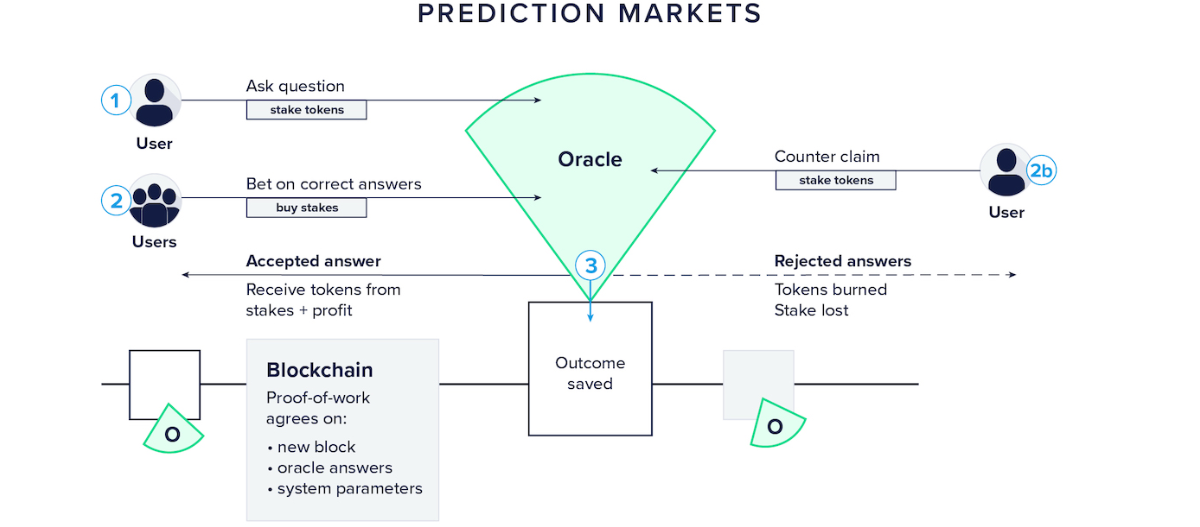
Source: Horizon
For instance, if a contract for an event such as whether the price of Bitcoin would hit a particular level sold at $0.70, then there is a collective estimate by the participants of a 70% chance of the event occurring. If the event occurs, the contract pays out $1.00, while it expires without payment if the event does not occur.
Unlike regular forecasting, predictions are constantly updated through buying and selling.
Key Facts
- The majority of contracts are priced in between $0.00 and $1.00.
- Price is based on how likely the event is to occur.
- Contract settlements occur after the official outcome of the event.
Understanding How Prediction Markets Work
In prediction markets, people can buy or sell their positions before the completion of an event.
The process usually consists of four stages:
- A prediction market is created for a future event.
- Participants buy contracts according to their expectations.
- The price of the contract changes due to new information.
- Market closure occurs when the official outcome is known.
Unlike other betting systems, the contracts used in such systems can be sold at any point before settlement to accommodate changing market situations.
The prediction markets based on blockchain technology use oracles to transmit authenticated information from the real world into the blockchain network so that such markets can settle on the basis of authenticated results and can resolve disputes in the process.
Types of Prediction Markets
Prediction markets usually function with three types of contracts.
| Market Type | Description | Example |
| Binary Markets | Have two outcomes and settle at either $1 or $0 | Will it rain next Monday? |
| Categorical Markets | Have multiple outcomes | Who will win the next national elections? |
| Scalar Markets | The outcome is dependent on whether the value is greater than or less than the threshold value | Will the population of the US be greater than 333 million? |
Major Prediction Market Platforms
Several platforms currently operate within the prediction market industry.
Kalshi was launched in 2018 and DeFiLlama data shows it had the highest trading volume on its prediction market in February 2026. Kalshi was founded in 2018 and according to DeFiLlama, it was the prediction market with the highest volume of trading during February 2026.
The company has valued itself at $11 billion after raising $1 billion in November 2025. Kalshi is an American regulated event contract exchange that utilizes normal payment approaches.
Founded by Shayne Coplan in 2020, Polymarket is a blockchain-based platform for contract verification. In October 2025, Intercontinental Exchange purchased $2 billion worth of shares, and the company claimed to have a valuation of $9 billion.
The company self-reported a valuation of $9 billion after receiving $2 billion from Intercontinental Exchange in October 2025. In February 2026, it also applied for trademarks of POLY and $POLY, signaling the possibility of a native token launch.
Opinion was launched in Q4 2025 on BNB Chain, backed by Binance’s founder CZ’s family office, YZi Labs. The platform later raised $20 million in a pre-Series A funding round during February 2026.
Work has also entered the sector by introducing additional event-trading markets designed to broaden participation.
Platform Highlights
- Kalshi operates under a regulated U.S. framework.
- Polymarket settles contracts directly on blockchain networks.
- Opinion and Work represent newer entrants expanding the market.
Predictive Markets Keep Growing
The industry activity grew immensely in 2024 and 2025. Blockchain security company CertiK announced an increase in the total trading volume of the prediction market from $15.8 billion in 2024 to $63.5 billion in 2025.
Mainstream media companies such as the Wall Street Journal and Newsweek have begun publishing the probabilities of predictive markets along with regular polls.
| Industry Metric | Reported Figure |
| Trading Indicator (2024) | $15.8 Billion |
| Trading Volume (2025) | $63.5 Billion |
| Kalshi Valuation | $11 Billion |
| Polymarket Valuation | $9 Billion |
| Opinion Funding | $20 Million |
Prediction Markets Are Subject to Constant Regulatory Control
Regulatory issues continue to influence the development of prediction markets around the world.
According to the U.S. Commodity Futures Trading Commission, the publication of the code in the blockchain network does not make organizations immune to regulations.In 2022, Polymarket paid a $1.4 million settlement after the agency alleged it offered event contracts without appropriate registration.
During July 2025, both the U.S. Department of Justice and the CFTC concluded their investigations into Polymarket. Shortly afterward, the company acquired a U.S. options exchange as part of its planned expansion into the U.S. market.
Internationally, Portugal and Hungary introduced restrictions affecting Polymarket during early 2026. At the U.S. state level, Kalshi faced a temporary ban in Massachusetts in January 2026, while Polymarket received a temporary restraining order from a Nevada state court during February 2026.
Regulatory Developments
- CFTC enforcement continues for non-compliant event contracts.
- Restrictions have been put on particular platforms in some jurisdictions.
- The regulatory oversight is still present as the industry grows.
- Industry Data
Recent industry data shows growth and difficulties.
According to CertiK, risks for prediction markets include wash trading and hybrid securities issues, as trading becomes more widespread.
In a poll conducted in January 2026, almost one-third of Americans foresee the expansion of online betting in the future, and the younger generation proved more familiar with the concept of prediction markets.
Conclusion
Prediction markets have grown in both regulated financial exchanges and blockchain platforms by facilitating trades involving contracts for future events. The growth of the industry has been reflected by increased volumes of transactions, investments in platforms, and greater public knowledge. Meanwhile, regulators in many jurisdictions remain focused on the prediction market sector through investigations, enforcement actions, and licensing.
Frequently Asked Questions
What is the meaning of prediction markets?
Prediction markets are the markets where traders trade the contracts whose value depends upon future events.
What are the various forms of prediction markets?
There are mainly three types of prediction markets; Binary, Categorical, and Scalar.
What are some examples of popular prediction markets?
Popular markets include Kalshi, Polymarket, Opinion, and Work.