Traditionally, social media networks have managed their users’ identity, information, and communities with centralized models. With the evolution of digital ownership and blockchain technology, there has been an exploration of new ways to manage these aspects separately from users’ specific applications.
Farcaster is among the applications using such an approach as a decentralized social media protocol rather than a social media network.
Rather than keeping users inside a single application, this protocol allows linking of multiple applications to the same social network, maintaining the identity, followers, and content of users.
The system integrates the identity system based on blockchains with off-chain data storage, with the goal of enhancing the scalability of the system without depending entirely on blockchain transactions.
Since 2020, when the development process started, several changes have been made to include new infrastructure, improved tools for developers, and new management for the protocol in an open-source form.
What Is Farcaster?
It is a decentralized social media protocol rather than a social network application. It allows several applications to be connected to the same social network so that individuals maintain their identity and audience in different platforms.
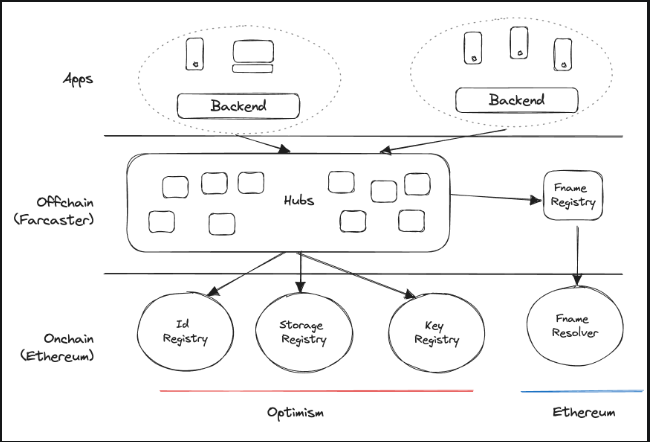
Source: Quicknode
Developed by former Coinbase engineers Dan Romero and Varun Srinivasan, the protocol separates account ownership from the applications used to access the network.
Instead of relying entirely on blockchain transactions, Farcaster combines on-chain identity with off-chain social activity through what its developers describe as “sufficient decentralization.”
Key Points
- Users retain the same identity across Farcaster-compatible applications.
- Identity is stored on-chain while social interactions occur off-chain.
- Applications are developed on social infrastructure that is common to all.
| Feature | Description |
| Type of Protocol | Decentralized social media protocol |
| Identity Layer | On-chain using Optimism smart contracts |
| Social Information | off-chain through Hubs |
| User Identity | Farcaster IDs (FIDs), ENS, Farcaster names |
| Scaling Mechanism | Snapchain |
| Interactive Feature | Frames |
| Present Protocol | Neynar (since January 2026) |
Farcaster Identity and Social Information Storage
The protocol splits duties among blockchain infrastructure and decentralized servers for faster operation but with verifiable identities.
Optimism is an Ethereum-based platform for creating user accounts via smart contracts. Each user account gets a Farcaster ID (FID), which correlates to its custody address. The protocol also maintains information about allowed signing keys and storage space allocation for each account.
Posts, replies, reactions, and followers are stored off-chain via decentralized Hubs. These servers sync protocol data while verifying messages using the registries of Farcaster.
Components of Identity
- The FIDs map each account to a custody address.
- The ENS and Farcaster names serve as user identities.
- The Hubs are responsible for synchronizing and validating the social activities within the network.
Snapchain Enablers Network Scalability
The Snapchain was introduced by Farcaster in order to facilitate high-speed social activity processing without passing through the blockchain.
Snapchain serves as an ordering layer which can keep the order of messages intact without being bound by the throughput constraints of blockchain technology.
The protocol also handles network capacity through storage management. The users have to keep enough storage for publishing their content and reactions in order to grow their network without any excessive activities.
Although protocol data remains decentralized, moderation decisions are handled separately by individual applications connected to the network.
Frames Expand Social Interactions
Frames allow developers to build interactive experiences directly inside Farcaster posts.
Instead of redirecting users to external websites, Frames enable several blockchain-enabled activities to occur within a social feed.
Frames Support
- NFT minting and blockchain payments.
- Poll voting and event registration.
- Games and decentralized application interactions.
Progression Timeline Demonstrates Continuous Development
The development journey of Farcaster can be said to have passed through several stages during the last few years.
The idea was conceived in October 2020 by Dan Romero and Varun Srinivasan as they developed the protocol. Nevertheless, the process of active development started in January 2021.
Frames were introduced in January 2024 and served as a means for increasing the level of developers’ engagement. In May 2024, Farcaster revealed an A-series fund worth of $150 million with a valuation of over $1 billion.
Snapchain was revealed in December 2024 and launched on the mainnet in April 2025. Subsequently, in October 2025, Farcaster took over Clanker, a social trading and token distribution system powered by AI technology.
In January 2026, Neynar, an infrastructure firm, took charge of maintaining the protocol. Meanwhile, Merkle Manufactory claimed to have paid back about $180 million of venture capital funds raised by them.
Why Open Architecture Is Important for Farcaster
Even though Farcaster has changed the way protocol is managed, it has left its architectural framework intact. In other words, the protocol itself remains an open-source and permissionless software project where developers can create apps based on it.
Besides, Farcaster belongs to the decentralized social networking wave along with Lens Protocol and Friend.tech, Nostr, and Bluesky. Although each project uses a different technical approach, they all focus on separating user identity from individual social media platforms.
Key Features
- User identities retain their portability within all compatible apps.
- The protocol infrastructure works in isolation from any app.
- Developers utilize one social network platform instead of creating independent platforms.
Conclusion
Farcaster combines blockchain-based identity with decentralized off-chain infrastructure to support portable social profiles across multiple applications. The architecture of the protocol makes use of Optimism for account identity, Hubs for social graph, Snapchain for message ordering, and Frames for interaction.
The protocol was initiated in 2020 and has been growing since then with the addition of infrastructure, funding, and other operations.
FAQs
What is Farcaster?
Farcaster is a decentralized social network protocol that enables people to carry their identity, following, and contents between compatible applications.
How is user data stored in Farcaster?
The identity data is stored on-chain through Optimism, while the post, follow, and react data is off-chain via decentralized hubs.
What is Snapchain?
Snapchain is an order layer that Farcaster uses for high frequency social interactions without being on the blockchain every time.