
- XRPL Lending Protocol cleared its re-audit, and all prior concerns have been fixed completely.
- Validator voting for the latest XRPL proposal took place, as more nodes installed the latest software updates.
- Ripple made steps to align with MiCA and RLUSD discussions got fresh attention.
XRP News developments this week centred on two parallel milestones within the Ripple and XRP Ledger ecosystem. The XRPL Lending Protocol completed a re-audit conducted by blockchain security firm Halborn, while Ripple announced that it had secured a preliminary Crypto Asset Service Provider license in Luxembourg.
The security review arrived as validators continued voting on an amendment tied to the XRP Ledger v3.2.0 upgrade, while the regulatory approval expanded Ripple’s pathway toward operating under the European Union’s Markets in Crypto-Assets framework.
XRPL Lending Protocol Clears Security Review
Halborn confirmed that it had completed a re-audit of the XRPL Lending Protocol following a series of code modifications implemented by developers working on the XLS-66 standard.
According to the security firm, the review found no critical vulnerabilities and verified that previously identified findings had been addressed.
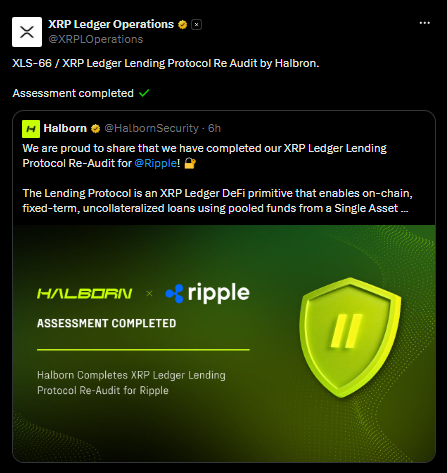
Source: XRP Ledger Operations
The protocol is designed as a decentralized finance primitive on the XRP Ledger that supports fixed-term uncollateralized lending through pooled liquidity held in a Single Asset Vault.
A re-audit was conducted to test out transaction validation logic, state consistency, accounting correctness, parameter validation, access control, and many other fundamental features involved in the operation of the protocol.
Completion of the analysis is yet another step in the development process of the protocol, as the XRP Ledger community is constantly testing out new features prior to their implementation.
Positive reception of the analysis by community members was explained by the lack of any critical vulnerabilities that would mean progress of the protocol in terms of its security.
XRP Ledger Foundation member and dUNL validator Vet provided his opinion on the development process, stating that security and use cases were growing simultaneously. He described the effort as an ongoing framework for maintaining security standards while introducing new functionality.
Validator Voting Continues on XRPL Upgrade
The audit results emerged while validator voting remained underway for the fixCleanup3_2_0 amendment included in the XRP Ledger v3.2.0 release.
Ripple has already expressed its approval of the amendment alongside other validators taking part in the governance process. The support for the amendment at the time of reporting was below the threshold for activation, with more validators still expected to vote.
The users have also begun updating their infrastructure in line with the new software release. Reports were suggesting that around 30% of the nodes had upgraded to the latest release of the XRP Ledger software after the announcement of re-audit.
The installation of the update is compulsory for activation. Failure to upgrade before the amendment reaches activation requirements could result in operators becoming amendment-blocked on the network.
The ongoing voting process reflects the governance procedures used to introduce protocol changes on the XRP Ledger, where amendments require sustained validator support before they become active on the mainnet.
Ripple Secures Preliminary MiCA License in Luxembourg
Separate from the protocol developments, Ripple announced that it had secured a preliminary Crypto Asset Service Provider license in Luxembourg.
The approval clears the way for the company to pursue a full rollout of Ripple Payments across the European Economic Area while advancing compliance with the European Union’s MiCA regulatory framework.
Ripple described the approval as a significant regulatory milestone. However, the announcement did not produce a notable reaction in XRP market performance.
Attorney Bill Morgan congratulated the company on its latest licensing milestone while pointing out that the XRP price movement was not affected by the news. As explained by Morgan, XRP price fluctuated in accordance with the general market environment and not based on company news.
As of press time, XRP was valued at $1.10, having hit a high of $1.12 and a low of $1.09 in one day. Meanwhile, the XRP futures open interest witnessed a minor growth rate of 0.60% on Binance within four hours.
Debate Intensifies Over RLUSD’s Expanding Role
Recent developments have also brought up the issue of RLUSD and its role within the XRP Ledger.
An X crypto researcher pointed out that the amendments introduced into XRP Ledger, as well as recent developments on the XRP Ledger side, became more and more similar to the functionality of RLUSD.
According to the researcher, such changes signal that RLUSD has emerged as a critical aspect of Ripple’s business strategy. The argument further implied that XRP would play the second part in the payment flow if there is no availability of liquidity in RLUSD.
The debate got more exposure when Morgan emphasized the rise in the RLUSD movement on the XRP ledger. He mentioned the statistics that included the increase in RLUSD held on XRPL, transaction volume, burning of tokens, number of holders, and real-world asset flows.
Conclusion
Recent events in connection with the XRP Ledger and the Ripple ecosystem have been related to security, governance, and regulations. The re-audit of the XRPL Lending Protocol cleared away the worries about it, while validation voting on the new network upgrade went on.
Meanwhile, the initial license granted by Luxembourg to Ripple has taken the company one more step towards full-fledged work under MiCA rules. Along with these events, the issue of the increasing role of RLUSD attracted more attention.