

Every single day, billions of deals are made in different parts of the world, from purchases of necessities to making payments, international trades, and investments into various businesses.
But behind all these processes, there is a monetary system which drives the economy, facilitates the functioning of businesses and financial markets via financial marketplaces.
Throughout history, there were various currencies used in different countries, such as precious metals, notes, and even digital money. In the current times, the financial system of the world is based on a currency issued by governments, which is used as the legal tender and drives economic operations throughout the country.
Fiat money is the most common form of money in today’s world, which forms the basis of contemporary economies and monetary systems.
In contrast to commodity money, fiat money does not have any backing of gold or silver. The most well-known fiat currencies are the U.S. dollar, Chinese Renminbi, euro, British pound, Japanese yen, Kenyan shilling, and many other currencies.
What Is Fiat Currency?
Fiat money refers to money created by the government but which has no intrinsic value because it is not based on any physical commodity. The acceptance of fiat money as a medium of exchange occurs because the government has deemed it legal tender, and it is expected to be accepted by other members of the economy.
Characteristics of Fiat Money
- Money created and controlled by the government and the central bank
- Not backed by gold, silver, or other commodities
- Functions as legal tender in an economy
- Dependent on economic activities for value
- Manageable using monetary policy tools
The History of Fiat Money
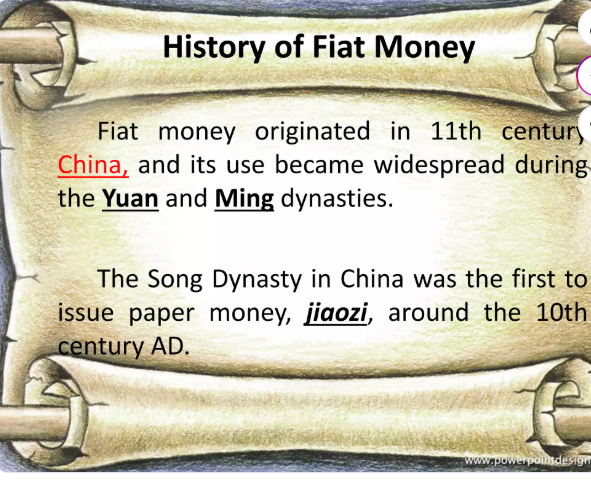
The beginning of the fiat currency dates back to China. It is noted in historical documents that paper money was circulated in the Szechuan province in the eleventh century. At first, it was possible to exchange these notes for goods like silk, gold, and silver.
Source: Slideshare
However, the concept of fiat currency came into wider practice in the thirteenth century, when Kublai Khan introduced this system. Over-spending and inflation during this time were connected by the historians to problems faced by the Mongol Empire economically.
Fiat money was also used in Europe in the seventeenth century in Spain, Sweden, and the Netherlands. However, the Swedes abandoned this form of currency and switched back to silver-based money.
The move towards fiat money was hastened in the twentieth century. In 1933, the US discontinued its domestic convertibility of gold. Under President Richard Nixon, the US went off the international gold standard in 1971. This move facilitated the use of fiat money throughout the world.
Fiat Money and Gold Standard
Prior to the dominance of fiat money, many countries used commodity standards, especially the gold standard.
In a gold standard system, money was equivalent to a claim on a fixed amount of gold held in reserve by the government. More money could only be issued when there was gold in reserve.
However, the move towards fiat money did away with this restriction.
| Feature | Fiat Currency | Gold-Backed Currency |
| Backing | Not physical | Gold reserves |
| Supply of money | Dependent on policies | Limited to gold reserves |
| Convertible | Not convertible to any commodity | Converts to gold |
| Flexibility | Greatly flexible | Limited |
| Need for reserve storage | No | Yes |
How Fiat Currency Works
The fiat currency works through a regulated mechanism controlled by the central banks and government. The central banks regulate the amount of money in the economy through monetary policies like interest rates and a monetary expansion program.
In case of slow growth in the economy, interest rates can be lowered in order to increase borrowing and expenditure. Moreover, if the inflation grows, the interest rates can be raised in order to lower demand.
The flexibility in changing the amount of money in circulation is what differentiates a fiat system from a commodity-based system, where currency production is based on the physical resources available.
Advantages and Disadvantages of Fiat Currency
The economists and finance experts are still debating several issues related to the fiat monetary system. There are some pros and cons of the system itself.
Advantages
- Free from being bound by limited commodity supplies
- Low cost for manufacturing and maintenance
- Flexibility in dealing with financial crises
- Wide recognition in international business transactions
- Need not maintain physical stocks
Disadvantages
- Susceptible to inflation in case too much money is produced
- Highly dependent upon public confidence
- Historical instances of failure of fiat currencies are there
Fiat Currency VS Cryptocurrency
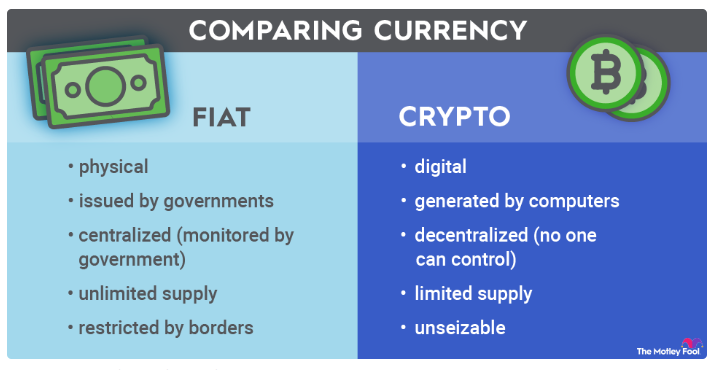
Though both fiat money and cryptocurrencies are mediums of exchange, they work in different systems.
The fiat money is issued and regulated by governments and central banks, while cryptocurrencies like Bitcoin are regulated in decentralized blockchain networks using software protocols.
Source: Motley Fool
Nevertheless, Bitcoin uses a fixed schedule for its supply, while the supply of fiat money can either be increased or decreased as per economic and monetary policies.
Cryptocurrency is also borderless and is largely irreversible after the transaction is completed. Furthermore, fiat transactions occur within an organized and regulated financial system that is managed by the institutions and the government.
Digital Fiat and CBDCs
As digital currencies have evolved, the focus has shifted towards introducing Central Bank Digital Currencies (CBDCs).
Unlike cryptocurrencies, CBDCs continue to be centrally controlled and liabilities of central banks. Various nations, including China, the European Union, and the United States, have considered research and pilot projects related to CBDCs.
The possible advantages offered by the use of CBDCs have been efficiency in payments and greater inclusion, whereas some of the disadvantages associated with their implementation have been those of privacy and surveillance.
Conclusion
The fiat money system is the most widely used monetary system. The worth of the fiat money system does not depend on physical items but depends on the power of the government, making it easy for central banks to regulate money supply and adapt to any changes in economic conditions.
FAQs
What is fiat money?
The money has been introduced into the market by the government but is not backed by any physical commodity like gold and silver.
Why is fiat money important?
It is important since it is regarded as money by the government and is used by individuals to facilitate their transactions.
What are the examples of fiat money?
Some of the examples of fiat money include the US dollar, the Euro, the British pound, the Japanese yen, and the Kenyan shilling.